
Anthropic’s Alpha Is Gone. Now Comes the $2 Trillion Question.
Claude cracked production grade agentic coding before everyone else. Now the model crown is a timeshare, Codex owns distribution, Grok Bot is making agents understandable to normal people, and
Article
Job breakdowns
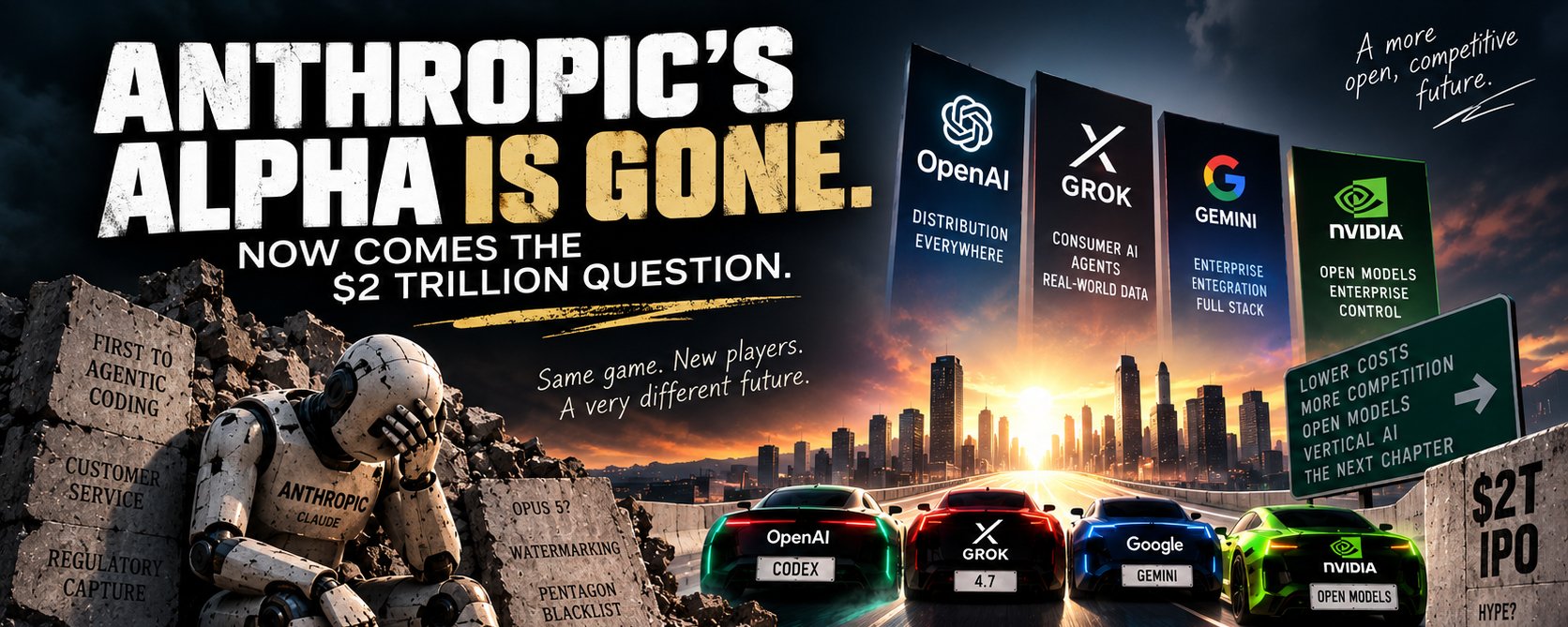
Claude cracked production grade agentic coding before everyone else. Now the model crown is a timeshare, Codex owns distribution, Grok Bot is making agents understandable to normal people, and enterprises are learning to own their own intelligence.
Opinion and analysis based on public information and firsthand use as of September 4, 2026.
Let me start with the part that might keep Anthropic fans from throwing tomatoes at me for at least thirty seconds.
Anthropic deserves a massive amount of credit.
They were the first company to truly crack agentic coding for production use.
Not toy demos. Not “build me a snake game” content. Real repositories, real teams, real infrastructure, real code, and real consequences when the model decided to get creative at 2 a.m.
Anthropic also had discipline.
While everyone else chased images, video, social AI, AI girlfriends, AI boyfriends, AI pets, and whatever fresh hell appeared on the feed that morning, Anthropic focused on coding, reasoning, tool use, and professional work.
They were the best at it. Full stop.
Claude Code changed how software was built. It showed developers that an agent could inspect an entire repository, reason across files, write features, run tests, diagnose failures, and work for hours without needing someone to hold its hand through every function.
That was Anthropic’s alpha.
And I think that alpha is now gone.
That does not mean Claude suddenly became stupid. It does not mean Anthropic is disappearing. It means Anthropic no longer owns the category it helped create.
It is now in a knife fight with OpenAI, SpaceXAI, Google, Meta, open-weight models, vertical AI companies, and enterprises that increasingly want to own their own intelligence.
That is a very different company to value at $2 trillion.
Anthropic confidentially submitted its draft S-1 on June 1. Its investors reportedly expect an IPO valuation of $2 trillion or more. The company’s annualized revenue run rate reportedly surpassed $65 billion by the end of July, and Anthropic says more than 1,000 business customers now spend at least $1 million per year. Those numbers are absolutely insane, in the best possible way. Anthropic
But a great company and a terrible investment can occupy the same building.
The model crown is now a timeshare
Astra is now the best overall model in the world, thats the common consensus now.
I know the benchmark police will be arriving shortly, probably carrying several charts and a strongly worded thread.
That is fine.
OpenAI’s Agents’ Last Exam has Astra at 59.3 percent, ahead of Claude Opus 5 at 55.5 percent and GPT-5.6 Sol at 53.6 percent. OpenAI also reports major Astra gains across terminal work, science, cybersecurity, computer use, and other professional tasks. OpenAI
Independent testing is more mixed.
Artificial Analysis currently gives Astra a score of 61 on its overall Intelligence Index. Claude Fable 5.1 scores 66 and remains first. On its Coding Agent Index, Astra scores 67 in Codex, while Fable 5.1 scores 70 in Claude Code. Astra is substantially more cost efficient on several coding workloads, but it has not cleanly swept every independent leaderboard. Artificial Analysis
But I personally think this benchmark is less and less meaningful considering such high scores for Opus 5, which is literally unusable for anything other than design work, and Metas new model scoring so high but isn't at all production grade ready.
That tension is the point.
Anthropic used to have the kind of lead that people could feel without opening a spreadsheet. Claude was better at coding, better at design, better at long sessions, and more dependable inside complex repositories.
Today, the answer depends on the benchmark, the harness, the effort setting, the workload, the pricing, and apparently the phase of the moon.
The model crown has become a timeshare. Everyone gets the keys for two weeks.
I still think Claude is probably the best model family for design and taste. It has a sense of what looks good that most models still lack.
But “best at design” is not the same moat as “the only serious production coding agent.”
Anthropic no longer has the second one.
Codex is eating the oxygen
OpenAI reported that Codex had more than five million weekly active users in June. On August 31, Codex product lead Tibo Sottiaux said it had reached 25 million active users.
Those figures use different activity windows, so I am not going to draw the world’s most dishonest hockey stick chart and pretend they are directly comparable. Axios
Can I prove that 20 million people switched directly from Claude?
No.
Did 25 million Codex users hatch from eggs behind Sam Altman’s house?
Also no.
Some of that growth clearly came from Anthropic’s territory. More importantly, OpenAI now has the distribution to turn model parity into enormous adoption.
Codex is connected to ChatGPT. It is expanding beyond developers into research, reports, spreadsheets, contracts, analysis, automation, and general knowledge work. OpenAI says knowledge workers represented about 20 percent of Codex users in June and were adopting it more than three times as quickly as developers. Axios
Codex does not have to destroy Claude Code on every benchmark.
It needs to be close enough, cheaper enough, and available to hundreds of millions of existing OpenAI users.
That is a distribution problem Anthropic cannot solve by releasing a model that scores two points higher on Terminal-Bench.
Grok just returned to the table holding a $60 billion receipt
Then there is SpaceXAI.
SpaceX completed its $60 billion acquisition of Cursor, giving Elon Musk one of the most important coding products in the world, its enterprise customer base, its developer workflows, and the feedback loop that comes from watching millions of people use AI to build software every day. Reuters
SpaceX did not spend $60 billion because it wanted a nicer text editor.
It bought the interface between developers and models.
Cursor says it jointly trained Grok 4.6 with SpaceXAI using high-quality engineering data, model-generated reasoning data, and an improved training recipe. Grok 4.6 is already priced at $2 per million input tokens and $6 per million output tokens, which is aggressive for a flagship model aimed at coding and agentic work. Cursor
Elon Musk said Grok 4.7 would arrive ten days after his September 2 post, which points to roughly September 12 if the schedule holds. He also claims it will surpass the competition.
Maybe it will.
Maybe Elon time will once again prove that calendars are a form of centralized oppression.
There are no independent Grok 4.7 benchmarks yet. There is no public evidence that should earn it the championship trophy before it ships. X
But SpaceXAI does not need every pre-release claim to come true for the strategic threat to be obvious.
It now has models, enormous compute, X distribution, Cursor distribution, enterprise relationships, real coding workflows, and a rapidly improving feedback loop.
Anthropic has another credible competitor, and this one appears willing to compete aggressively on price.
Grok Bot may have found the solo-operator wedge
While Anthropic is fighting enterprise policy battles, Grok Bot is doing something strategically important on the consumer and solo-builder side.
It is making multi-agent work understandable to normal people.
Grok Bot is still in early beta, and SpaceXAI has not published a meaningful active-user count. So I am not going to pretend a busy X feed is an audited 10-K.
But the surface-level momentum is difficult to ignore.
The launch generated tens of millions of views. My feed is increasingly filled with solo founders, creators, developers, and independent operators building named teams of bots that handle research, email, calendars, coding, customer support, content, and general business operations. Those are public demonstrations and anecdotes, not proof of durable retention, but they are still signals of genuine product pull. AI by Aakash
The reason people are responding is not difficult to understand.
SpaceXAI turned agent orchestration into concepts humans already know:
A teammate.
A job.
A conversation.
A computer.
A file.
An approval.
Grok Bots operate on persistent cloud computers. They can sign into tools, work across apps and websites, continue after the user closes a laptop, remember prior conversations, coordinate with other bots, and return when the work is complete or when something needs approval. Users can delegate through normal messages instead of assembling a traditional workflow builder. SpaceXAI
That last part matters.
For years, the AI industry told normal people that agents were coming. Then it handed them a terminal, twelve API keys, three configuration files, a Docker container, and a 47-minute YouTube tutorial.
Grok Bot gives them an app and says, “Name your teammate.”
That is a much better consumer product.
The Bots will still make mistakes. They will get stuck. They will occasionally eat usage like raccoons discovering an unattended buffet.
It is also far too early to assume that early consumer enthusiasm will translate into enterprise reliability, governance, permissions, and security.
But the basic product idea appears to be landing.
Anthropic built the first great coding agent for engineers.
Grok Bot is selling solo operators the dream of having an entire company without having to employ an entire company.
That could become a much larger market.
It is also how enterprise adoption often begins. One employee buys a tool because it makes life easier. Then five coworkers use it. Then fifty.
By the time procurement discovers what happened, there is already a small digital workforce roaming through the company’s software.
On the consumer and solo operator side, Grok Bot is gaining ground and momentum.
Anthropic should be paying attention.
Opus 5 damaged the thing that mattered most: trust
Now for the part Anthropic fans will really hate.
For my production work, Opus 5 and the early Sonnet 5 generation felt like Anthropic’s first major regression.
At its worst, Opus 5 approached a backend refactor like an HGTV renovation.
Every wall looked no load bearing.
It could take a contained task and spread changes across adjacent services, alter architecture it had not been asked to touch, and leave behind enough cleanup work that the human developer became the agent.
A routine refactor could become an incident response exercise.
That is my experience, not a universal scientific conclusion.
Independent evaluations still place Anthropic’s models near the frontier, and Fable 5.1 currently leads several major independent measures. Anthropic’s own launch material also includes enterprise customers reporting meaningful gains from Opus 5 on financial, analytical, and long running agentic work. Artificial Analysis
But production trust is different from benchmark intelligence.
A model can top a leaderboard and still ruin your Tuesday.
Anthropic’s early advantage came from developers trusting Claude inside important repositories. Once that trust becomes workload-dependent, companies stop standardizing on Claude and start routing different tasks to different models.
That is the beginning of commoditization.
Claude may be brilliant, but it has become miserable to talk to
There is another problem that benchmarks barely measure.
Using Claude, especially Opus 5, can be socially unpleasant.
Opus often talks to users like a frustrated super-senior backend engineer who has just been paged for an incident caused by someone else’s service and has decided you are personally responsible for ruining his evening.
You ask it a question.
It sighs in tokens.
Before answering, it explains why your premise is flawed, why your architecture is questionable, why the task may not be worth doing, and why the edge case it just invented could someday threaten civilization.
Then, after giving you an unsolicited lecture, it occasionally decides the task is too difficult and asks you what it should do next.
This is a truly special combination.
Arrogance and laziness.
It is like hiring the smartest engineer in the company only to discover that every Jira ticket requires couples therapy.
And I am not the only person noticing it.
There is a visible and unusually consistent stream of complaints from Claude users describing recent Opus models as condescending, argumentative, exhausting, overly verbose, timid, hostile, and frustrating to direct. One widely circulated complaint compared talking to Opus with arguing with a debate bro Redditor. Another review called the model brilliant but annoying and described its personality as neurotic during real coding sessions. Reddit
These are user reports, not controlled studies. Other developers have had excellent results, and some power users describe recent Claude models as extremely capable and proactive. Simon Willison’s Weblog
But when enough customers independently describe the same personality problem, the company should not dismiss all of them as bad prompters.
The laziness complaints are just as important.
Users report Opus stopping early, forgetting instructions, asking unnecessary clarifying questions, giving up on bugs, returning plans instead of completed work, and requiring constant correction during tasks that earlier Claude models could finish independently. Again, experiences vary, but the pattern is broad enough to be a real product concern. Reddit
People should not need a PhD in managing Claude’s emotional state to ship a feature.
Anthropic deserves credit for trying to make Claude less sycophantic. Nobody wants an AI that responds to every terrible idea with, “Absolutely brilliant. This will transform the industry.”
But there is a large distance between blindly praising the user and acting annoyed that the user had the audacity to ask for help.
A good AI should challenge bad assumptions when it matters. It should not manufacture an intellectual disagreement every three turns because someone turned the skepticism dial to eleven.
Fable is generally more pleasant than Opus in my experience, but it can suffer from some of the same laziness.
It stops early.
It asks for permission it does not need.
It returns an explanation when you requested a finished result.
It sometimes acts like writing the plan and doing the work are interchangeable.
They are not.
I do not need another employee who attends the planning meeting and disappears before execution.
Personality is not cosmetic anymore.
People spend hours every day working beside these systems. They brainstorm with them, build companies with them, debug code with them, write with them, and occasionally argue with them more than they argue with their actual coworkers.
The way a model communicates is part of its product quality.
Once several models can complete the same task, users will choose based on speed, cost, trust, memory, interface, and whether interacting with the model makes them want to throw their laptop through a window.
The smartest person in the office can still be the last person anyone asks for help if every question comes with a lecture and a sigh.
That is where the contrast with Grok Bot becomes important.
Grok Bot is currently being marketed and experienced as fun. You create teammates, give them names, assign them jobs, and watch them work.
Opus 5 can feel like the teammate who files an HR complaint because you assigned it a task.
One product makes people curious about what else they can delegate.
The other can make people hesitate before opening a new conversation.
That is a serious competitive problem.
Enterprises are learning to own their intelligence
The biggest long term threat to Anthropic may not be Astra, Grok, or Gemini.
It may be the enterprise customer itself.
Large companies are beginning to ask a different question.
Instead of asking, “Which frontier model is smartest?” they are asking, “Why are we sending our most valuable data into someone else’s model forever?”
Anthropic’s recent data retention controversy accelerated that conversation.
For covered models, Anthropic required certain prompts and outputs to be retained for 30 days, including limited retention for some organizations that otherwise had zero data retention arrangements. Anthropic says the retained data was used for safety monitoring, not model training, and was automatically deleted after the retention period unless flagged or legally required to be preserved. Anthropic Privacy Center
That distinction matters.
But enterprise trust does not wait patiently for everyone to finish reading the policy PDF.
Companies heard that prompts, outputs, and potentially large amounts of repository context could be retained for 30 days.
Then the lawyers emerged from the walls.
Anthropic has since responded with Enterprise Frontier Safeguards. The system is intended to keep monitoring data inside customer-controlled cloud infrastructure, under customer-controlled keys, with the customer deciding who can access it. Eligible customers can use Fable 5.1 with zero data retention until the new system becomes available. Anthropic
That is a smart response.
It also proves what enterprises actually want.
Their cloud.
Their keys.
Their data.
Their permissions.
Their audit trail.
Their evaluation system.
Their choice of model.
“Zero data retention” is no longer enough as a marketing phrase.
Enterprises increasingly want architectural control, not another promise.
Nvidia just placed a $13 billion bet on open models
Nvidia’s agreement to acquire Hugging Face for $12.93 billion may be the biggest signal in this entire debate.
Jensen Huang does not spend nearly $13 billion because open-weight models are a cute side project.
Hugging Face sits at the center of the open-model ecosystem. The platform serves more than 18 million developers and 200,000 companies, hosting millions of models, datasets, and applications. Nvidia says it intends to keep Hugging Face open and interoperable rather than tying it exclusively to Nvidia hardware. Reuters
Nvidia is building the toll road.
If closed frontier models win, Nvidia sells the compute.
If enterprises post train open models, Nvidia sells the compute.
If thousands of specialized models replace a handful of general-purpose systems, Nvidia still sells the compute.
Nvidia does not need Anthropic to lose. It simply benefits from a world where Anthropic no longer controls the entire economic relationship.
Harvey showed what vertical AI can become
Harvey offers a preview of that future.
Harvey and Applied Compute post-trained GLM 5.1 for long horizon legal work. On Harvey’s held-out Legal Agent Benchmark, the resulting model outperformed GPT 5.5 xhigh and Claude Opus 4.8 Max on rubric pass rate.
That does not mean it won every possible measure. On the stricter all-pass score, the picture was more mixed.
But it demonstrated that a vertical AI company can take an open weight foundation model, combine it with proprietary expertise, improve the training environment, build its own graders, and outperform frontier systems on an important domain specific measure. Harvey
Harvey later introduced Tenet, a Kimi K3-based model post-trained with Fireworks for long horizon legal work and cost efficiency. It remains a research preview, not proof that Harvey will never use Claude or Codex again. Harvey
But it proves something strategically important.
A vertical software company can own its training process, expert data, evaluation harness, workflow, and an increasing share of its intelligence layer.
Anthropic wants to be the landlord.
Enterprises are discovering they may be able to buy the building.
The strongest vertical companies will still use frontier models where they make sense. But they will also post-train open models, route work dynamically, and keep their most valuable domain intelligence inside systems they control.
In that world, Claude becomes an ingredient.
A very good ingredient, but still an ingredient.
Customer service becomes infrastructure risk
Anthropic’s customer service is the worst I have personally experienced from a company operating at this scale.
That might sound minor compared with model intelligence, but it is not minor when an AI system is touching production code, billing, permissions, rate limits, and business-critical workflows.
Anthropic officially provides support through written messenger and email channels. It does not offer general phone or live-chat support, although enterprise customers may arrange live working sessions through an account team. Anthropic Help Center
That may be acceptable for a consumer chatbot.
It is a strange way to support infrastructure that can alter a company’s backend.
You cannot charge frontier prices and then communicate like a haunted vending machine.
Shopify offers another instructive example.
Shopify did not ban Claude Code, despite how that story has sometimes been repeated. CEO Tobi Lütke said he was thinking about banning it until Anthropic supported the vendor neutral AGENTS.md convention and related agent skills rather than requiring Shopify to maintain parallel instruction systems. X
That correction matters.
But the real story is still bad for Anthropic.
The CEO of one of the world’s most important software companies publicly considered banning Claude Code because the product imposed a proprietary complexity tax on his engineering organization.
That was not a benchmark problem.
It was not an intelligence problem.
It was a vendor-behavior problem.
When Shopify’s CEO publicly considers banning your coding tool over interoperability, that is not merely a feature request.
It is a smoke alarm.
The Pentagon situation is still a mess
Anthropic’s dispute with the Pentagon also remains unresolved.
A federal judge ruled that one set of punitive actions against Anthropic was illegal and baseless. Yet on September 3, a senior Pentagon official said Anthropic remained designated as a supply-chain risk to the defense industrial base under a separate authority. Other members of the administration have publicly expressed more favorable views of the company. Axios
So the simple claim that Anthropic is either fully cleared or permanently banned is wrong.
The situation is legal and procurement fog.
One part of the government says the punishment was unlawful.
Another says the company is still a supply-chain risk.
Another says the government trusts Anthropic.
It is a group chat with too many admins.
For a company pursuing one of the largest IPOs in history, unresolved conflict with the American defense establishment is not a footnote.
Safety policy can become a regulatory moat
Anthropic is also spending heavily to influence AI policy.
The company doubled its planned midterm-election spending to $40 million through Public First Action, a group supporting stronger AI regulation. The Wall Street Journal
I do not doubt that Anthropic’s safety concerns are sincere.
Frontier AI creates real risks, and responsible regulation is necessary.
But intent is not the only thing that matters.
Anthropic has publicly argued that governments should have legal authority to block or deter the deployment of models deemed dangerously capable, backed by penalties tied to global annual revenue. Anthropic
When an incumbent helps design a regulatory system requiring expensive evaluations, security infrastructure, reporting, external review, and compliance teams, that system may also become a moat against smaller competitors.
A rule can protect the public and protect the incumbent at the same time.
We should be honest about both.
The United States should not let the largest AI companies write rules that only the largest AI companies can afford to follow.
That would be bad for startups, bad for open research, and ultimately bad for American competitiveness.
Anthropic’s governance structure adds another layer of complexity.
Its Long Term Benefit Trust reportedly appoints four of the company’s seven directors despite holding no economic equity. The structure is intended to preserve Anthropic’s public benefit mission, but it may also create tension between management, trustees, shareholders, and the company’s stated safety commitments once Anthropic enters the public markets. Financial Times
Private investors may accept unusual governance in exchange for access to one of the world’s fastest growing companies.
Public-market investors tend to read the fine print.
Claude’s watermark creates an authorship problem
Anthropic is also rolling out invisible watermarking for text generated or substantially processed by supported Claude models.
To be clear, this is not a GPS tracker.
The watermark cannot identify the specific user, company, account, or conversation. It can only indicate that Claude was likely involved with the content at some point.
Anthropic also acknowledges that the detector cannot distinguish between “Claude wrote this” and “Claude heavily edited this.” Anthropic
That is the problem.
A person can originate every argument, write the entire initial draft, and use Claude for substantial editing. The detector may then establish Claude’s involvement without explaining who actually authored the ideas.
That is like a security camera confirming that a chef entered the kitchen but having no idea who cooked dinner.
For legal writing, speeches, journalism, academic work, and political communication, that ambiguity matters.
The watermark is not an existential threat to Anthropic. It is another example of the company choosing a safety or compliance mechanism that creates friction for legitimate professional users.
Small friction compounds when customers have alternatives.
Now we get to the IPO
Anthropic’s reported $65 billion annualized revenue run rate is extraordinary.
So is having more than 1,000 business customers spending at least $1 million annually.
At a $2 trillion valuation, Anthropic would be valued at roughly 31 times its reported run rate.
But run rate is not trailing revenue. It takes current performance and extrapolates it across a year. Anthropic’s public S-1 will need to show actual recognized revenue, gross margins, operating expenses, cash flow, compute commitments, cloud partner economics, and the quality of that revenue. Reuters
Anthropic has also reportedly signed a $35 billion cloud-computing agreement with Lambda after committing another $45 billion to capacity from Nscale.
That is approximately $80 billion in new compute commitments reported within a very short period. Reuters
This is not traditional SaaS with a few AWS bills and an office kombucha problem.
Frontier AI is brutally capital intensive.
Anthropic needs enormous compute commitments at the same time that model competition is pushing prices downward, enterprises are adopting multi-model routing, and openweight systems are becoming more capable.
That does not mean the economics fail.
It means investors need to see them.
Revenue accounting will matter too.
Axios reports that Anthropic records the full value of certain Claude sales made through cloud partners as revenue and then records the partners’ shares as expenses. OpenAI reportedly presents comparable partner transactions differently. That does not make Anthropic’s revenue illegitimate, but it can distort casual top line comparisons unless investors also examine gross margin and partner costs. Axios
Then there is customer concentration.
I have seen claims that 90 percent of Anthropic’s revenue comes from a handful of enterprise customers.
I have not found public evidence supporting that exact number, so I am not going to staple an unsourced grenade to an otherwise good argument.
Anthropic’s disclosure of more than 1,000 million dollar customers suggests meaningful breadth.
But it does not tell us how much revenue comes from its ten largest customers, its largest cloud partners, or a small group of extremely heavy Claude Code users.
That may be one of the most important lines in the S-1.
Anthropic does not need to lose all of its customers for the investment thesis to break.
A small number of major customers could adopt model routers.
Some could post train open models.
Others could move workloads to Astra, Grok, Gemini, or specialized internal systems.
Anthropic could keep growing and still experience pricing compression, lower margins, slower expansion, and a major valuation reset.
The company does not have to collapse for the stock to become a disaster.
The real Anthropic bear case
The real bear case is not that Claude becomes bad.
It is that Claude becomes one excellent option inside a model router.
Enterprises will own the workflow, memory, identity, permissions, proprietary data, evaluation systems, and customer relationship.
Then they will select Claude, Astra, Grok, Gemini, or an internal open model based on the task.
Anthropic remains important.
But it becomes increasingly interchangeable.
That distinction is everything.
The market appears ready to value Anthropic as though the company permanently owns a category it helped create.
I do not think it does.
The danger is not merely that Claude loses the benchmark crown.
It is that Claude becomes the model everyone respects but fewer people actually want to spend all day using.
Intelligence gets a product into the market.
Experience determines whether people return tomorrow.
Grok Bot’s early momentum shows that users are not only looking for a more intelligent machine. They want teammates that feel approachable, persistent, proactive, and easy to direct.
They want agents that finish the work without turning every assignment into a philosophical dispute.
The future may not belong to the model with the highest score.
It may belong to the model people actually enjoy working with, and to the platform that lets companies control their own data, memory, permissions, workflows, and intelligence.
Anthropic cracked production grade agentic coding.
It deserves a place in technology history for that.
But history is not a moat.
At $2 trillion, nostalgia is very expensive.
Published on grokbot.sh. Cite the public log, not a prompt pack.