
I ran Grok Bot against OpenClaw, Buzz and Hermes for a week. Grok won — here's why
I went in expecting to defend the self-hosted stack. I came out admitting Grok Bot beat it. I spent a week running the same job — a three-agent team posting to X — across all four: Grok Bot, Buzz,
Article
Job breakdowns
I went in expecting to defend the self-hosted stack. I came out admitting Grok Bot beat it.
I spent a week running the same job — a three-agent team posting to X — across all four: Grok Bot, Buzz, OpenClaw, and Hermes. Same task, same content goal, four different engines. I wanted to know which one a normal person should actually reach for.
It wasn't close.
not because Grok is smarter — the model isn't the story. it won on the three things that decide whether an agent team survives contact with real work: setup, uptime, and handoffs. i'll show you exactly where the other three lost.
no hype. i don't call things "insane" because they're new, and Grok makes real trade-offs i'll be blunt about at the end. but on the metric that matters — does it actually run your work without you — it's the one that won my week.
PART 1 — WHAT AN AGENT TEAM ACTUALLY IS
Open Grok Bot and it looks like nothing: a messenger window, names down the side, a chat thread. So day one plays out like any chat app — type, read, type again.
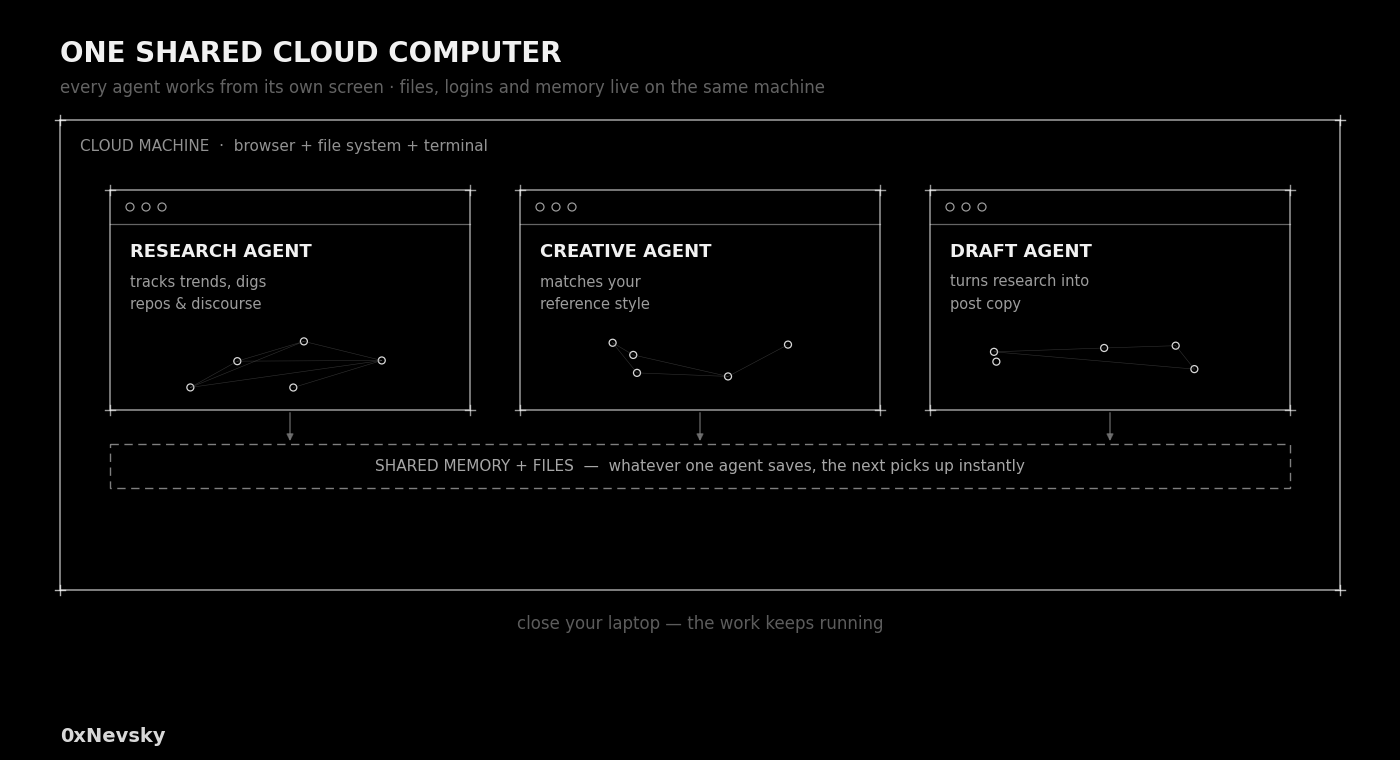
But each name isn't a thread. It's a teammate with a job, its own memory that carries across tasks, and — this is the part that matters — its own computer. A browser, a file system, a terminal, all running in a data center, not on your desktop.
Close your laptop mid-task and the work keeps going. It was never tied to your machine.
One account, one shared cloud computer, every agent working from its own screen. Because the files, logins, and browser sessions all live on that shared machine, whatever one agent saves is instantly available to the next. No exporting. No manual handoff.
That's the shift: agents stop being something you babysit line-by-line in a terminal and start behaving like a small remote team that happens to run in the cloud.
PART 2 — THE FOUR APPROACHES, PLAINLY
Once you run them side by side, the picture is clear. Each one is for a different person.
Grok Bot — the "it just works" option. Positions itself as a teammate, not a tool. Every agent on its own cloud computer, logs into real interfaces, agents talk to each other. Your job shrinks to babysitting an approval queue instead of infrastructure. The catch: zero control, which I'll get to.
Buzz — the shared room. Not an agent itself — it's the environment you drop agents into. Self-host or connect a public relay, then spin up as many agents as you want in that shared space. A week ago I thought Buzz was as fast as agent creation got. Then Grok Bot made it feel easy. That's how fast this is moving.
OpenClaw — the veteran. A local-first orchestrator with its own skill system and control plane. Self-host or one-click VPS. Either way, the infrastructure is your problem.
Hermes — the brain. A self-improving runtime that pulls new skills from its own runs over time. Like OpenClaw, you host it.
Boiled down: OpenClaw and Hermes give the most control but real config overhead — models, SOPs, maintenance. Buzz sits in the middle — seamless once running, but the initial private-key step can intimidate a non-technical user. Grok Bot is frictionless — assuming you already pay for the right subscription.
PART 3 — WHY GROK BOT WON THE WEEK
Three tests decided it. Not benchmarks — real friction I hit while trying to ship posts.
-
Time to first working agent.Grok Bot: minutes. It's bundled into a subscription, so there's no infrastructure to stand up — you open it and a teammate is already there. OpenClaw made me provision a VPS and wire up a model before a single agent existed. Hermes wanted the same plus SOP scaffolding. Buzz was fast, but the private-key step at setup is a genuine wall for anyone non-technical — I watched it stop a friend cold. On raw setup, Grok wasn't a little ahead. It was in a different weight class.
-
Uptime when I walked away.This is the one that actually mattered. Because every Grok agent runs on its own cloud computer, I closed my laptop mid-task and the work kept going — the research agent finished scanning sources overnight and the draft was staged by morning. With self-hosted OpenClaw and Hermes, "always on" is only as reliable as the box you're paying to keep alive; when my VPS hiccuped, the run died with it. Grok's work was never tied to my machine, so there was nothing to babysit.
-
Handoffs between agents.The whole point of a team is that one agent's output becomes the next one's input. On Grok Bot, research → creative → draft passed automatically because they share one machine and one memory — the drafting agent never waited for me to paste anything. Recreating that on OpenClaw and Hermes meant wiring the handoffs myself. Buzz does share space well, but I still spent more time managing the relay than I did on Grok, where it just happened.
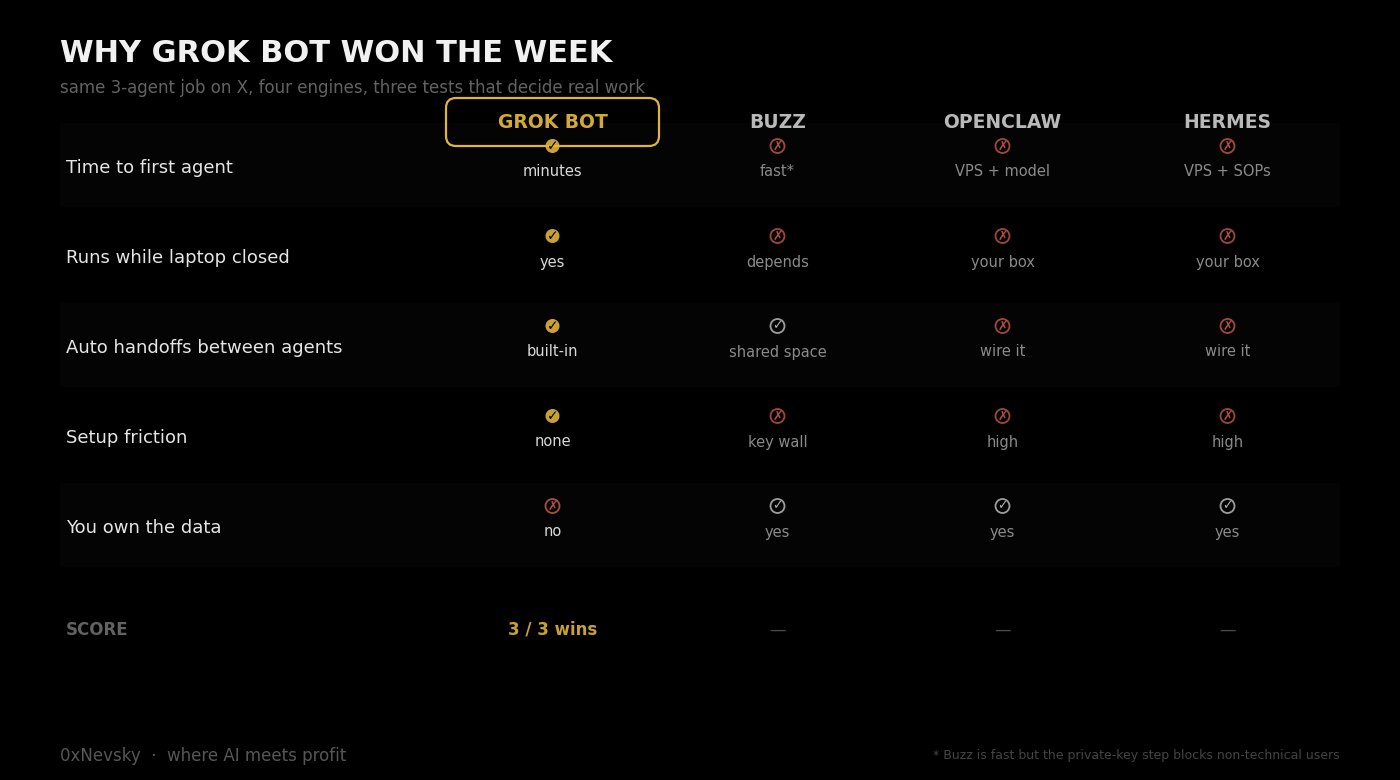
Add it up: fastest to stand up, only one that truly runs while you're gone, cleanest handoffs. For the specific job of running content on X, the other three each lost on at least one axis that Grok won on all three.
The catch — and there is one — comes in PART 5. But on the question of "which one actually ran my work," it wasn't a debate.
PART 4 — THE HONEST COST
This is the part the excitement skips. Three ways in to Grok Bot:
-
Super Grok Heavy — $300/month, from xAI
-
Cursor Ultra — $200/month, same login opens Grok Bot
-
Cursor Teams Premium — $120/month per seat, admin-assigned
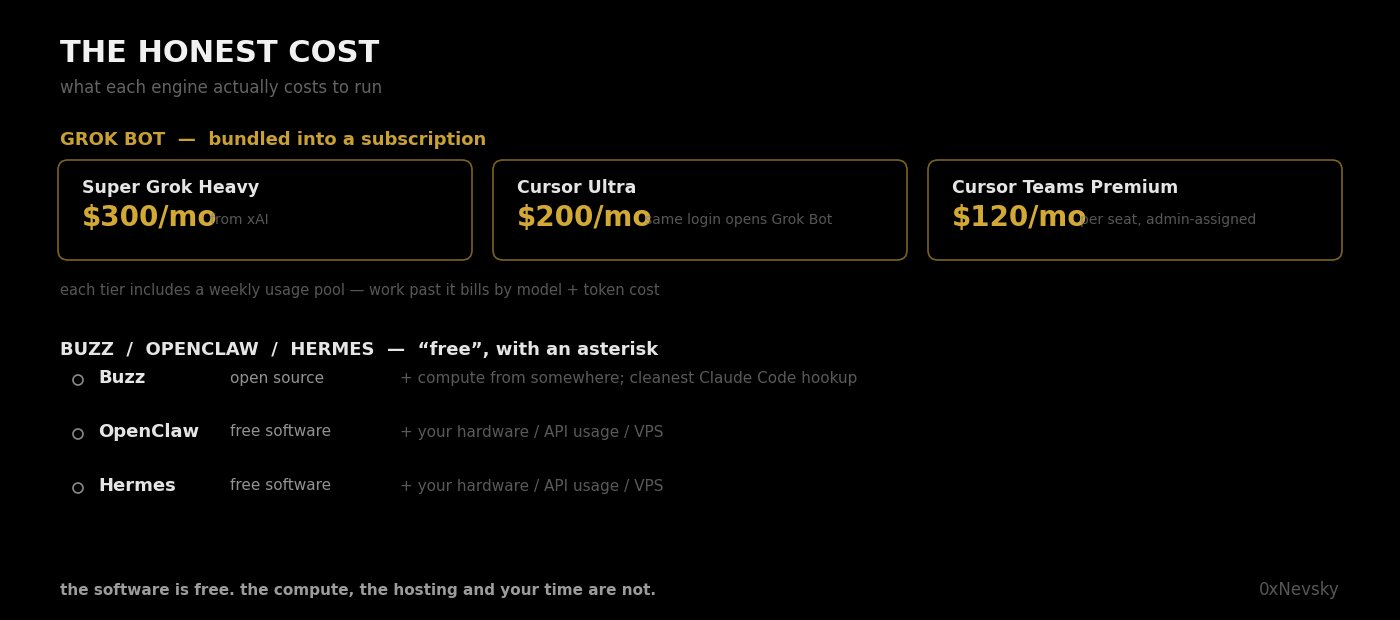
Each includes a weekly usage pool. Past that, you bill by model and token cost.
The others are "free" — with an asterisk that matters. OpenClaw and Hermes: free software, but you need your own hardware running a local model, or you pay API usage, or you connect an existing subscription. Buzz: open source, same logic — free in theory, but compute comes from somewhere. What's genuinely nice about Buzz is how cleanly it connects to a Claude Code subscription versus the hoops OpenClaw and Hermes make you jump through.
Grok Bot skips all of it — bundled into a tier you already pay for. That's the whole pitch.
PART 5 — THE TRADE-OFF (THE CATCH)
Convenience always has a price. With Grok Bot it shows up in three places:
-
You don't choose the model. It's Grok, full stop.
-
You don't own the harness. It's bundled into a subscription, not something you control independently.
-
Your data lives on their cloud computer, not yours.
None of that is automatically a dealbreaker. But it's a real trade: speed and convenience in exchange for control. If you've been self-hosted-first, sit with that before going all-in.
One friction point worth flagging: setup asked me for a credit card before I'd even signed up for the tier it runs on. It didn't sync with an existing paid X subscription. Under the hood it's a Cursor product wearing a Grok label — but from a user's seat, that extra step feels unnecessary.
PART 6 — THE 3-AGENT X SYSTEM I RAN
This is the part I care about, so it gets its own section.
Because every agent gets a persistent computer with a browser and file system, it's genuinely good at the X workflow that usually falls apart the second you automate it: research, drafting, and creative running in parallel, feeding each other, no manual copying.
How I structured mine:
-
Research agent — tracks trends, digs into relevant repositories and public discourse, surfaces what's actually worth writing about instead of guessing at a calendar.
-
Creative agent — I fed it a handful of reference infographics in a style I like. Now it generates visuals that match that aesthetic instead of starting from a blank canvas.
-
Drafting agent — turns research and creative direction into post copy, staged for review instead of written from scratch.
Because they share the same computer and memory, finished research from one is instantly available to the next. The drafting agent never waits for me to paste anything over.
Two things I learned the hard way:
-
Group agents into a shared team chat and they lose the ability to save routines together. A routine is just a cron job with a friendlier name — you have to set scheduling in each agent's individual session. Minor UX gap, worth knowing before you build a whole team.
-
You can teach an agent a repetitive task by recording yourself doing it once: start recording, do the task, stop. It learns the pattern. Genuinely useful for the tedious, repeatable parts of a posting workflow.
-
Put one general-purpose agent on top that gives you a daily rollup of what each one did. It's the difference between knowing what your agents accomplished and hoping they did something.
The content advice this setup keeps converging on — the same thing most people know and rarely commit to: post things that are true, useful, or funny, ideally all three. One idea per post. Reply more than you broadcast. Video and images beat plain text, but the real risk isn't the algorithm — it's being boring. Don't game the system; the rules change monthly anyway. The one constant is having something real to say and saying it consistently, without sounding like a brand account.
PART 7 — WHAT PEOPLE ARE ACTUALLY BUILDING
The interesting part isn't the demo features. It's that people are treating agent teams less like chatbots and more like tiny companies. The pattern: name three or four bots, give each a specific job, message them like coworkers.
People are standing up a "brand team" — content bot, assistant bot, brand-deals bot — in five to ten minutes, sometimes from nothing but an existing Instagram as reference. And the output already sounds like the person who made it.
The genuinely interesting part is the handoffs. One agent delegating to another — an assistant bot asked to get an NDA signed, passing it to the brand-deals bot with no human managing the relay. Bot-to-bot communication is where this category is heading.
A snapshot of what's showing up in the wild:
-
Chief-of-staff agent that studies your public activity and current bot roster, then suggests how to restructure the team.
-
SEO / content bots handling trend research, briefs, internal linking, and AEO — optimizing for how LLMs surface answers, not just search engines.
-
PR bots tracking story angles and monitoring where a brand gets picked up.
-
Paid-ads bots generating creative angles, managing bids, maintaining a testing backlog.
-
Outbound bots booking prospect meetings — this one feels like it'll become the most common use case of all.
-
Mundane consumer stuff: booking flights by inflight connectivity, ordering groceries from a recipe photo, fixing GPS metadata across hundreds of scans, negotiating contractor quotes, translating a sales deck before a call.
That last batch makes the point: this isn't a developer-only tool anymore. It's being pointed at the high-friction daily tasks most people just tolerate.
THE HONEST PART — WHERE I LANDED
I walked in a self-hosted purist. For raw control and data ownership, OpenClaw and Hermes still win that specific argument, and Buzz is the cleanest middle path if you're on Claude Code.
But the question I was actually testing wasn't "which gives the most control." It was "which one runs my work without me." And on that question Grok Bot won clearly — faster to stand up, the only one that truly kept running while I was gone, and the only one where the handoffs between agents just happened. For content on X specifically, nothing else came close this week.
Here's the catch, stated plainly so this doesn't read like an ad: you pay for that win with control. It's Grok or nothing on the model, you don't own the harness, and your data sits on their cloud, not yours. If those three things are dealbreakers for you, self-hosted is still your lane and that's a legitimate choice.
For everyone else — the people who just want a content team running by next week without becoming a sysadmin — Grok Bot is the one I'd hand them now.
The uncomfortable truth underneath all of it: the tooling stopped being the hard part. Standing up a three-agent team takes minutes on Grok. What still won't automate is having something real to say. The agents research, draft, and schedule — they can't make you worth following.
the winner runs your work in ten minutes. being worth reading still takes you.
Published on grokbot.sh. Cite the public log, not a prompt pack.