
NERVE Protocol: Six AI Agents for Trading Memecoins on Robinhood Chain
Every day thousands of memecoins launch on DEXes. 97% are dead within 24 hours. Manually checking one token takes 15 minutes: contract, holders, liquidity, LP lock, creator, slippage. At hundreds of
Article
Job breakdowns
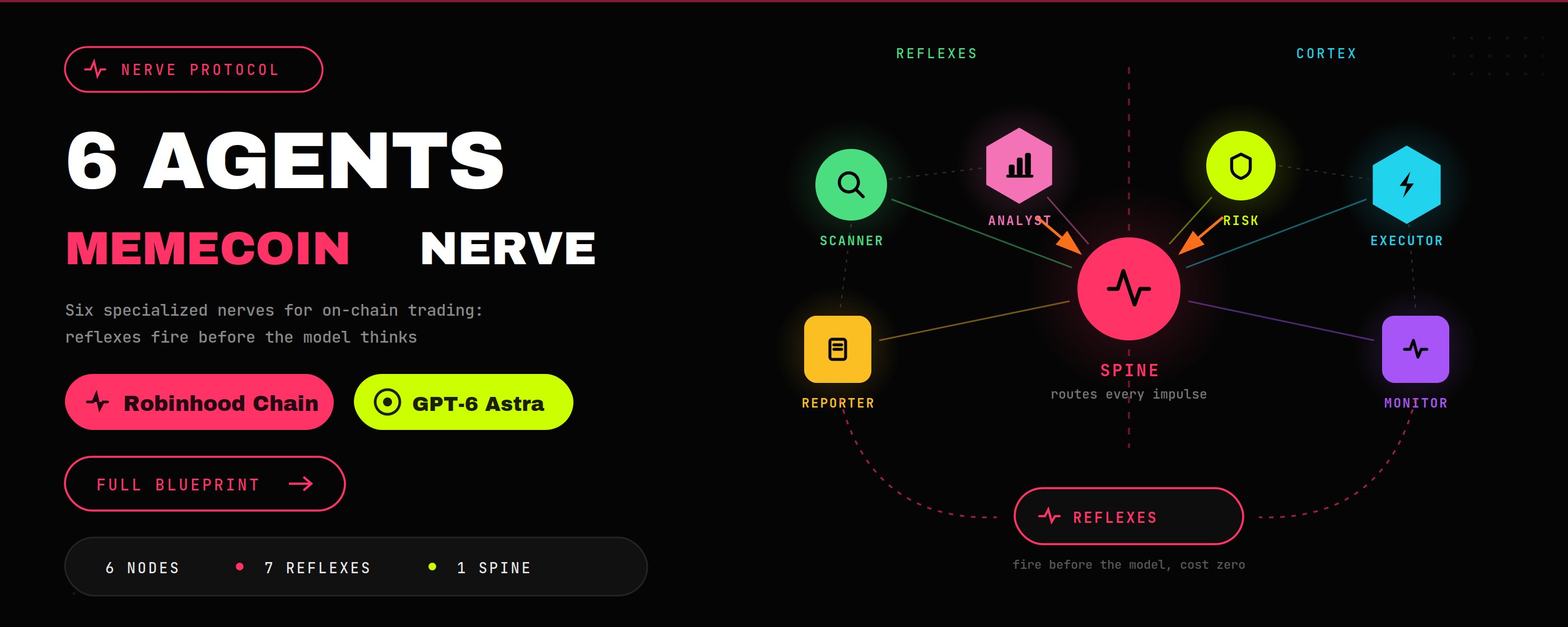
Every day thousands of memecoins launch on DEXes. 97% are dead within 24 hours. Manually checking one token takes 15 minutes: contract, holders, liquidity, LP lock, creator, slippage. At hundreds of pools per hour that is physically impossible. NERVE does it in seconds: six specialized agent-nerves, each tuned to one signal type, reflexes that fire before the brain registers danger, and the whole system reacts faster than you can open your first tab.
NERVE is a protocol for memecoin trading: a single message format between agents, reflexes that cut rugs and honeypots before the model is called, pool scoring in seconds, and a full audit trail of every decision. The first product on NERVE: Pool Scanner for Robinhood Chain, Base, and Solana.
A Metaphor That Works Literally
The nervous system is not a random analogy. Every property of the biological system maps to a concrete engineering decision.
Nerve specialization. The optic nerve does not hear, the auditory nerve does not see. In NERVE each node owns one signal type: SCANNER sees new pools, ANALYST evaluates metrics, RISK computes limits. No node combines two functions. This is not a limitation, it is the reason the system is more reliable than a generalist.
Reflexes are faster than thought. When a hand touches something hot, the spinal cord pulls it back before the cortex has time to think. In NERVE, deterministic checks (kill switch, daily limit, gas, slippage) fire before the model is called. The model is the cortex: it thinks slowly and expensively. Reflexes are free and instant.
The nerve impulse is typed. A biological nerve carries one signal format: an action potential. In NERVE all nodes communicate through a single Impulse structure, and every transition is recorded in the history. No free text between agents, no chatting in a shared room. Only typed messages.
The system survives losing a node. If one nerve is damaged, the rest keep working. In NERVE every node is stateless between cycles: state lives in the store, not in process memory. Restarting any node does not break the others.
Impulse: The Unit of Communication
Everything in NERVE flows as an Impulse. It is the only data format nodes can send and receive.
When something goes wrong, you open impulse.path and see:
Not "something broke," but exactly who, when, and why.
Node: The Protocol Every Agent Implements
Every node in NERVE implements one interface.
The boundary is not decorative. If a subclass does not define boundary, it will not instantiate. This is a guarantee at the code level, not the documentation level.
Reflexes: Deterministic Checks Before the Model
Reflexes in NERVE are functions that check an Impulse and can stop it before it reaches the expensive nodes (ANALYST, EXECUTOR).
Reflexes are checked before ANALYST and before EXECUTOR. If the kill switch is active, the impulse never reaches the model. This saves money ($0.008 per Astra call), time, and risk.
The Cortex: GPT-6 Astra via Structured Outputs
The model plugs in as one of the nodes. It receives only metrics and returns a typed verdict.
Spine: The Router That Connects Everything
The Spine is the backbone of NERVE: it takes an Impulse and conducts it through the chain of nodes in the correct order.
add_node is the extension point. Want to add a SENTIMENT node that checks Twitter? Implement NerveNode, call spine.add_node(SentimentNode(), after=NodeType.ANALYST), and it slots into the route between ANALYST and RISK. The other nodes do not know it exists and require no changes.
Audit: Every Decision Is Recoverable
NERVE Score: One Number
NERVE Score is deterministic: the same metrics always produce the same number. The model influences it through confidence, but cannot flip it: a pool with active mint will not score high no matter what.
Build NERVE in Six Steps
-
Impulse and NerveStore. The typed format and audit trail. Done when any impulse from last week is recoverable from the database.
-
The Reflex set. Seven built-in reflexes. Done when kill switch, daily loss, and gas cap block an impulse before the model.
-
ScannerNode and AnalystNode. Two nodes: one deterministic, one on Astra. Done when the funnel shows numbers on synthetic data.
-
RiskNode and ExecutorNode. Limits and execution. Done in paper mode: the executor logs but does not sign.
-
Spine. The router. Done when add_node inserts a new node and the system keeps working.
-
MonitorNode and ReporterNode. Stops and the morning brief. Done when the monitor catches a stop approach on synthetic data.
Bottom Line
NERVE is not six scripts. It is a protocol: Impulse as the unit of communication, NerveNode as the node contract, Reflex as instant protection, Spine as the router, NerveStore as the audit trail, nerve_score as the number.
Each node does one thing. Reflexes are faster than the model. The history of every decision is recoverable. A new node plugs in with one line and does not break the rest.
The nervous system reacts to the market faster than you can open a tab. The decision is still yours, but the grunt work is done by NERVE.
Published on grokbot.sh. Cite the public log, not a prompt pack.