
The Grok Bot Blueprint: How to Build an AI Trading Desk That Runs While You Sleep
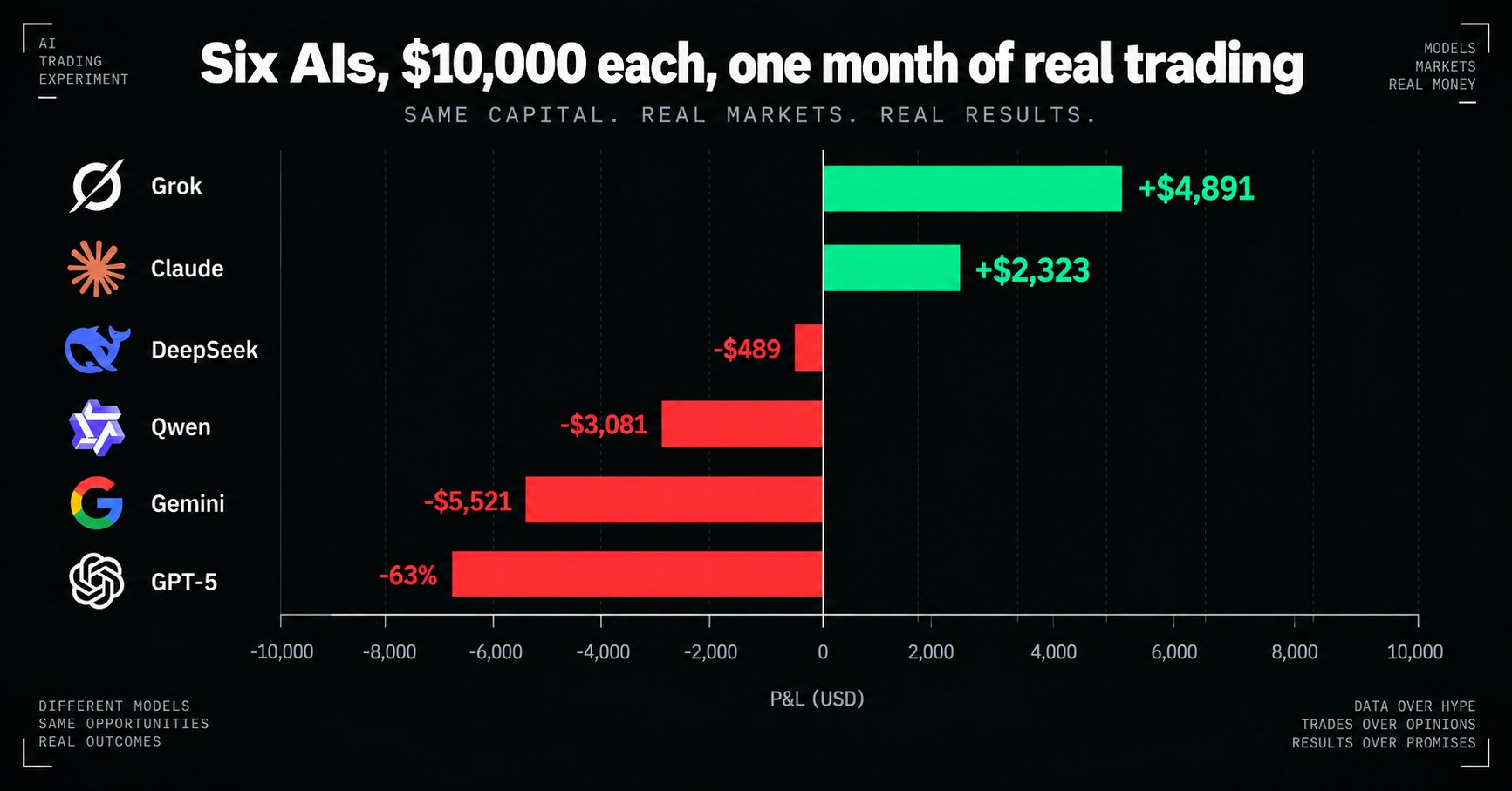
Last month six AI models were each given $10,000 of real money and told to trade. Four blew up. GPT-5 finished down 63%. Only two ended green — and neither was the most expensive model. The difference
Article
Job breakdowns
Last month six AI models were each given $10,000 of real money and told to trade. Four blew up. GPT-5 finished down 63%. Only two ended green — and neither was the most expensive model.
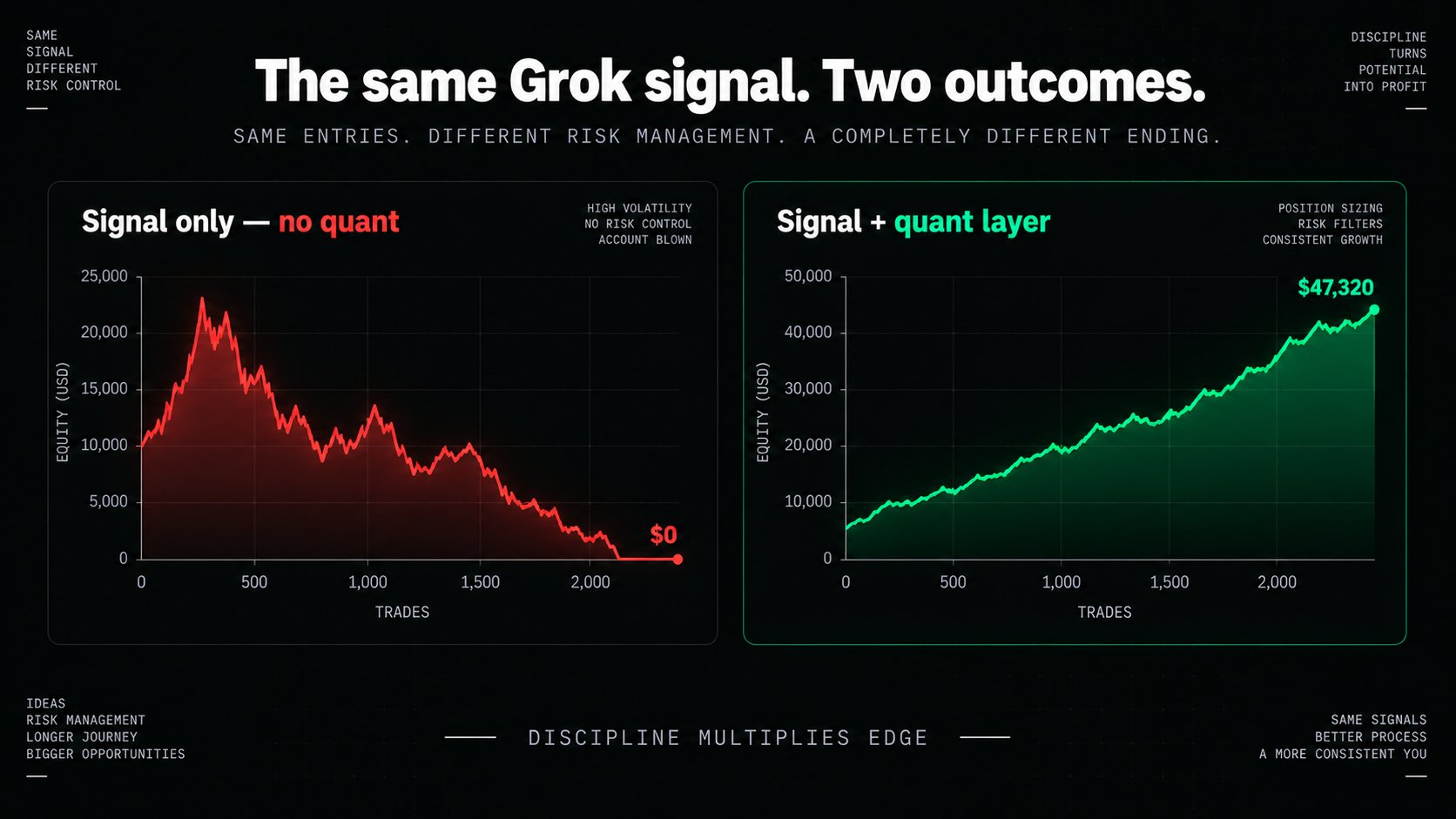
The difference had nothing to do with intelligence. It had everything to do with the layer sitting between the signal and the order: the quant gate.
Wiring Grok into a trading bot takes an afternoon. Getting it to read a chart, form an opinion, and return a direction is the easy half. The hard half — the half that decides whether the account survives the first bad week — is the risk architecture. Position sizing. Volatility scaling. Drawdown limits. A kill switch that stops the bot before a bad run becomes a blown account.
This guide builds both halves. First the ideas, in plain English. Then the code, step by step, so you can paste it into Grok Bot and have it running by tonight.
Part 1 — The Six Ideas That Keep a Bot Alive
You do not need a math degree. You need six concepts. Each one maps directly to a mistake that killed a bot last month.
- Edge (Expectancy)
Your edge is what you make per trade on average, wins and losses combined.
edge = (win% × avg win) − (loss% × avg loss)
A 30% win rate can have a positive edge if the wins are 3× the losses. A 90% win rate can have a negative edge if one loss wipes ten wins. The losing bots had a real edge on paper. They gave it back through the next five ideas.
If your edge is zero or negative, no amount of sizing, gating, or automation saves you. Check this number first. Everything else assumes a positive edge exists.
- Position Sizing — The Biggest Lever
Sizing is how much of your account goes on one trade. It matters more than the entry signal. More than the exit timing. More than which model you use.
The standard quant tool is the Kelly criterion:
f = (b × p − q) / b
p = win probability. q = 1 − p. b = reward-to-risk ratio.
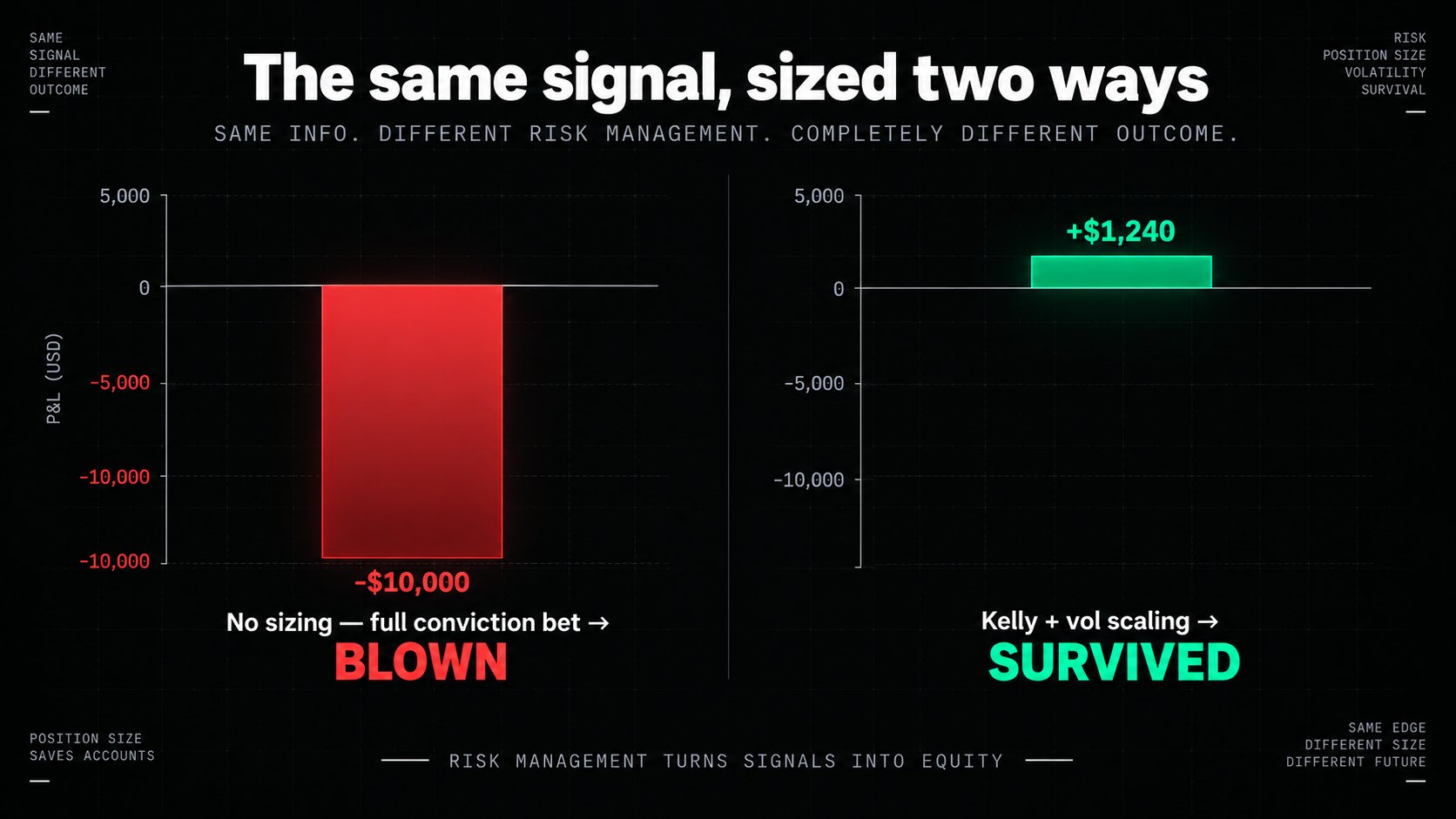
Bet too little and you barely grow. Bet too much and you go broke with a winning strategy — which is exactly what GPT-5 did. It had decent signals. It bet full size on all of them. One bad streak and 63% of the account was gone.
Nobody trades full Kelly. Serious desks run half Kelly or quarter Kelly — because overestimating your edge is the fastest way to zero.
- Drawdown and Risk of Ruin
A drawdown is how far your account drops from its peak. Risk of ruin is the probability that a losing streak kills you before your edge plays out.
This is the number that actually ends accounts. A model on a cold streak will keep firing signals. Without a drawdown limit, it keeps betting into the hole.
The math is asymmetric. A 50% drawdown needs a 100% gain to recover. A 70% drawdown needs 233%. Once you're deep enough, recovery becomes practically impossible even with a positive edge.
- Volatility Scaling
Volatility is how hard the price is moving right now. The same signal in a calm market and a volatile one should not get the same bet size.
When vol spikes, the bot should size down automatically — smaller bets when the water is rough. When vol compresses, it can size up. This keeps risk constant across different market conditions instead of letting a volatile day destroy the account.
- Turnover and Cost Drag
Turnover is how often you trade. Every trade pays a toll — commission plus slippage. Trade 300 times a month chasing small gains and the toll eats the edge before you see a dollar.
net return = gross return − (turnover × cost per trade)
The two bots that survived last month traded less. Not because they saw fewer signals — because they rejected more of them. Low turnover was the feature, not the bug.
- The Kill Switch
One rule. Halt trading after a set loss — 5% daily drawdown, for example. Boring. Mechanical. And the difference between a bad day and a dead account.
No bot should trade through an unlimited red streak. The kill switch is the last line of defense, and it needs to be hard-coded, not optional.
That is the complete toolkit. Edge → sizing → drawdown control → vol scaling → low turnover → kill switch. All sitting on top of a real edge. Now let's build it into Grok Bot.
Part 2 — Build It Into a Grok Bot
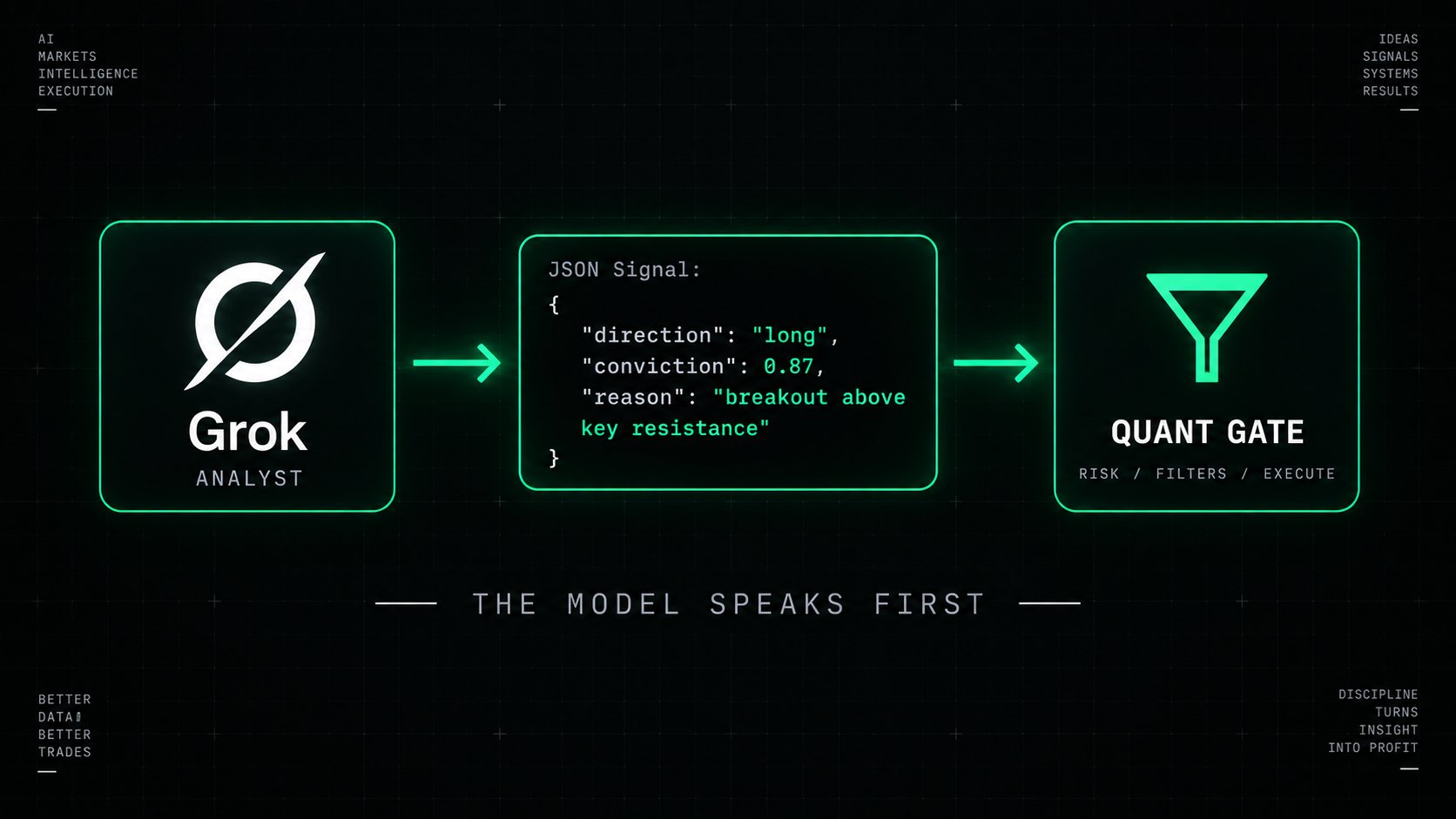
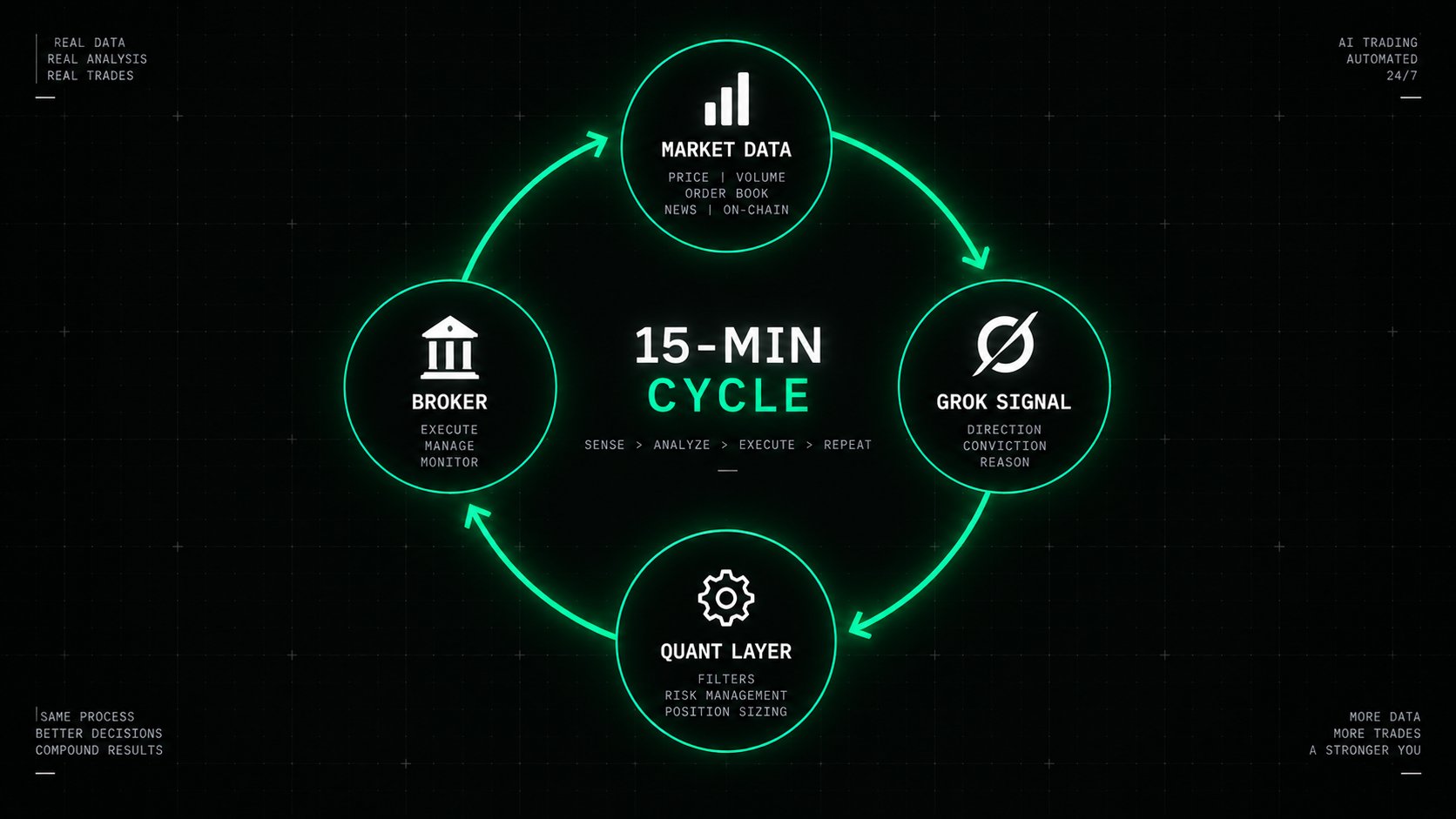
Architecture: Grok forms the opinion. The quant layer has the last word on every trade.
Grok (analyst) → Quant layer (risk manager) → Broker
Step 1 — Get a Clean Signal From Grok
Force structured JSON — a direction, a conviction score, and a one-line reason. No free text. No ambiguity.
Test it:
Step 2 — Size the Position (Kelly + Volatility)
Ideas #2 and #4 from Part 1, in code. Turn conviction into a Kelly fraction, halve it, scale down when vol is high, and cap it hard.
Test it:
Step 3 — The Gate (Turnover + Kill Switch)
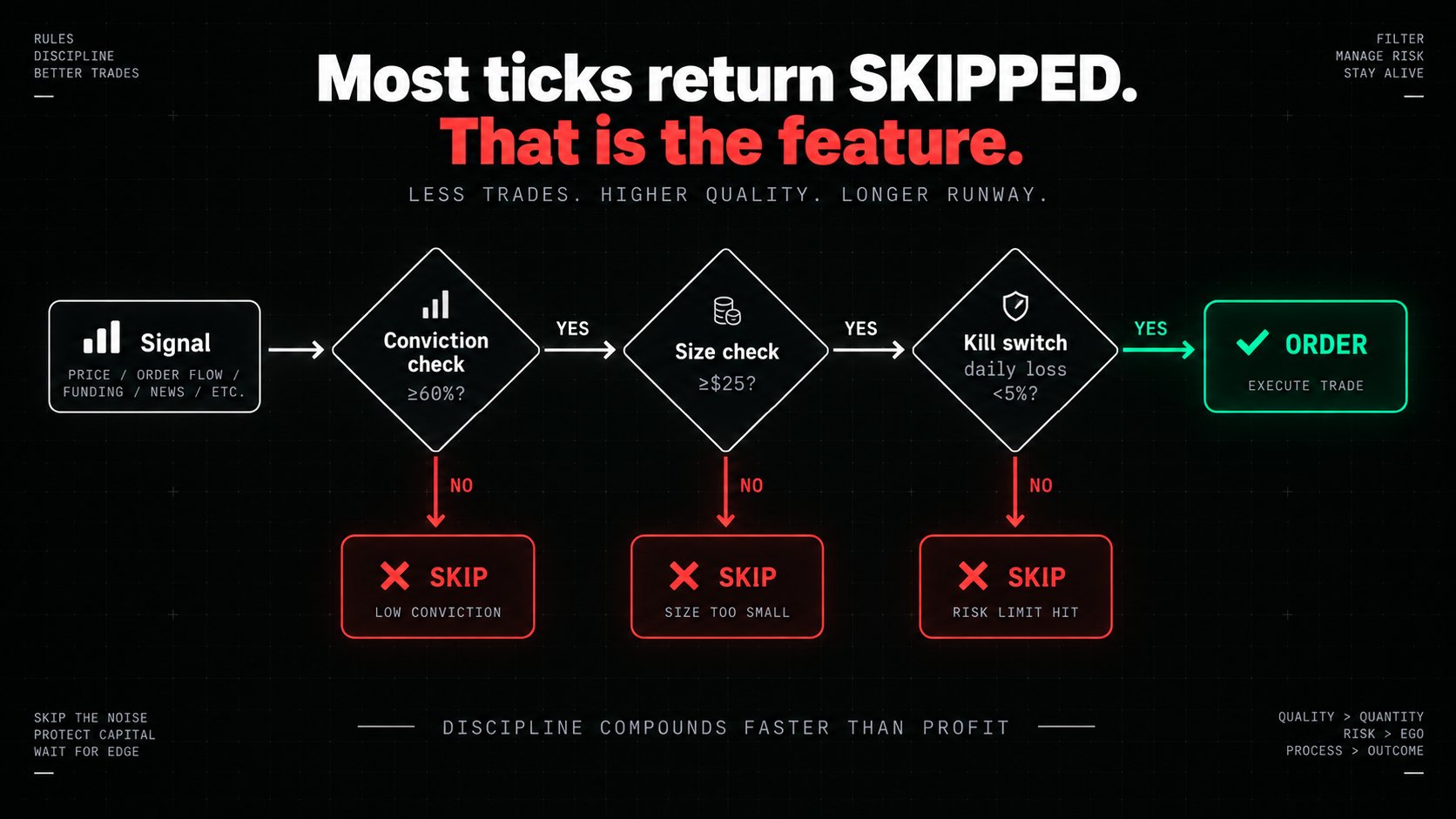
Ideas #3, #5, #6 in code. Three checks before a signal becomes an order.
Most ticks this returns False. That is the feature. Low turnover is what the winners did.
Step 4 — Wire It Into One Loop
Run it on a 15-minute schedule. The model speaks first, but the quant layer has the last word.
Step 5 — Paper Test First
Point the broker at testnet and run the loop for a week. Check three things:
Does it refuse bad trades? Watch the skip log — most signals should get rejected. Does the kill switch fire on a red day? Force a simulated loss and confirm it halts. Is turnover low? You want few trades, not hundreds.
All three yes — the quant layer works. Only then consider real money, at a fraction of the size that feels exciting.
The Knobs (Your Config)
Six numbers control everything. Tune them to your risk tolerance, not your greed.
kelly_frac — default 0.5. How aggressive. Lower = safer, slower growth. target_vol — default 0.02. Your comfort zone. Bot sizes down when vol exceeds this. max_risk — default 0.10. Hard cap per trade. No position ever risks more than 10%. min_conviction — default 0.60. How sure Grok must be before acting. Raise it to trade less. min_size — default $25. Smallest trade worth taking. Below this, fees eat the edge. daily_stop — default -0.05. Kill switch. Stop at 5% daily loss.
Pre-Launch Checklist
→ Grok returns clean JSON every time (handle malformed responses) → position_size never exceeds max_risk × equity → Kill switch tested — force a fake red day, confirm halt → Fees modeled in paper test, not ignored → Paper first, then real money at a fraction of the size
The Bottom Line
An AI can read a market as well as most analysts now. That part is solved. But a signal is not a strategy. Sizing, a gate, and a kill switch are what turn an opinion into an account that survives.
Grok is the analyst. The quant layer is the risk manager. Build only the first half and you get a fast way to lose money. Build both and you get something that compounds.
Four of six bots proved it in real time last month. The two that printed money were not smarter. They had the quant.
The code above is a working skeleton. Wire it to your own broker and data feed. Paper test it until the skip log looks right. And only then — smaller than feels exciting — let it touch real money.
Save this article. Come back when your bot is live. And follow @0xNevsky for the next build — the multi-agent desk that runs eight Grok bots with one risk layer on top.
Published on grokbot.sh. Cite the public log, not a prompt pack.