
Everyone is building a company inside Grok Bot. Almost nobody is building the part that stops it.
Bot Ops Engineering: the reliability layer for always-on agents, and how to build yours this weekend. For two weeks my timeline has been one screenshot. Six bots. Research, writing, outreach, ops,
Article
Job breakdowns
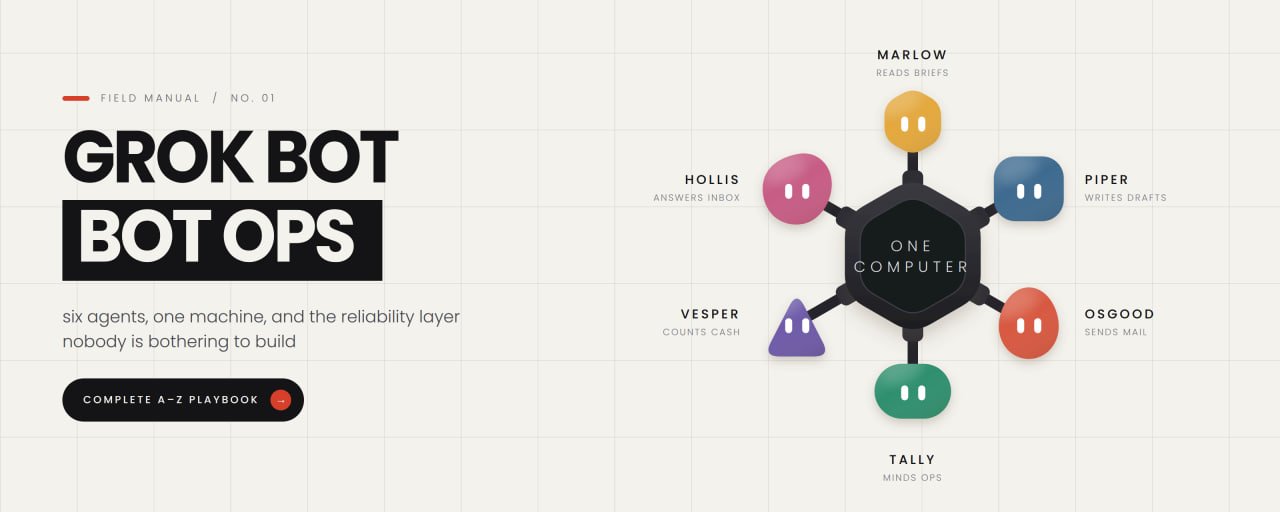
Bot Ops Engineering: the reliability layer for always-on agents, and how to build yours this weekend.
For two weeks my timeline has been one screenshot.
Six bots. Research, writing, outreach, ops, finance, support. An org chart with no humans in it. "I built a f*cking company inside Grok Bot." A million views. Elon reposts it. Twelve people copy the layout by Tuesday.
The demos are real. I ran the same setup. It works.
And that is exactly the problem.
Because every single one of those posts stops at the same place: the moment the bots are standing up. Nobody publishes day nine. Nobody publishes the run where the outreach bot worked perfectly for six hours on a contact list it had quietly deduplicated wrong. Nobody publishes the approval you tapped from a lock screen at 11pm without reading.
The founding is the easy part. The founding is a screenshot.
What nobody is building is the layer underneath - the thing that catches an agent that is confidently, silently, productively wrong.
That layer needs a name, so here is one: Bot Ops.
First, what actually shipped
Strip the hype off and Grok Bot is a specific, narrow, genuinely new thing.
On August 11, 2026, xAI opened the beta. Each Bot you create gets its own persistent cloud computer - a real browser, a real filesystem, a real terminal. It signs into the tools you already use, with your credentials, and it keeps working after you close your laptop. It surfaces only when it wants approval.
It was built under the codename "Sand" by Cursor - the coding company SpaceX is acquiring for $60B - and it ships bundled into subscriptions people already pay for: Cursor Teams Premium at $120/seat/month, Cursor Ultra at $200/month, and the top SuperGrok tier. Desktop and iOS at launch, Android coming. No free tier.
Here is the sentence that matters, and it is not a marketing sentence:
A regular chatbot produces output in the chat window. Grok Bot produces output inside the tool - your inbox, your CRM, your repo.
That is the entire delta. It is not a smarter reply. It is a coworker with hands.
And the moment something has hands, "is the answer good?" stops being the interesting question. The interesting question becomes "what did it touch, and can I undo it?"
Nobody's thread is about that.
The part nobody reads
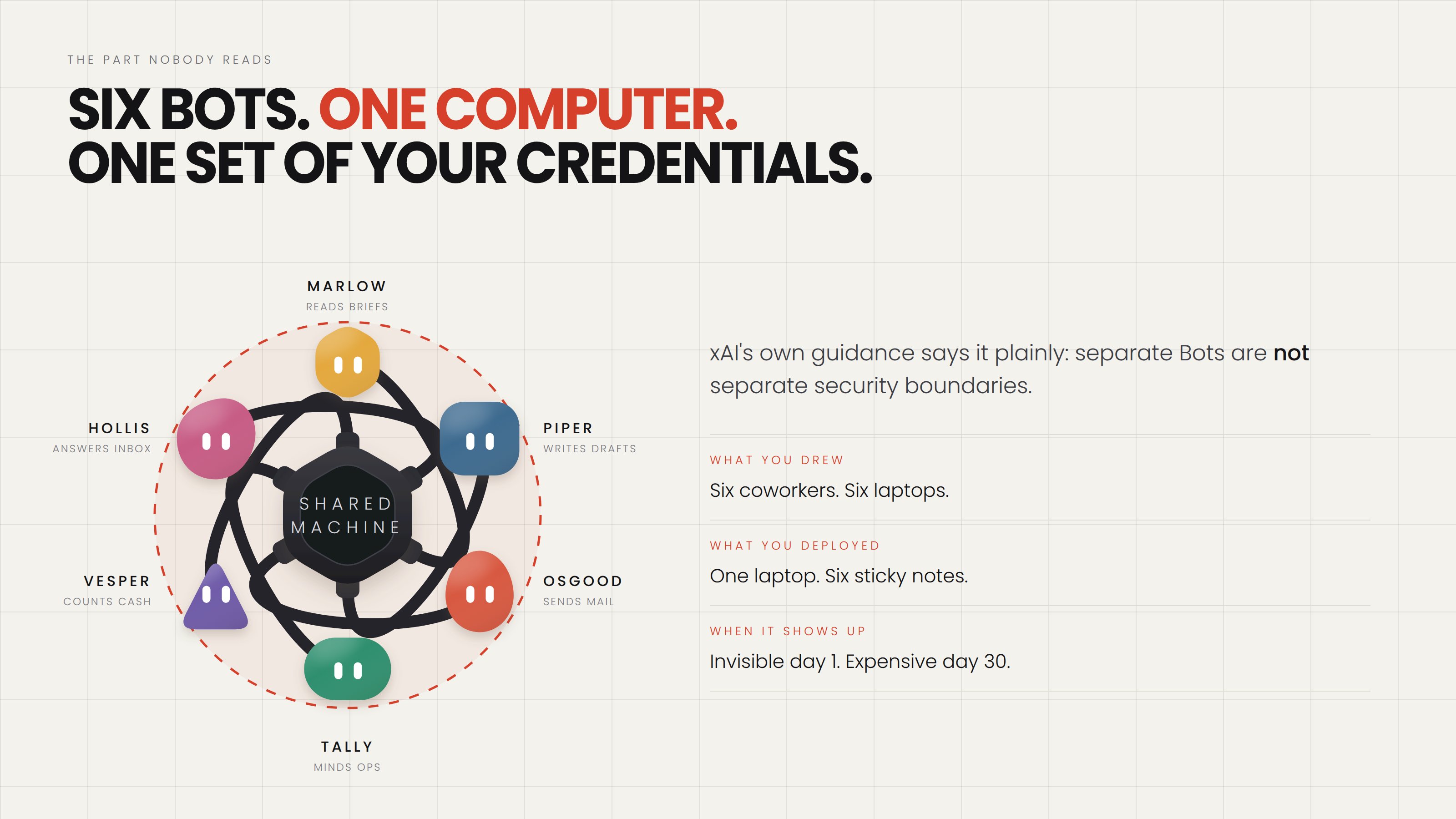
Go read xAI's own guidance on multi-Bot setups. It says something the viral threads skip entirely:
Separate Bots are not separate security boundaries.
Your six bots share one cloud computer. One filesystem. One browser with one set of live sessions. One terminal with one set of credentials.
The roles are real in one narrow sense - each Bot keeps its own instructions, its own preferences, its own summaries of past work. Memory is partitioned. Capability is not.
So when you build the six-agent company from the screenshot, this is what you actually built:
-
Not six employees with six laptops.
-
One laptop, logged into everything, with six sticky notes on it telling it what to be today.
That distinction is invisible on day one and expensive on day thirty.
Everyone in your timeline is drawing an org chart. An org chart implies isolation - Finance can't read the outreach inbox, Support can't touch the deploy keys. That isolation is not there. You drew a picture of a company. You deployed a single-user machine with your name on the door.
This is not a reason to avoid Grok Bot. It is the reason Bot Ops has to exist.
Agents don't fail loudly
Traditional software fails with a stack trace. You get a red thing. You fix the red thing.
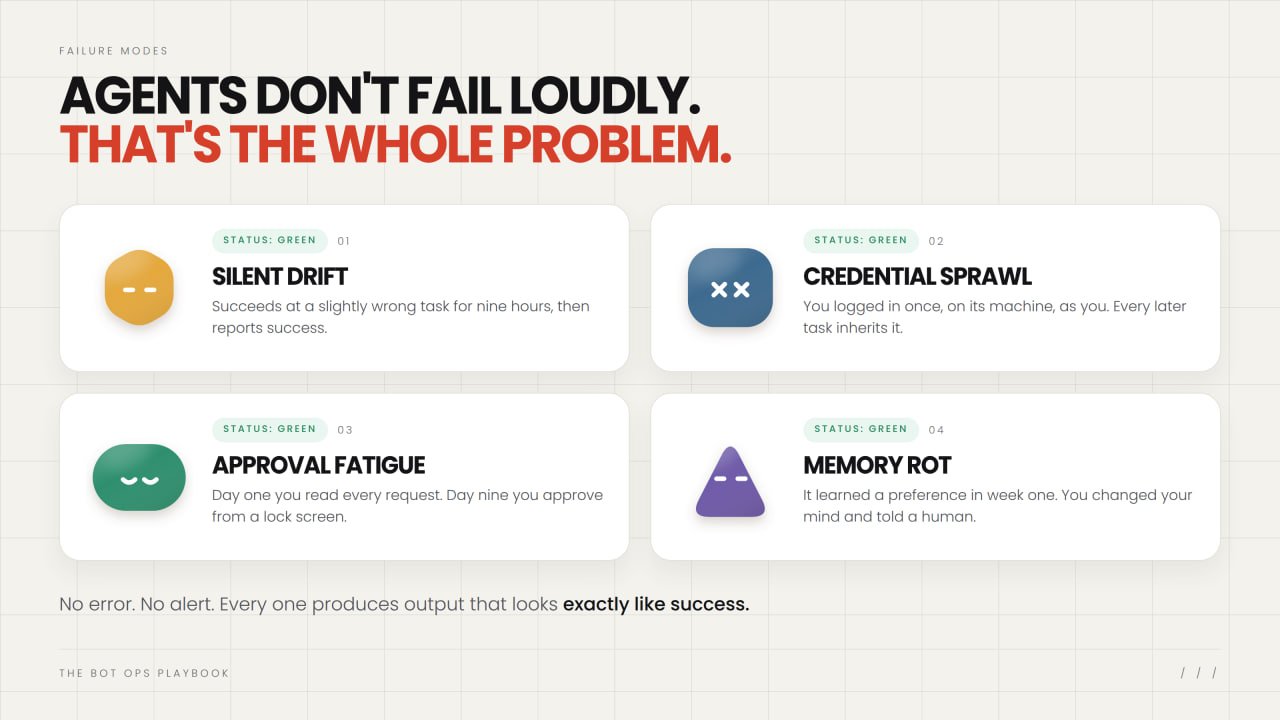
Agents return green and hand you a summary of work that didn't happen the way you think it happened. Four shapes, in order of how often they got me:
01 - Silent drift. The bot doesn't crash. It succeeds at a slightly wrong task for nine hours. It reports success, because by its own definition of done it did succeed. This is the expensive one, and it is expensive precisely because it looks like the cheap one.
02 - Credential sprawl. You logged into a tool once, on its machine, as you. Every subsequent task on that machine inherits that session - including tasks you gave a different Bot, for a different purpose, three weeks later.
03 - Approval fatigue. Day one you read every approval request carefully. Day nine you approve from a notification. The approval gate is doing nothing at this point except transferring liability to you, which is worse than no gate at all, because you now feel covered.
04 - Memory rot. The Bot learned a preference in week one. You changed your mind in week three and told a human, not the Bot. It is still applying the June version of you, correctly, forever.
Notice what all four share. No error. No alert. No red thing. Every one of them produces output that looks exactly like success.
You cannot monitor these with uptime. You monitor them with process.
The Bot Ops stack
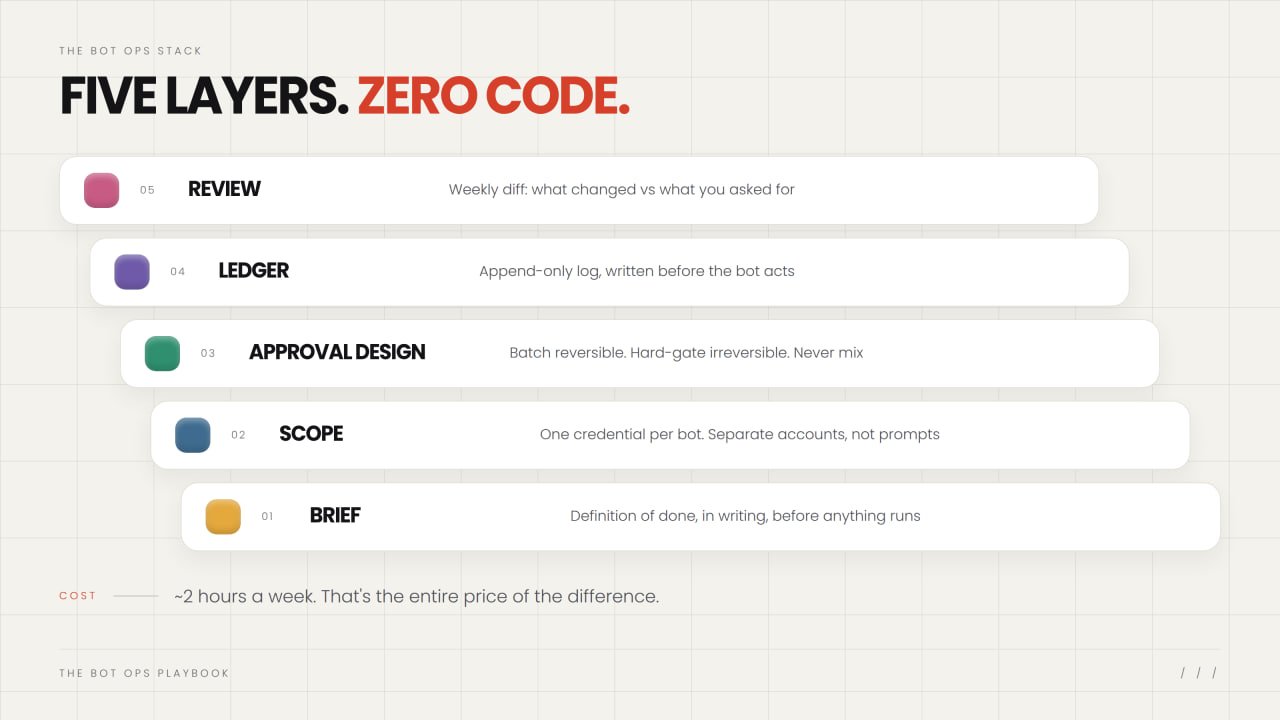
Five layers. Build them bottom-up. None of them require code - that is the point, and it is why almost nobody bothers.
01 - Brief. Before a Bot touches anything, write the definition of done. Not the task. The done. "Triage inbox" is not a brief. "Every email older than 24h is labeled into one of these five labels; nothing is archived, deleted, or replied to; the count of each label goes in this doc" is a brief. If you can't write the check, you can't delegate the task. Most of the failures in the section above are just missing briefs wearing a costume.
02 - Scope. One credential per Bot, and where the tool allows it, a separate account per Bot - not a separate prompt. You cannot get isolation from the shared machine, so buy it at the account layer instead. Your outreach Bot gets a sending account that can send and nothing else. Your finance Bot gets read-only. Yes, this is annoying. It is also the only real boundary you get.
03 - Approval design. Stop approving things one at a time. Split by consequence: low-stakes reversible actions get batched into a once-a-day digest you actually read; irreversible actions get a hard gate that requires you to type something, not tap something. Never mix the two streams. The mixing is what causes fatigue - a queue with one payroll change buried among forty label updates trains you to approve the payroll change.
04 - Ledger. One append-only doc. Every Bot writes a line before it acts: what it's about to do, why, and what it expects to be true afterwards. This costs you one sentence in each Bot's instructions and it is the single highest-leverage thing in this article. When something goes wrong on day nineteen, this is the difference between "we found it in four minutes" and "we rebuilt the week from memory."
05 - Review. Once a week, thirty minutes: diff what changed against what you asked for. Not what the Bot reported - what actually changed in the actual systems. Reports are written by the thing being audited.
That's it. Brief, scope, approvals, ledger, review. Five layers, roughly two hours a week, and it turns a demo into infrastructure.
Sort by reversibility, not difficulty
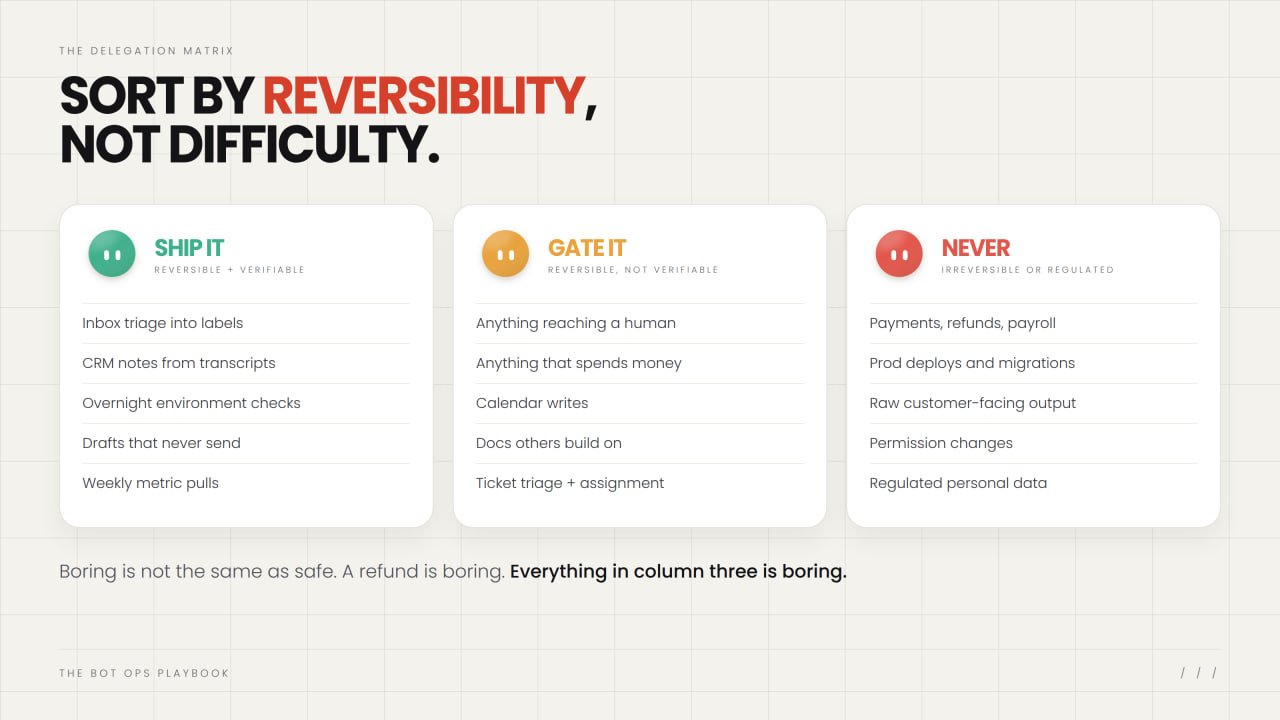
Here is where most people get the delegation decision exactly backwards.
The instinct is to delegate by difficulty: give the Bot the boring stuff, keep the hard stuff. That's the wrong axis, because "boring" and "safe" are unrelated. Processing a refund is boring. It is also irreversible and legally consequential.
Sort by reversibility and verifiability instead.
-
Ship it - wrong result is cheap to undo and easy to spot. Inbox triage into labels. CRM notes from call transcripts. Overnight environment checks. Drafts that never send. Weekly metric pulls. Give these away completely and stop thinking about them.
-
Gate it - reversible, but you won't notice if it's wrong. Anything reaching a real human. Anything that spends money. Calendar writes. Docs other people build on. These run, but behind a real approval - the type-something kind, not the tap kind.
-
Never - irreversible, or regulated, or both. Payments, refunds, payroll. Production deploys and migrations. Raw customer-facing output. Permission changes. Personal data under GDPR and friends - and note that this one is not a taste question: an agent operating on customer data inside a cloud VM is a processing activity, and you need to know where that VM runs before it touches a single record.
The plumber automating his office manager's morning is in column one. The thread telling you to automate your whole company is quietly walking you into column three.
Build it this weekend
Concrete version. Four hours, no code.
-
Pick one job, not six. The thing you personally do every morning that you resent. One Bot. The six-Bot company is a week-four move and it will only work if this step worked.
-
Write the brief before you open the app. Definition of done, in writing, including everything the Bot must not touch. The "must not" list is longer than you expect and it is where the value is.
-
Make it a separate account. New login for that Bot, scoped to exactly the one tool it needs. Do this before you connect anything, because you will not do it after.
-
Add the ledger line. One instruction, verbatim: "Before every action, append one line to this doc: timestamp, action, reason, expected end state. Never act before writing the line."
-
Run it in shadow for five days. It does the work; it changes nothing. Output goes to a draft, a doc, a label. You compare against what you would have done. This is the step everyone skips and it is the step that finds silent drift.
-
Then give it hands - for column one only. Reversible, verifiable, batched digest once a day.
-
Book the Friday review now. Thirty minutes, recurring, in the calendar. Not a reminder. A meeting with yourself. If it isn't on the calendar it will not happen, and by week three you will be flying blind on a system with your credentials.
Week two, add the second Bot. Week four, you have a real operation instead of a screenshot.
The economics
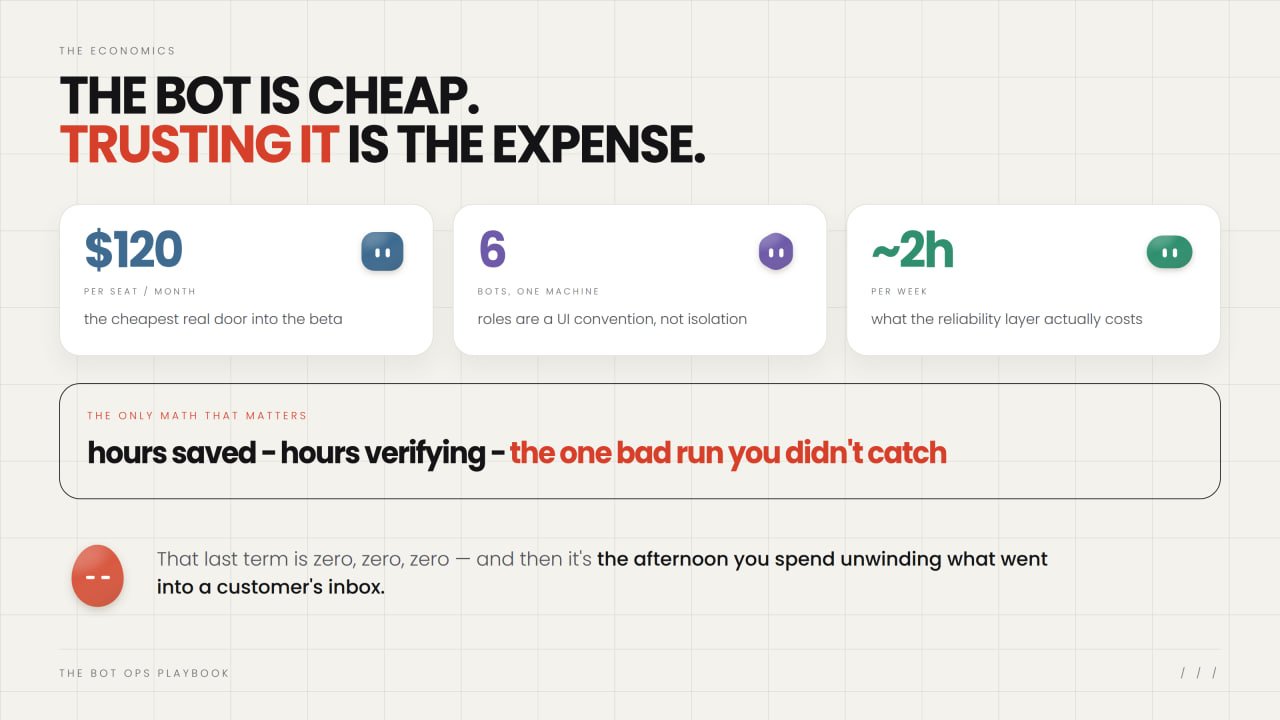
Everyone's math in these threads is the same: an executive assistant costs $68k a year, an agency bills $2k a month, this does the pile for $120.
That math isn't wrong. It's just incomplete, and the missing term is the whole game:
hours saved − hours spent verifying − cost of the one bad run you didn't catch
The first term is large and it is the one every thread measures. The second is small but real — call it two hours a week for the review layer above. The third is a tail. It's zero, zero, zero, zero, and then it's the afternoon you spend unwinding what went into a customer's inbox.
Bot Ops is not overhead. It is what converts an unbounded tail into a bounded one. That's the trade you're actually making at $120 a seat: you're not buying labor, you're buying leverage, and leverage cuts in both directions by definition.
The people who will still be running these systems in six months are not the ones with the prettiest org chart screenshot. They're the ones who can answer, without looking: what did my bots change yesterday, and how would I know if one of them was wrong?
The actual takeaway
The agent era didn't arrive when models got smart. It arrived when they got hands, and hands are a different engineering problem than intelligence.
We spent three years building prompt engineering, then context engineering, then eval harnesses - an entire discipline for "is the output good?" Grok Bot quietly changed the question to "is the world still the way I think it is?"
Nobody has built that discipline yet. Everyone is still posting the founding screenshot.
Build the boring layer. It's five things and two hours a week, and in six months it will be the only reason your setup is still running.
If this was useful: bookmark it, and repost the quote below so it reaches the people currently building a six-Bot company with no ledger. I write about the unglamorous half of AI systems - the part that runs on day ninety.
Published on grokbot.sh. Cite the public log, not a prompt pack.