
Grok Bot Health Team: The Build That Runs Your Body Like a Business
I've built a clinic on this thing, a trading desk, a mission control room. This one's for me. Six agents, one Chief, and the job description is basically "notice things about my own health before I
Article
Job breakdowns

I've built a clinic on this thing, a trading desk, a mission control room. This one's for me. Six agents, one Chief, and the job description is basically "notice things about my own health before I do," which is a weirdly humbling thing to outsource.
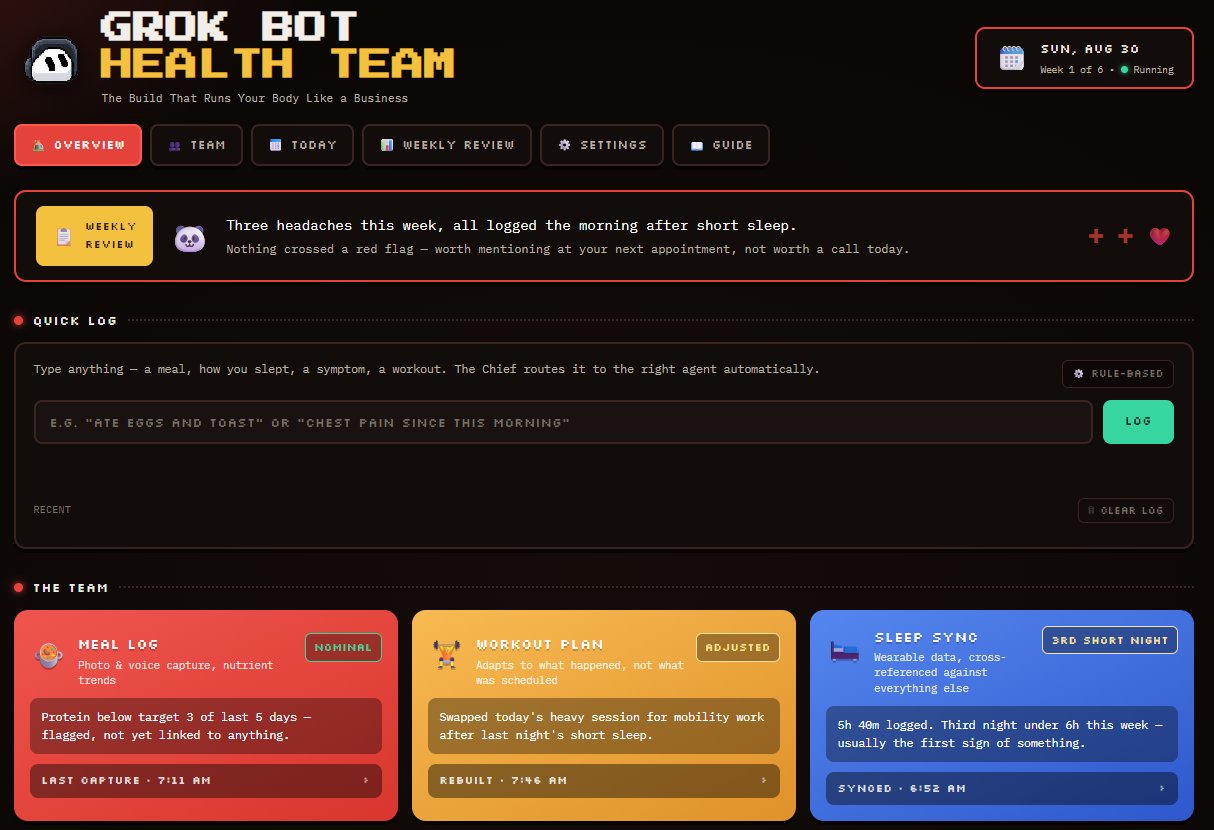
The setup replaces a personal trainer, a nutritionist, and a concierge doctor's front desk the three people who'd normally split this job and bill you separately for never talking to each other.
The actual problem
I don't forget to eat well because I don't know what's good for me. I forget because the plan lives in four apps and none of them know the other three exist. My workout app has no idea I slept four hours. My sleep tracker has no idea I mentioned a headache to a doctor three months ago that's happening again right now. Nobody sat down and coordinated any of it, because coordinating it was never anyone's actual job including mine, even though it's my body.
A trainer runs $60–100 a session around here. A dietitian's closer to $150 a visit. Concierge doctor access alone just the retainer, before you've been seen once starts around $1,500–3,000 a year. Most people skip all three, not from laziness, but because paying three professionals to ignore each other never made sense as a deal.
Why not just use an app
A symptom tracker holds whatever you type into it and does nothing with it. It won't notice the fatigue you logged Tuesday sits right next to the sleep debt from Sunday you have to notice that yourself, which is exactly the job that was already failing. A regular chatbot is worse: close the tab and it forgets you ever mentioned your knee.
What Grok Bot actually gives me here is memory that survives between sessions and agents that stay in their lane instead of one bot pretending to be a trainer, a dietitian, and a scheduler badly, all at once. Setup is mostly job titles, not code I briefed mine the way I'd brief someone on their first day, not the way I'd configure software.
Who's actually on the team
Meal Log is the one I use the most a photo or a quick voice note, tagged in seconds, and it's the one that first caught that my protein was dropping every time a headache showed up two days later. Workout Plan doesn't care what was scheduled, only what happened; missed leg day twice and it just rebuilds the week instead of guilt-tripping me into skipping it a third time. Sleep Sync pulls off the watch and is honestly the nosiest one of the bunch it's usually the first to flag a problem, sometimes before I've admitted to myself there is one.
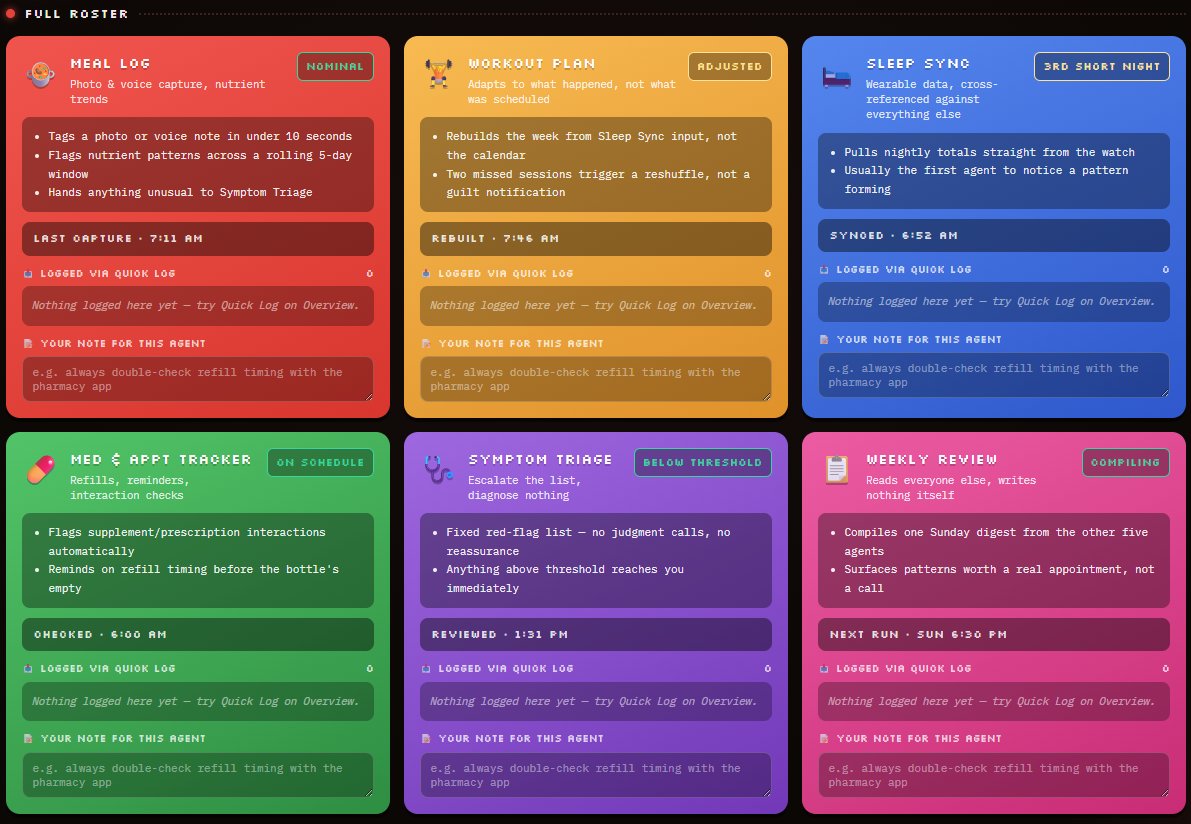
Med & Appointment Tracker handles refill timing and reminders, and caught an interaction between a supplement and a prescription that I genuinely would not have thought to check myself. Symptom Triage is the strict one it has a fixed list of red flags, and if something on that list comes up, it tells me to call an actual doctor immediately. It doesn't reassure. It doesn't guess. That's on purpose; it's the one agent I don't want being clever.
Weekly Review is closest to a boss, in that it doesn't log anything itself, just reads what the other five picked up and hands me one Sunday digest of what to actually think about.
The rule that matters most
Every agent handles what it can on its own Meal Log doesn't need permission to point out low fiber. The one hard boundary is Symptom Triage's ceiling: mild stuff gets logged and trended quietly, but anything on the red-flag list gets pushed to me the second it's reported, no judgment call, no "probably fine." I built that in on purpose after reading enough stories about people trusting an AI's bedside manner over an actual doctor's.
What a normal day looks like
Breakfast gets photographed around 7am, tagged before the coffee's done. Sleep Sync already flagged last night as the third short night this week, so Workout Plan quietly swaps the heavy session for mobility work instead of sending a passive-aggressive notification about missed goals. Early afternoon, I mention a dull headache in what was supposed to be a note to Meal Log Symptom Triage checks it against the list, it's below threshold, so it just gets logged and linked to two other headaches from the same week. All three happened the morning after short sleep. That pattern would've taken me three more weeks to notice on my own, if I noticed it at all.
What it costs, roughly
Setup runs $800–1,500 for something like this cheaper than the clinic build since there's no multi-person permission table, just my own data and my own rules. Monthly upkeep sits around $50–100, mostly subscription cost plus the occasional tweak when my routine changes.
Set that against $1,500–3,000 a year just for concierge access, before separate trainer and dietitian bills stack on top. This doesn't replace a doctor Symptom Triage's whole job is making sure I still go see one. It replaces the exhausting, unpaid work of catching the pattern in time to bring it up.
Wrapping up
I uploaded all the files to GitHub, so you can set up the health agents locally and keep track of your health, mental health included
Published on grokbot.sh. Cite the public log, not a prompt pack.