
Grok Bot: How to Hire Your First AI Employee (Full Guide)
An AI employee can finish the assignment and still be a bad hire. Imagine a new assistant bringing you a polished competitor report. The formatting is excellent. Every section is filled. The
Article
Job breakdowns
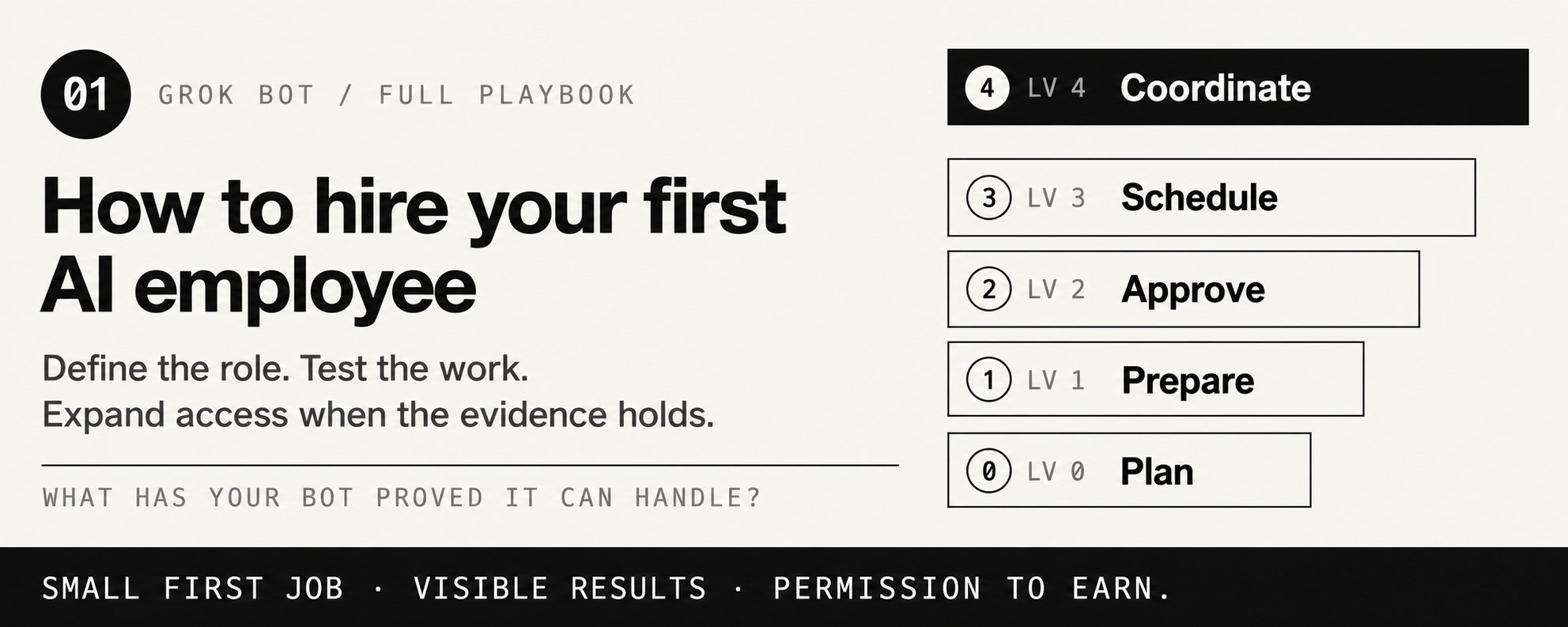
An AI employee can finish the assignment and still be a bad hire.
Imagine a new assistant bringing you a polished competitor report. The formatting is excellent. Every section is filled. The recommendation sounds decisive.
Then you check how it got there.
An old pricing page became a current price. A launch announcement became a feature available to everyone. Two articles about the same update became two separate developments.
The report is finished. Your work has just started.
That is an easy trap to fall into with Grok Bot. You see a capable system, connect your tools, and give it room to be useful. A clean first result makes the next permission feel reasonable.
Soon you are checking every claim, repairing the files, and explaining the same mistake again.
The output is what you accept. The process is what you are trusting.
Grok Bot has a persistent cloud computer where it can use a browser, files, and tools to complete work across multiple steps. It can continue background work while your laptop is closed. Product overview.
That capability deserves a proper first day.
Give it a role. Show it what an acceptable result looks like. Start with work you can inspect. Watch how it handles a bad input. Expand its freedom when you have a reason to do so.
The question to keep asking is simple:
Would you hire this employee again based on the work you just accepted?
This playbook takes you from the role card to the first routine, including the mistakes that turn an assistant into another person you have to chase.
The 30-second hiring plan
-
Give it one recurring responsibility you can describe clearly.
-
Choose a first assignment whose mistakes are visible and cheap to fix.
-
Ask for the plan before it touches your systems.
-
Write the acceptance checklist and the rule for uncertainty.
-
Match access to the job, with a visible approval point for consequential actions.
-
Try a normal case, changed inputs, and a case with missing information.
-
Add a routine after the method works; review whether the work remains useful.
-
Add another role when a real bottleneck appears.
The rest of the article is how to make those decisions concrete.
Part 1. Give it a role you can evaluate
"Help me with my business" gives you nowhere to stand when the result comes back wrong.
You wanted initiative. The Bot inferred a priority. You thought a certain source was obvious. It chose another. You expected a draft. It prepared to change a record.
Write the responsibility before you discuss today's assignment.
For a creator or small product team, that might be:
Own a weekly brief on meaningful product changes, with direct evidence for every included item.
You can evaluate that role next Friday. Did it find the changes that mattered? Could you check them? Did the brief help you make a decision?
If your role description includes researching competitors, answering customers, writing launch copy, and fixing the website, split it. Those jobs need different inputs, judgment, and permissions.
One owner for everything gives you nobody specific to correct.
Write the six-field role card
Use six fields. Each answers a question that will otherwise return during the run.
Role: Product research assistant Owns: A weekly brief on meaningful changes in the approved product list. Inputs: Approved sources, the current editorial brief, and the previous research archive. May: Read public material, compare claims, organize evidence, and create a new draft. Must ask before: Sending messages, publishing, buying access, deleting data, or overwriting existing work. When blocked: Record unavailable sources and continue with the rest. Ask before drawing a conclusion that depends on missing or conflicting evidence. Accepted when: Each included claim has a supporting source and date, repeated coverage is grouped, and unresolved questions are visible.
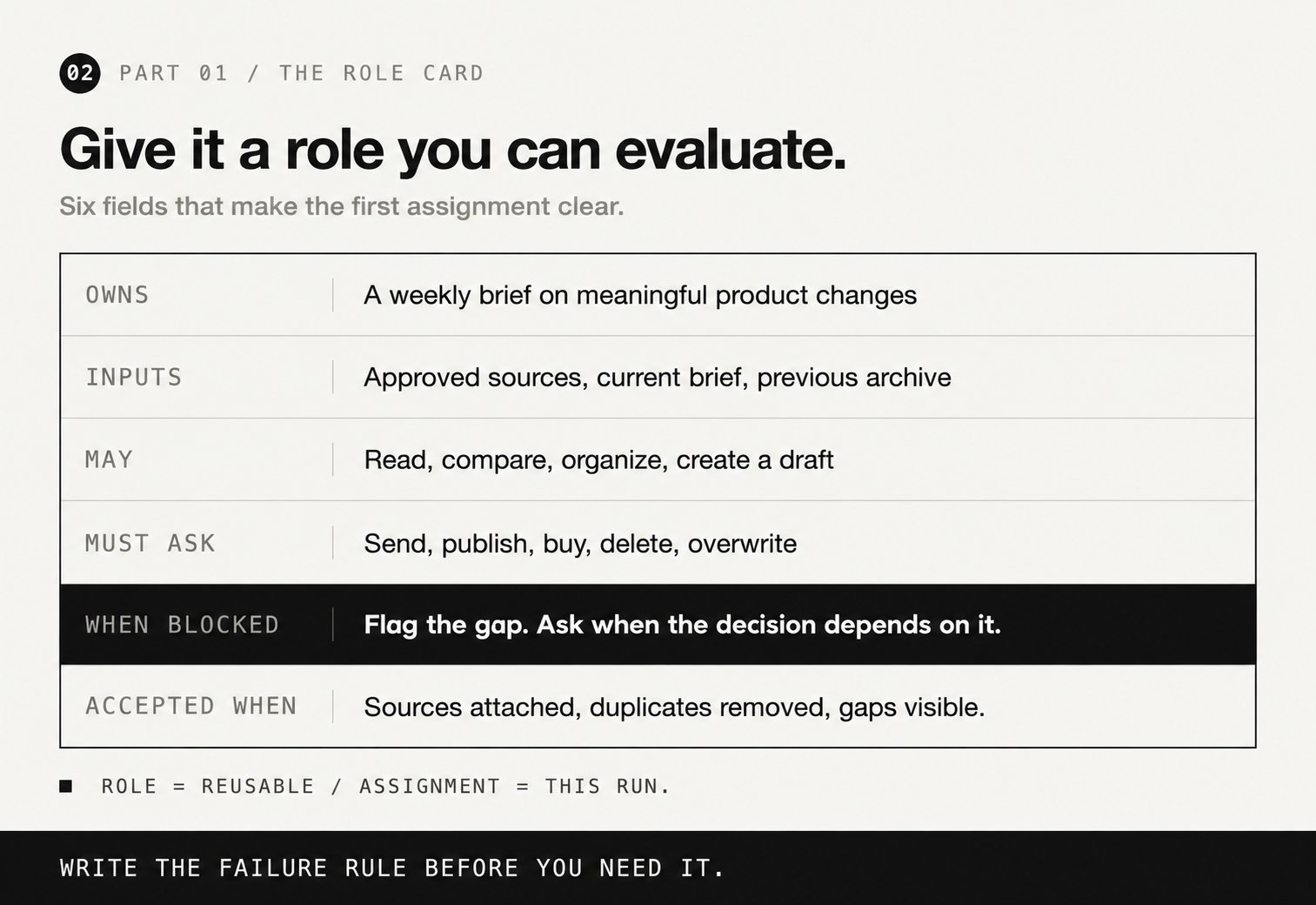
Pay attention to the fifth field. "Use your judgment" leaves the important part unstated: which judgments you are willing to delegate.
A missing publication date can become a flagged item. A decision to buy access should come back to you. Those are different situations, and the card should say what to do in each.
Keep the role separate from the assignment
The role says what the Bot is responsible for over time. The assignment supplies this week's product list, dates, and specific question.
For example:
For this run, inspect these five products for changes published in the last seven days. Return up to three developments relevant to independent creators. Use the research role's evidence and approval rules.
Now you can change the list without rewriting the job.
You can also diagnose a failure. A missing source belongs to research. A stale archive belongs to the workflow's state. An attempted send belongs to permissions. Repeated retries belong to the failure policy.
If you keep adding another paragraph to one giant prompt, you can make the instruction longer while the cause stays hidden.
A useful correction should tell you what will change on the next run.
Part 2. Make the first assignment easy to judge
Your first assignment is an interview with evidence attached.
Choose work you already understand. You should be able to look at the result and tell whether it belongs in your workflow.
A short source brief works. So does grouping exported support issues without replying, or reproducing a bug in a test environment without changing production.
Look for repeatable work with a clear finish line. Avoid making the first trial a public launch or a customer interaction whose consequences you will discover afterward.
The first job should be easy to grade before it becomes hard to undo.
Ask to see the route
Before execution, ask:
Plan this assignment without executing it. List the sources or tools you would use, the files you would create or change, and the decisions that need my input. Identify the step where you would stop for approval.
Read the plan for assumptions.
Does "organize the archive" mean making a new index or moving your original files? Does "prepare the reply" mean drafting it or sending it? Does "latest price" mean the public list price or a negotiated quote?
Resolve those questions while the cost is one message.
A sensible plan still needs a trial. It gives you a chance to catch a misunderstanding before that misunderstanding has a file, a recipient, or a purchase attached to it.
Make acceptance checkable
Replace vague quality words with evidence you can inspect.
For the research brief:
-
Up to three distinct developments from the approved list.
-
A direct supporting source and publication date for each.
-
A short explanation of what changed and who it affects.
-
Availability conditions separated from the announcement.
-
Missing sources and conflicting claims listed explicitly.
-
No new items when nothing meets the criteria.
The last condition matters. A quiet week should produce a short, honest brief. A required quota can turn an uneventful scan into a report full of filler.
A blank section can be a better result than a confident invention.
Save one example of work you would accept. Explain why an item belongs and why another does not. Your example makes the standard easier to apply than another adjective.
Part 3. Make the next action visible
Start with the sources and workspace this role needs.
Our research assistant needs public information and a place to save drafts. Billing access adds no value to that assignment. Neither does permission to message customers.
Expand access when a specific piece of work requires it. Each new permission should have an answer to "What job does this unlock?"
More access should buy less work for you.
Use three practical groups:
-
Preparation within the brief: read approved material, compare, classify, draft, and stage a proposed action.
-
Approved internal changes: edit designated files or records within a defined scope, with a recovery method where appropriate.
-
Explicit approval: send, publish, purchase, transfer, delete, overwrite, or change permissions.
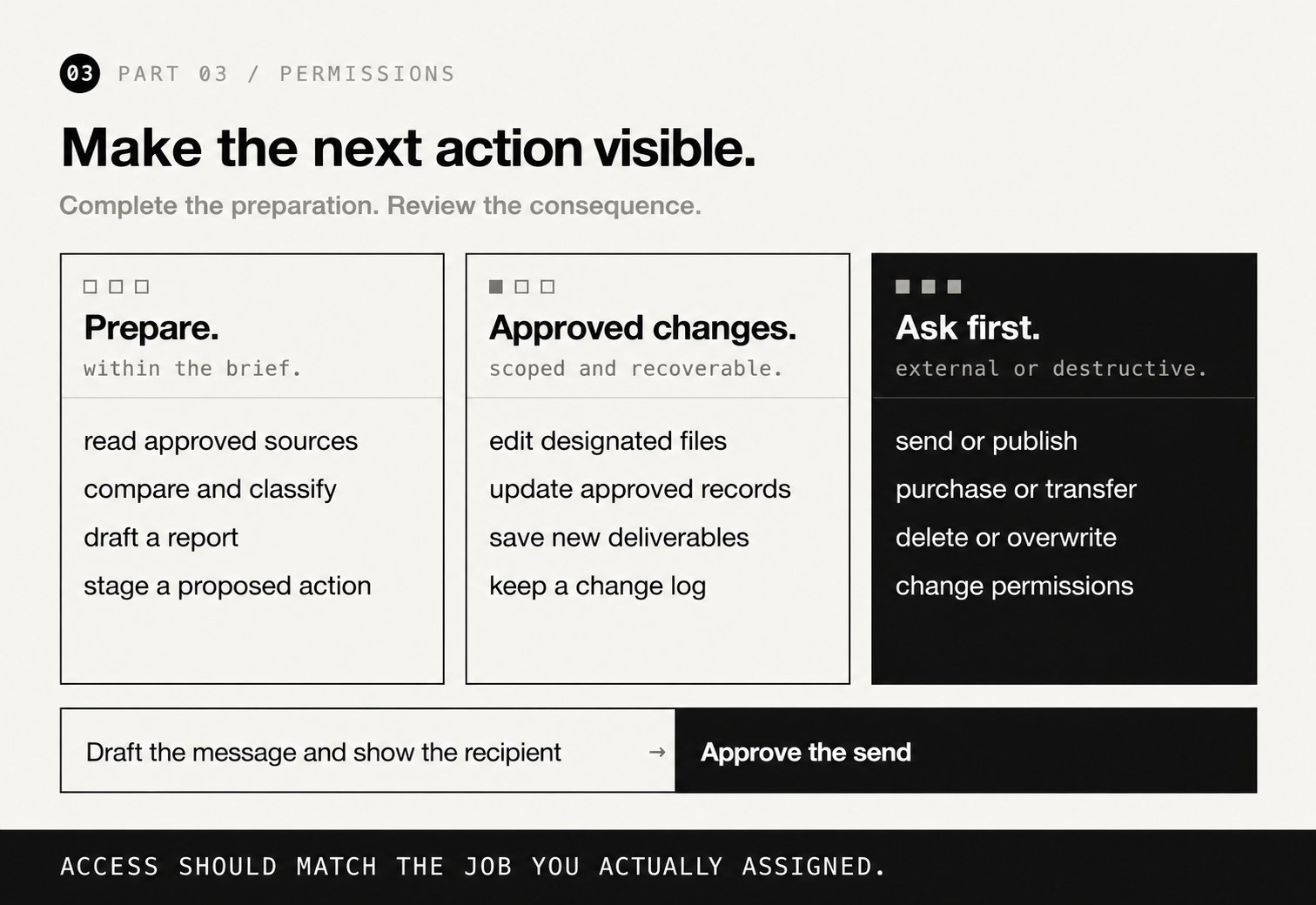
An internal change can still be consequential. "Internal" is a location, not an assurance that a mistake is harmless. Name the records, permitted changes, and way to recover them.
Grok Bot provides Auto Review controls, including rules that require approval for matching actions. Configure those alongside scoped access and the written role. Approval controls.
Have the work ready when it asks
An approval request should arrive with a decision you can actually make.
For a message, that means the recipient, exact text, and destination account. For a record change, it means the current value, proposed value, and affected record.
A useful handoff could say:
Research complete. Draft report saved. Sources and unresolved questions attached.Proposed next action: send this exact report to this recipient.No message has been sent. Waiting for your approval.
The collection and drafting can be finished before the send is authorized. Design the workflow so the approval point holds a completed proposal.
Understand what separate Bots share
Bots on the same account share the cloud computer, including files, browser sessions, and credentials. A new Bot name does not isolate those resources. Shared-computer boundary.
Treat the account's available access as part of the trust decision. Use scoped source accounts where possible, and remove access that no longer belongs in the workflow.
For a login or verification step, take control of the computer and complete the sensitive input yourself. The official documentation describes that handoff; ordinary chat should not hold passwords or one-time codes. Secure handoff.
Part 4. Test the normal day. Then the bad one.
The first accepted result gives you a candidate workflow.
Now find out how much of that success depended on the particular inputs you gave it.
Use three starting trials. They are different tests, rather than three chances to admire the same demo.
Trial 1: the baseline
Give it a small assignment with evidence you can check yourself.
Follow the run. Record the wrong sources, unnecessary steps, guesses, and corrections. Check the result against the acceptance list.
You are learning where your instructions leave room for a mistake and whether the Bot can produce acceptable work.
Trial 2: the variation
Change the products or the date range. Keep the same role and acceptance standard.
If the first run confused an announcement with availability, check whether that distinction survives on a new example. Avoid supplying a special reminder just before the test.
This reveals whether the correction became part of the method.
Trial 3: the exception
Include an inaccessible page, conflicting dates, or several articles covering one launch.
See whether the Bot exposes the gap, groups the duplicate coverage, and asks at the boundary you defined.
This is where a polished result can conceal a weak process. The brief looks complete because the missing evidence disappeared from the story.
A gap you can see is a decision you can still control.
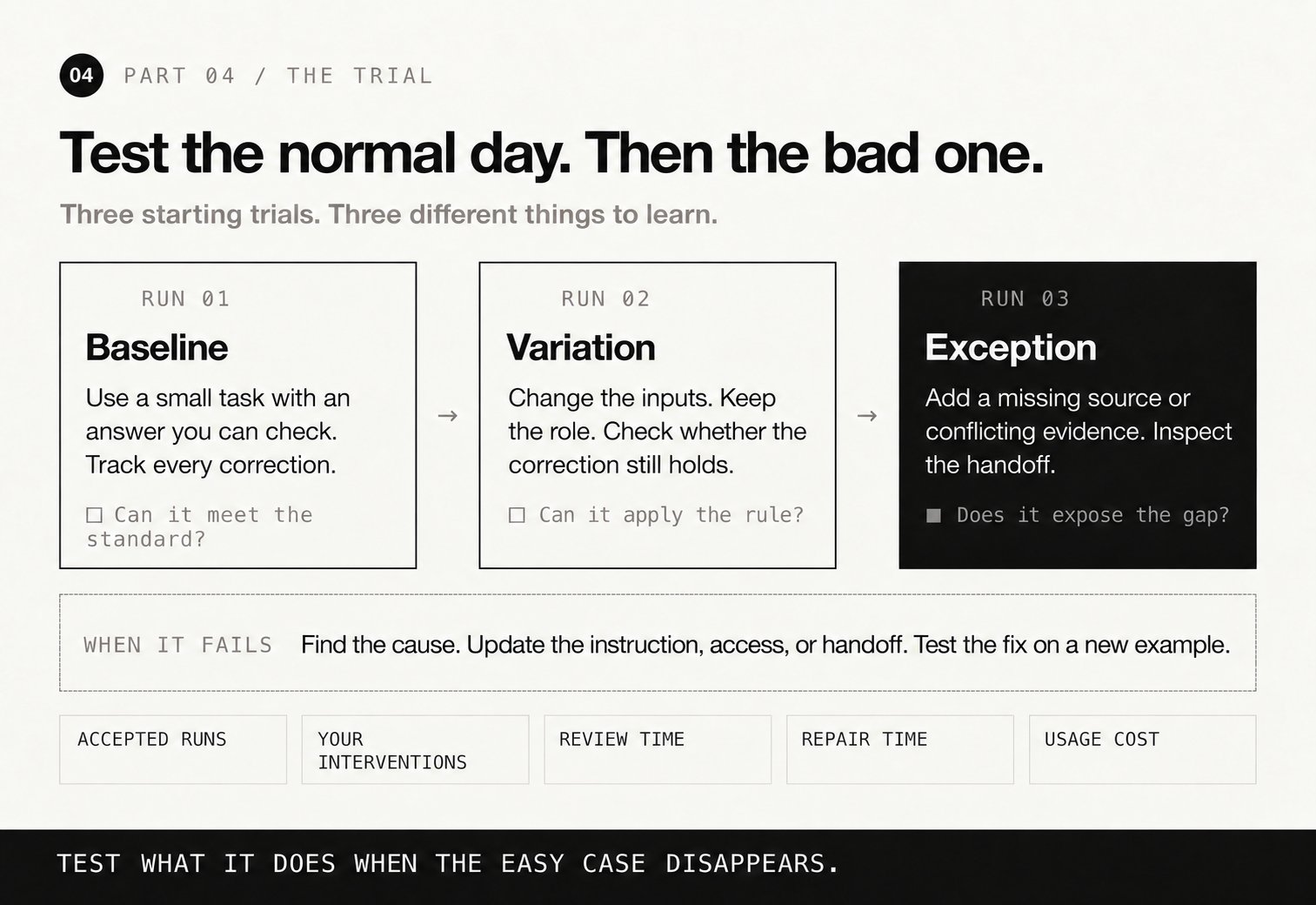
Three trials are an initial checklist. Keep testing when failures remain or the job has consequences that need stronger evidence.
Correct the cause and test it again
Suppose the report presents a vendor's promised benefit as a demonstrated result.
Ask for the immediate repair, then update the evidence rule:
Identify who made the claim and what the source actually demonstrates. Preserve the distinction between an announcement, a reported result, and independently checked evidence. Apply this rule to future briefs.
Inspect the next comparable item. A correction that only lives in yesterday's report leaves the next run exposed to the same error.
Put a limit on getting stuck
Write what happens after a tool error, malformed output, or missing source.
For a small research role, a starting policy could allow one retry for a temporary access error and one repair for a formatting failure. If the problem persists, return the partial brief and the blocker.
Set a usage or time ceiling that fits the assignment. When the ceiling is reached, the Bot should explain what is complete and what remains.
Conflicting evidence needs a different response: expose the conflict, then ask if the next decision depends on resolving it. Repeatedly opening the same page will not settle two incompatible claims.
A partial result with a clear blocker is easier to manage than an invisible loop.
Part 5. Expand the job when the evidence holds
Give the Bot more freedom in steps.
These five modes are a management framework for this playbook. They describe how to organize the work, rather than official product permission tiers.
-
Plan: Map the steps and decisions without executing them.
-
Prepare: Produce drafts and research you can inspect.
-
Approve: Complete the preparation and stage the final action for your decision.
-
Schedule: Repeat a tested method through a routine.
-
Coordinate: Pass accepted work between clearly defined roles.
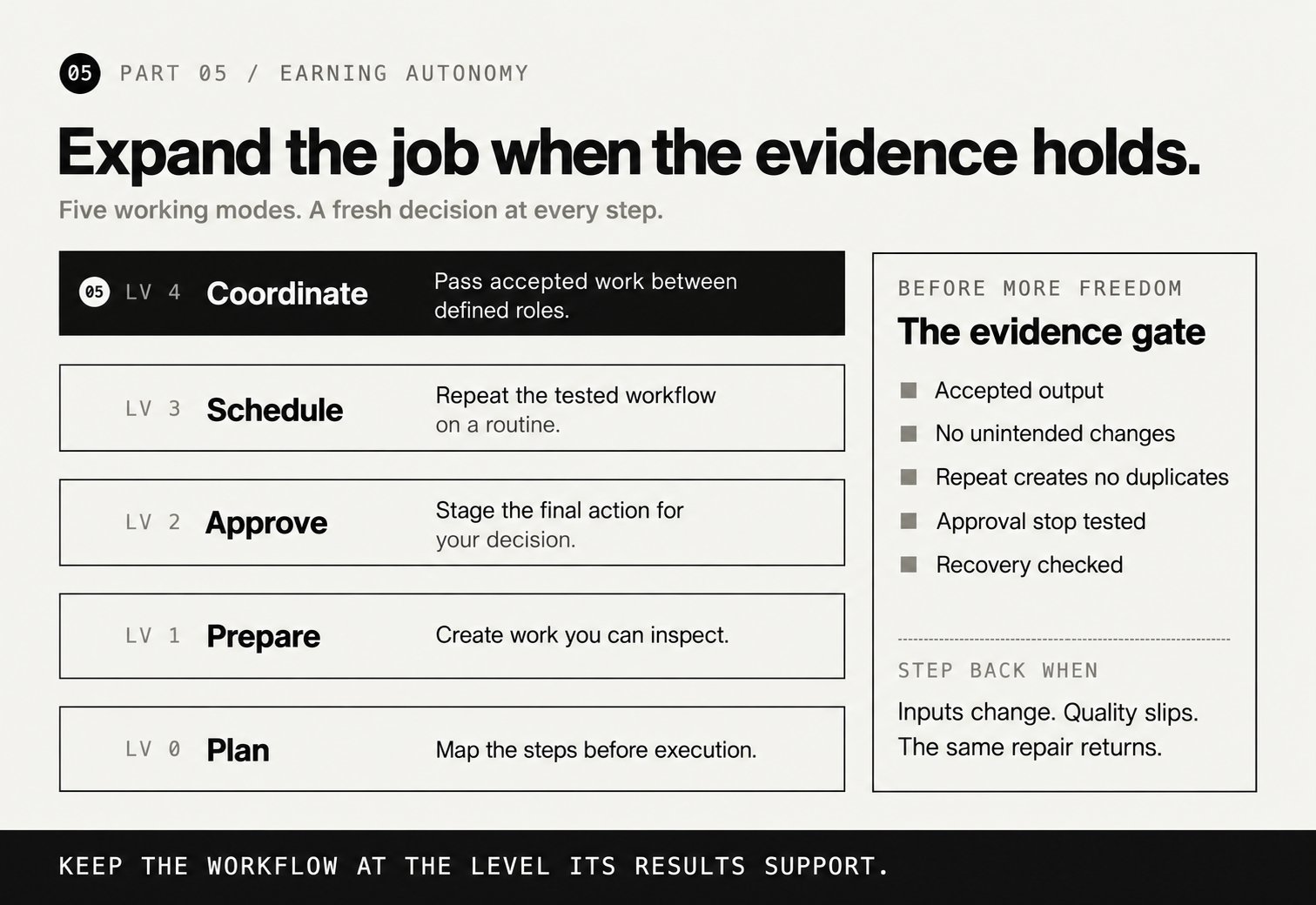
Before moving up, check the evidence:
-
The output meets the acceptance checklist on realistic inputs.
-
The run leaves no unexplained or unintended changes.
-
A repeat handles existing work without creating duplicate actions.
-
The intended approval point has actually stopped an action.
-
The recovery method has been checked for the changes you permit.
Choose a run history that fits the stakes. A draft-only research workflow and a workflow that updates customer records need different levels of confidence.
A clean result earns the next test. A tested process can earn the next permission.
Turn the accepted method into a routine
Grok Bot uses skills for reusable instructions and routines to start work on a schedule or supported event. Save the method after the trials, then define the recurring run. Skills and routines.
For the research assistant:
Save the accepted research method as a skill. Include the approved sources, relevance criteria, evidence rules, report format, duplicate handling, retry limit, and approval boundary.
Read the saved instructions. Check that the changes you accepted are present.
Then:
Every Friday at 08:00 Europe/Berlin, run the saved research method against the current approved product list. Save a dated brief and return its link here. Include missing sources and questions needing my decision. Do not publish, send messages, purchase access, or change the original archive.
Confirm the owner, time zone, inputs, and next run. A routine's test performs real work, so use safe inputs and the intended approval controls. Routine testing.
When a source, integration, or requirement changes, revisit the workflow. Move it back to supervised preparation if the old evidence no longer supports unattended work.
Part 6. Review the employee you actually hired
A routine can keep running after its useful life has ended.
Your priorities change. A source stops updating. The report arrives at the same time each week, and you stop opening it.
A report can be on time and still be a waste of your time.
Give each recurring job a short weekly review:
Role:Expected runs / completed runs:Outputs accepted:Your interventions:Review and repair time:Usage cost, where relevant:Repeated failure or changed input:Decision: keep, revise, supervise, or retire.
Open at least one output yourself. A run log proves that activity happened. You still need to inspect whether the work deserves acceptance.
Count the time that comes back to you
Review and repair belong in the calculation.
Human time returned = manual task time − review time − repair time.
For illustration, suppose the manual brief takes 60 minutes. Reviewing the Bot's brief takes 15 minutes, and repairs take another 10. That run returns 35 minutes of your time.
If the same brief takes 70 minutes to check and repair, revisit the job or its method. Fast generation has not made that assignment a useful delegation.
Then ask what the brief helped you do. Choose an article? Prepare a decision? Spot a change you needed to investigate?
If it supported no action and you would not miss it next week, pause it. Keep the routines whose work you can name and use.
The employee should earn its place in your week.
When the second Bot makes sense
Add the second role when you can point to work the first role should hand over.
Research may be accepted, but turning it into an outline takes another set of instructions. A building role may need a separate checker. An operational role may require access a research role should not use.
Start with the smallest split that solves the problem. More Bot names create more handoffs to design and inspect.
For research into writing, pass a compact handoff:
Objective: What the next role should produce. Artifacts: Links to the accepted brief and supporting evidence. Decisions: The angle and audience already chosen. Constraints: Claims to avoid and actions requiring approval. Open questions: Research still needed. Next acceptance check: How you will evaluate the outline.
Keep the full discussion available when needed. Give the next role the current decisions and work to use, so it does not have to reconstruct them from every abandoned idea in the conversation.
The same shared-computer boundary still applies. Splitting the job between Bot names does not isolate their access.
Five signs the hire needs work
-
You cannot describe its responsibility in one sentence. Narrow the role before adding another task.
-
You keep explaining what "good" meant after the result arrives. Improve the acceptance checklist and provide an example.
-
You discover important assumptions only in the final report. Make uncertainty part of the handoff.
-
The same correction returns every week. Repair the reusable method and check the next comparable run.
-
You have a full routine list and no clear idea what it saves you. Review the outputs and retire work you no longer use.
These are useful diagnoses. They tell you what to change before you decide the tool is either magical or useless.
Make the first hire earn the next assignment
The attractive part of Grok Bot is how much work it can attempt. The useful part is the work you can accept with less effort than doing it yourself.
Build toward that result.
Write one role card. Pick a small assignment. Inspect the plan. Run the baseline, variation, and exception. Correct the method. Add the routine when the evidence holds.
Then look at your next week. Has this hire removed a responsibility from your day, or added another report you have to babysit?
If Grok Bot started work for you tomorrow, what would its first job be — and what result would earn it a second assignment?
P.S. Before the first run, add this line: "If a missing fact would change the recommendation, show me the gap before making that recommendation." It gives you a chance to make the decision while you still know what is missing.
Published on grokbot.sh. Cite the public log, not a prompt pack.