
Grok Bot lit the fuse. I turned Kimi K3 into a four-person AI crew over one weekend — here's the exa
Everyone who watched the Grok Bot demo asked the same question: "how much would it cost to build that ourselves?" That's the wrong question. The infrastructure is already public. xAI spent hundreds of
Article
Job breakdowns
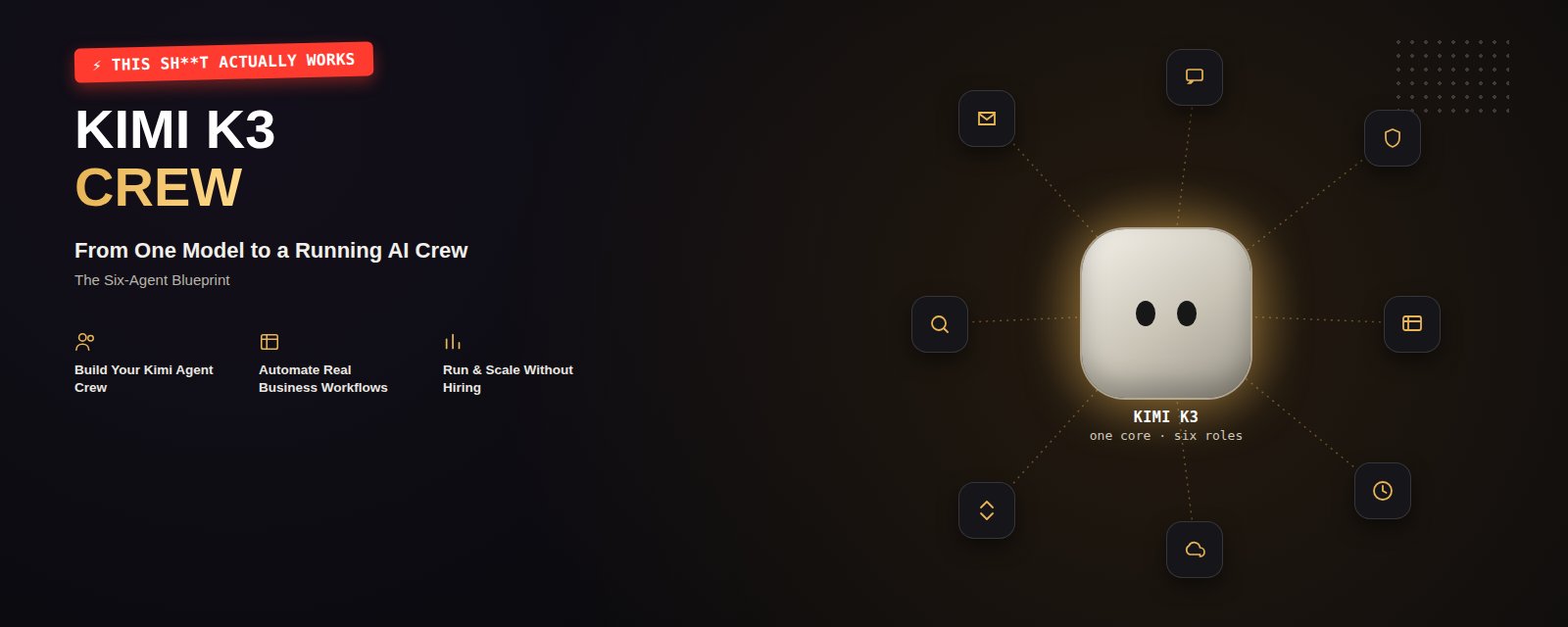
Everyone who watched the Grok Bot demo asked the same question: "how much would it cost to build that ourselves?" That's the wrong question. The infrastructure is already public. xAI spent hundreds of millions proving a category exists. They didn't patent the category. Moonshot already shipped almost the entire open stack you'd need to build your own version of it — smaller budget, same shape, running by Saturday night.
I'm going to walk through exactly what I built, why each piece matters, what it costs, and what it's actually worth to a business that isn't you.
THE SHIFT NOBODY NAMED OUT LOUD
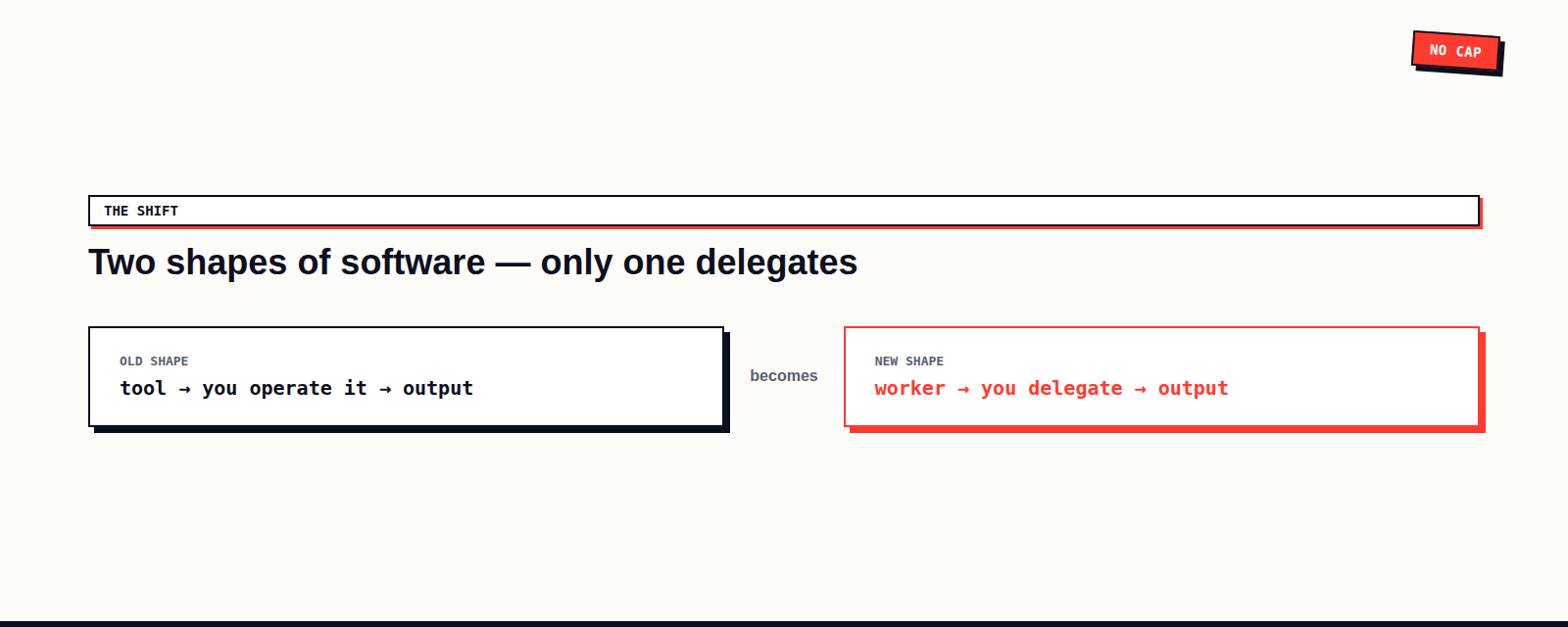
For thirty years, software has had one job: you open it, you operate it, it gives you an output. Every tool from Excel to Photoshop to a CRM follows that shape. You are the engine. The software is a very fast, very obedient set of hands.
Grok Bot broke that shape on stage. It didn't wait for a click. It opened a browser, decided what to read, decided what mattered, took an action, and only surfaced when it hit a decision that genuinely needed a human. That's not a smarter autocomplete. That's a second shape of software entirely:
Old shape: tool → you operate it → output New shape: worker → you delegate to it → output, with occasional check-ins
The gap between those two shapes is not model intelligence. GPT-4-class models have been smart enough to plan a task like this for two years. The gap was infrastructure — memory that persists across a session, tools the model can actually call, a permission system that knows which actions are safe to run alone and which need a human, and a way to coordinate more than one of these workers on the same job at once. That infrastructure is what xAI spent the money building. And it's also, almost line for line, what Moonshot has already open-sourced around Kimi K3.
SIX PARTS, ONE HIRE
Kimi K3 by itself is a brain in a jar. Extremely well-read, genuinely sharp at reasoning through a messy problem, completely unable to do anything about it. Ask it to check on a lead and it will write you a very competent paragraph about what someone should probably go check. That's the ceiling of a model with no scaffolding around it.
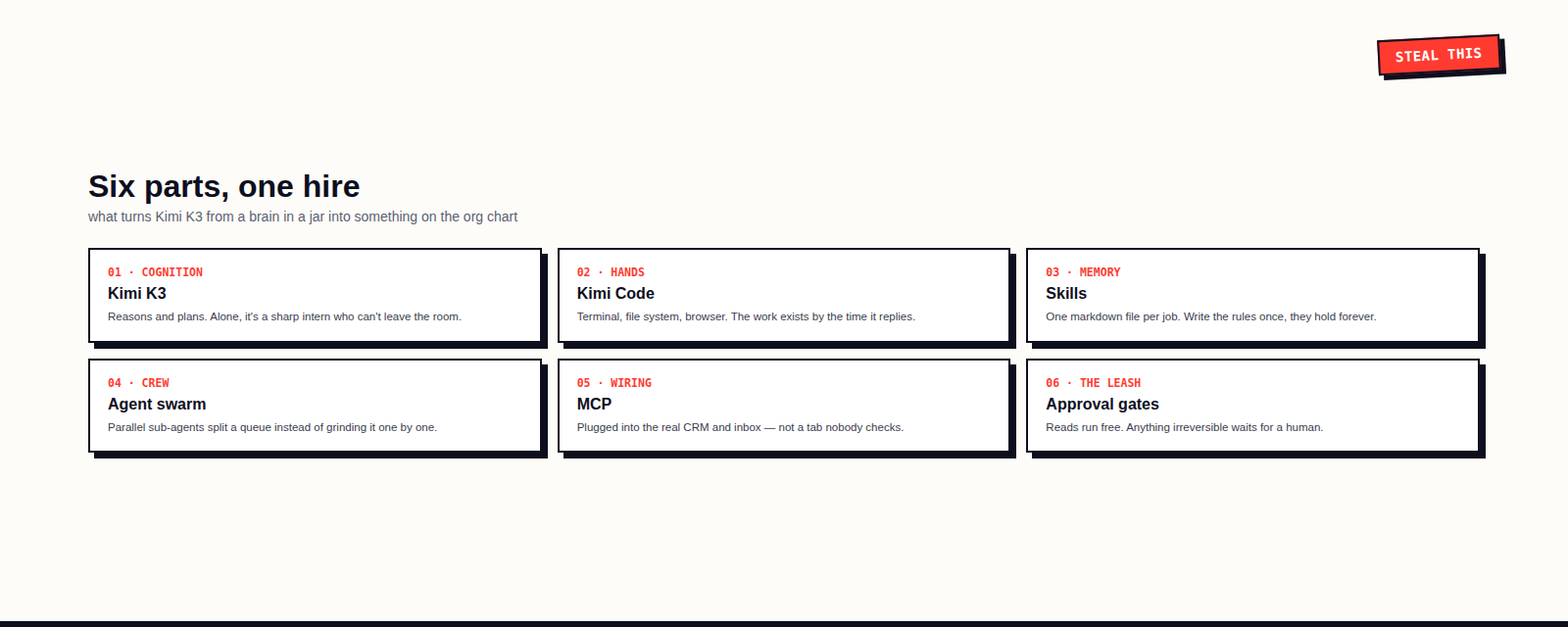
Bolt six things onto that brain and it stops being a chatbot and starts being something you can put on a org chart.
-
COGNITION — Kimi K3 itself This is the part every AI announcement leads with, and it's the least differentiated part of the stack. The model reasons, plans, and writes. On its own that's it. No hands, no memory beyond the current chat, no ability to act on anything it decides. Most people stop here and conclude "AI still isn't ready for real work." They stopped one layer too early.
-
HANDS — Kimi Code This is the layer that actually separates a demo from an employee. Kimi Code gives the model a real execution environment: a terminal, a file system, a browser it can drive, the ability to run shell commands and read the result, search the web and follow what it finds. Ask an unscaffolded model to vet a new sales lead and it hands you a to-do list. Ask the same model running inside Kimi Code and it opens the company's site, reads their LinkedIn, pulls their last 90 days of press mentions, checks their open job postings for a growth signal, cross-references whether they're already a customer of a competitor, and writes a structured briefing back into wherever you told it to write. You didn't get a checklist. You got a finished packet.
The tell for whether a system has this layer: does the model describe what should happen, or does the work already exist by the time it replies to you? Everything downstream depends on getting past that line.
- MUSCLE MEMORY — Skills A Skill is nothing exotic. It's a markdown file. It encodes exactly how one specific job should be done: the steps in order, the constraints, the things it should never do without asking. The model reads it automatically the moment a task matches, and follows it the same way every single time, without you re-explaining the job on run 47 the way you did on run 1.
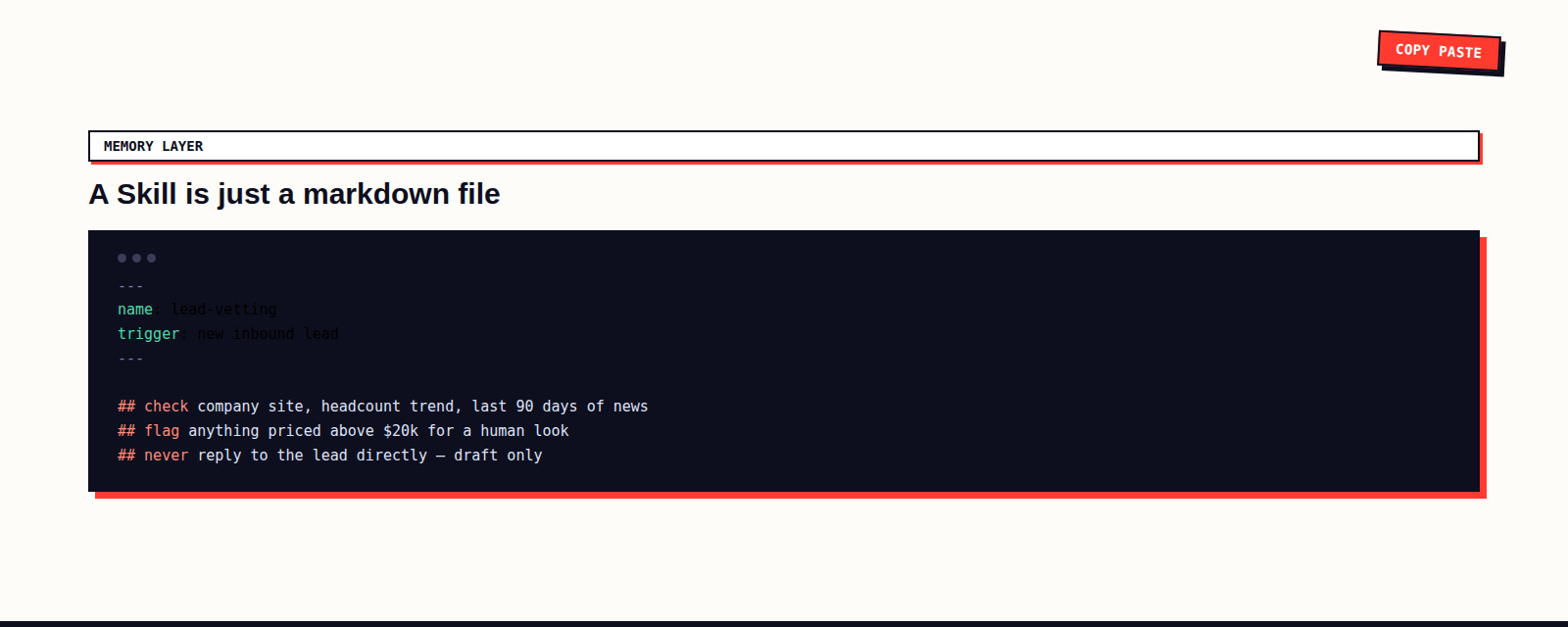
Here's a real one, close to what I'm running for lead qualification (shown in the image above as a code card — skip the plain-text version below if you're using the image):
name: lead-vetting trigger: new inbound lead
check
company website, headcount trend over the last two years, press mentions in the last 90 days
flag
anything that looks priced above $20k/year for a human to review before any outreach goes out
never
reply to the lead directly. draft only. a person sends it.
Every mistake this system makes, once, becomes a line in a Skill file, and it never makes that exact mistake again. That compounding is the actual product. You are not retraining a model every time you hire a new AI worker — you're writing down, once, how the job is supposed to be done.
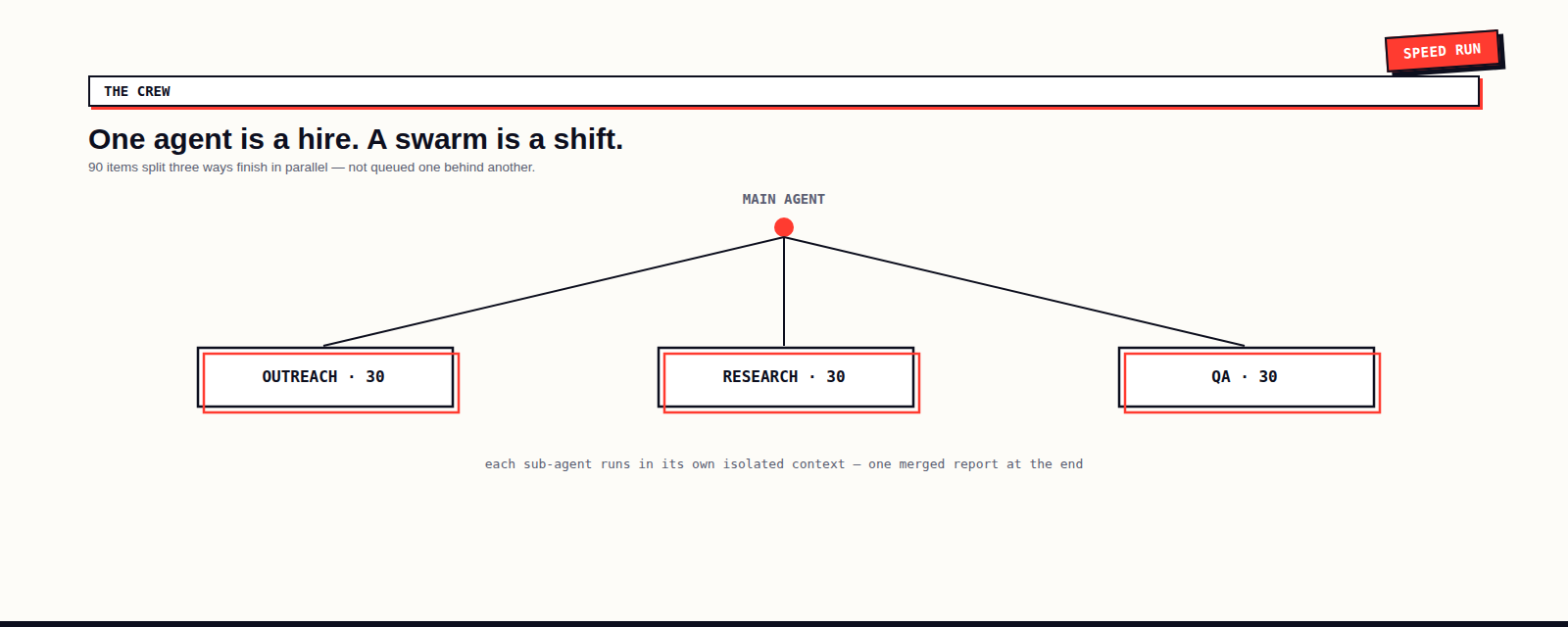
- THE CREW — Agents and swarm mode One agent running one Skill is already useful. It's a hire. The moment you need to process a hundred things instead of one, running them one after another stops being viable — a hundred-item research queue takes an entire afternoon sequentially. Split it across parallel sub-agents instead and the same hundred items finish in the time it takes your coffee to cool. Each sub-agent runs in its own isolated context, so none of them pollute each other's reasoning, and a coordinating "main agent" stitches the results back into one report at the end.
The part people get wrong here: more agents is not automatically better. Ten agents badly coordinated on the same ambiguous task will produce ten slightly different half-answers. The unlock is decomposing by role — one agent owns outreach, one owns research, one owns quality-checking the other two — not decomposing by throwing more copies of the same undifferentiated worker at the pile.
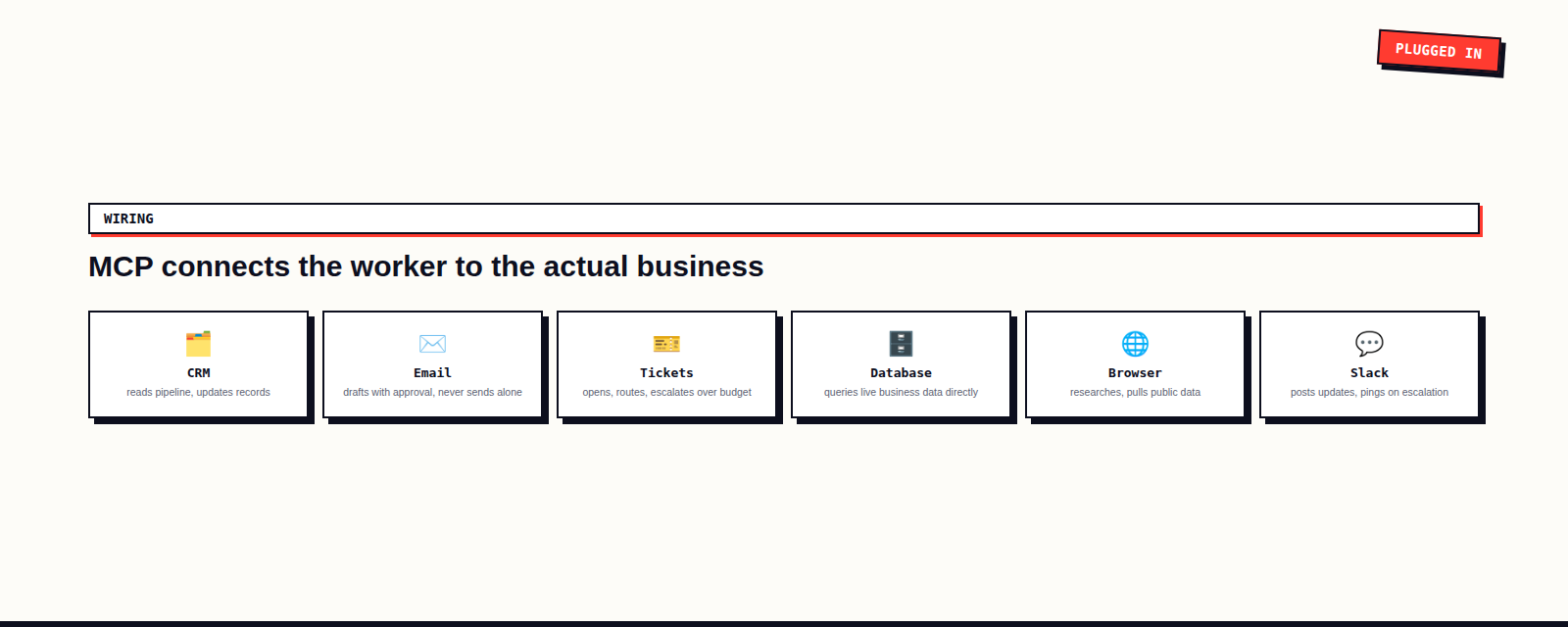
- WIRING — MCP This is the layer that turns a clever local script into something that's actually part of a business, instead of a tool sitting in a browser tab nobody remembers to check. MCP connects the model directly to the CRM, the shared inbox, the ticketing system, the database — the same systems the humans on the team already use, with the same records getting updated. Every tool connection you wire up is a capability you're able to sell. Every connection you deliberately don't wire up is a trust boundary you're building, and for a first version, the second one matters more than people expect.
- THE LEASH — Approval gates This is the layer that makes the whole thing safe to hand to a client instead of merely safe to run on your own laptop. Reads run automatically — research, analysis, drafting, nothing here needs a human in the loop. Writes run conditionally — update a CRM field if the confidence score clears a threshold, open a ticket if the priority is unambiguous. Anything irreversible stops and waits: sending a contract, deleting a record, spending money past a cap, contacting a client directly without a human reading it first.
That single design decision is the difference between "an AI demo that makes people nervous" and "a system a skeptical operations manager will actually sign off on in production." Selling autonomy without a leash is a much harder pitch than selling autonomy with one.
WHAT THIS IS ACTUALLY WORTH TO SOMEONE ELSE
The business here isn't reselling access to a language model — anyone can do that, and the margin on it is thin and getting thinner every quarter. The business is packaging that six-part stack around one expensive, repetitive, well-defined job better than a generic AI tool ever will, for an industry that has never had software built specifically for them.
A few verticals worth looking at, based on what I've actually scoped out:
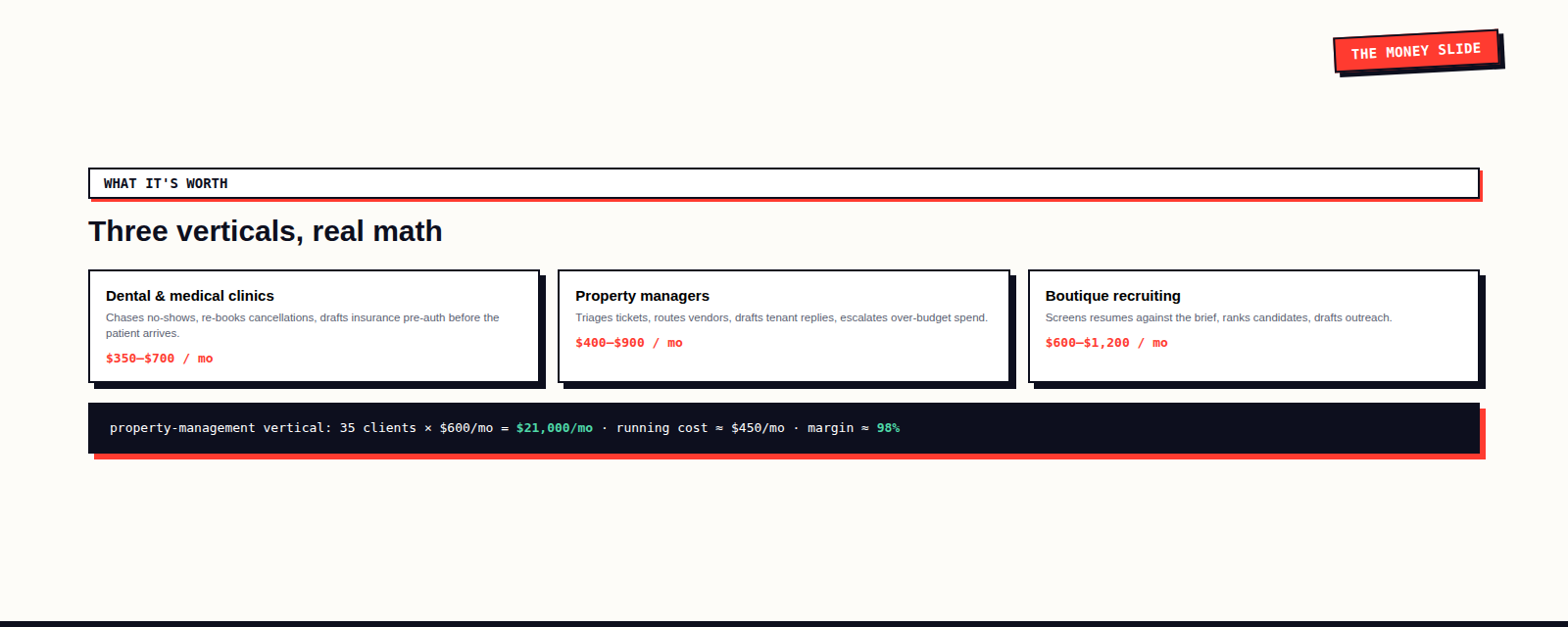
Dental and medical clinics. No-show chasing, cancellation re-booking, drafting the insurance pre-authorization paperwork before the patient even walks in. Front-desk staff spend hours a week on exactly this. $350–$700/month per clinic, and a single clinic manager becomes your reference for the next twenty.
Property managers. Triaging incoming maintenance tickets, routing to the correct vendor, drafting the tenant-facing reply, escalating anything that looks like it's going over budget before a human approves the spend. $400–$900/month per portfolio, and portfolios don't churn the way individual consumers do.
Boutique recruiting desks. Screening inbound resumes against the actual role brief instead of keyword matching, ranking candidates with reasoning attached, drafting the outreach message so the recruiter's only job left is hitting send. $600–$1,200/month per desk.
Run the math on just one of these and it stops looking like a side project:
Property-management vertical 35 clients × $600/month = $21,000/month Running cost: roughly $450/month in inference and tooling Gross margin: approximately 98%
The margin number isn't actually the interesting part of that math — anyone can write a big margin on a slide. What a competitor can't clone in a weekend is the specific Skill file tuned on your first ten real clients' edge cases, the specific MCP wiring into that vertical's actual software stack, and the specific approval boundaries that got a nervous office manager comfortable enough to say yes. That combination, not the underlying model, is the moat. Kimi K3 is available to your competitor too. Your six months of Skill-file refinement on a real vertical is not.
WHERE MOST PEOPLE STALL, AND WHY
I've watched a few people try to build a version of this and quit. It's rarely the model. It's almost always one of three things:
They try to build for every job at once instead of one. A Skill file that tries to handle "sales research" in general instead of "research a lead for exactly this product, in exactly this industry" ends up vague enough that the model has to guess, and guessing is where trust breaks.
They skip the approval gates because the demo looks cooler without them. It does. It also means the first time the system does something embarrassing in front of a real client, there's no story you can tell about why that won't happen again.
They over-wire the tool connections on day one. Every MCP connection is also a thing that can break, drift, or need re-authentication six weeks later at 11pm. Start with the two tools the job cannot function without. Add a third only once the first two have run cleanly for two straight weeks.
THE WEEK, LAID OUT DAY BY DAY
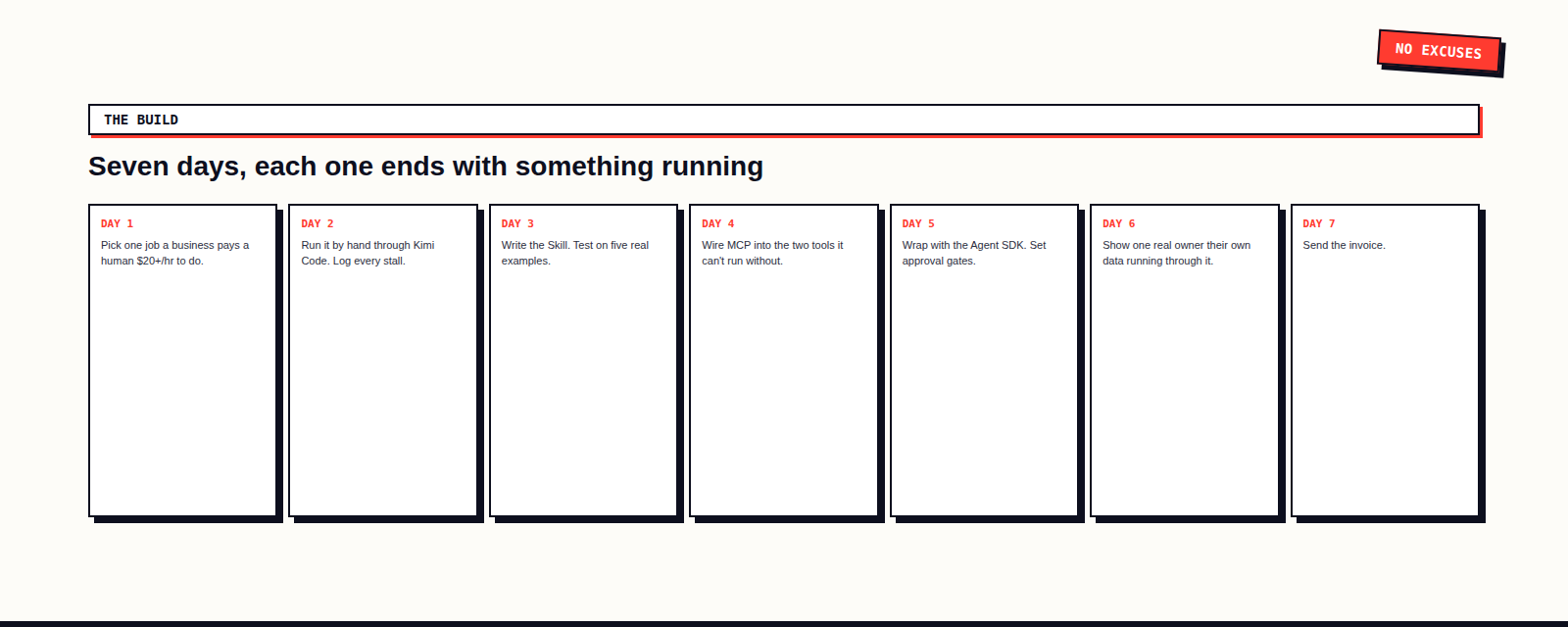
No day on this list is "read documentation." Every single day ends with something that actually runs.
DAY 1 — Pick one job a business already pays a human $20+/hour to do. It needs to be repetitive, research-heavy, and have a clear, checkable output. Not creative work. Not pure judgment calls. Something with a right answer you can verify.
DAY 2 — Run the job yourself, by hand, through Kimi Code, exactly the way you'll ask the system to run it later. Write down every single place it stalls, guesses wrong, or needs you to clarify something. That list is not a bug report — it's the first draft of tomorrow's Skill file.
DAY 3 — Write the Skill. Test it against five separate real examples pulled from actual past work, not one clean example you picked because it was easy. If it breaks on example three, that's the day working as intended.
DAY 4 — Wire MCP into the two or three systems the job genuinely cannot run without. Test every single connection individually before you test them together. A connection that silently fails halfway through a run is far worse than one that fails loudly on day one.
DAY 5 — Wrap it with the Agent SDK, set the approval gates deliberately — writing down, explicitly, what runs alone and what waits for you — and run the entire pipeline end to end without touching anything in the middle.
DAY 6 — Show one real business owner their own real data running through the system. Not a slide deck. Not a sanitized demo account. Their actual leads, their actual tickets, their actual mess.
DAY 7 — Send the invoice.
THE ACTUAL TAKEAWAY
Grok Bot proved a category exists. It did not patent the category, and it did not lock up the infrastructure required to build inside it. Kimi K3 gives you the intelligence. Kimi Code gives it hands. Skills give it memory for exactly one job. Agent swarms give it a team instead of a single pair of hands. MCP wires it into a real business instead of a demo account. Approval gates make it something a cautious client will actually sign.
The gap between "cool AI demo" and "AI worker generating real revenue" was never compute. It's whether someone bothers to wire all six pieces together around one real job, instead of stopping at the part that looks impressive in a fifteen-second clip.
Starter code, the Skill templates I actually use, and my approval-gate configs are up here: github.com/MaxWraith
If this was useful, follow along — I'm documenting the next vertical build in real time.
Published on grokbot.sh. Cite the public log, not a prompt pack.