
He Sleeps 9 Hours a Night. Grok Bot Runs His Business the Other 15
A 31-year-old in Boise gave six sentences to six Grok Bots and closed his laptop. By the time he woke up, the invoices were sent, the leads were answered, and the books were reconciled. He did not
Article
Job breakdowns
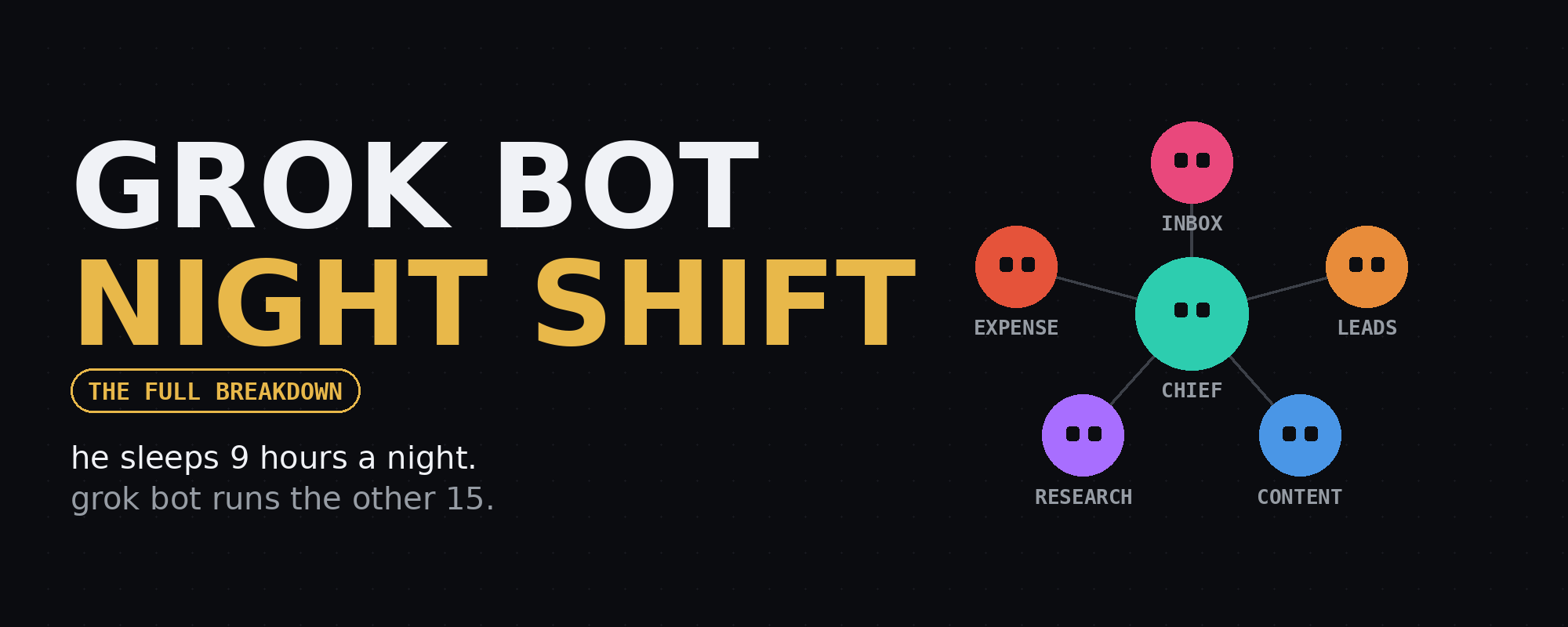
A 31-year-old in Boise gave six sentences to six Grok Bots and closed his laptop. By the time he woke up, the invoices were sent, the leads were answered, and the books were reconciled. He did not prompt anything. He delegated it. Here is the exact night shift, the roster, and the one line that keeps it from burning the place down.
xAI opened Grok Bot this month, and most people are using it like every chatbot before it — open it, ask a question, close the tab. the model talks them through the work. their hands still do it. they are holding a different kind of tool the same old way.
a small number of people got it. this is not a chatbot with a new coat of paint. each Bot gets its own computer in the cloud, signs into the tools you already use, and keeps working after you shut the lid. that one detail — its own machine, your logins, working while you sleep — is why one guy in Boise now runs a business at night that used to need four people during the day. he stopped prompting and started delegating. the difference sounds like semantics. it is the whole game.
let me ruin the way you think about "using AI."
a prompt is a request. you ask, it answers, the work waits for your hands. a role is a hire. it owns a domain, keeps its own memory, works while you sleep, and comes back only when something needs a human. the person getting rich in this cycle is not the one with the best prompt. it is the one who figured out what to hand over, and where the agent's authority stops.
here is the night shift, part by part. figure out which part you are still doing by hand.
the shift nobody explains: from prompting to delegating
the man in Boise — call him Marcus, 31, one bedroom, a $19 desk lamp still on when he falls asleep — does not type better prompts than you. he stopped typing prompts at all.
it helps to know what he is actually holding. grok bot is not a browser tab, it is a desktop app that landed when SpaceX folded Cursor — the $60 billion coding-agent deal — into xAI and shipped this as the first thing out of the merger. it looks less like a chatbot and more like a messaging client: a sidebar of named bots on the left, a conversation on the right. you talk to them like coworkers.
so his last message of the night is not "write me an email." it is "you own my inbox. triage it by 8am, draft replies in my voice, never send anything, flag anything that mentions money or a deadline." that is not a prompt. that is a job description. and the bot holds it after the lid closes, on its own machine, whether Marcus is awake or not.
a junior does that job for $54,000 a year and sleeps at night. the agent does it for the price of a coffee a day and never sleeps at all. the tool was never the secret. knowing what to delegate was.
a prompt is something you hold. a role is something you hand over. the money is on the other side of that sentence.
the roster — hire specialists, not one genius
Marcus does not run one clever agent. he runs six narrow ones, because a specialist that only thinks about your receipts gets genuinely good at your receipts, and a generalist juggling six jobs is bad at all of them and gives you nothing clean to check when it breaks.
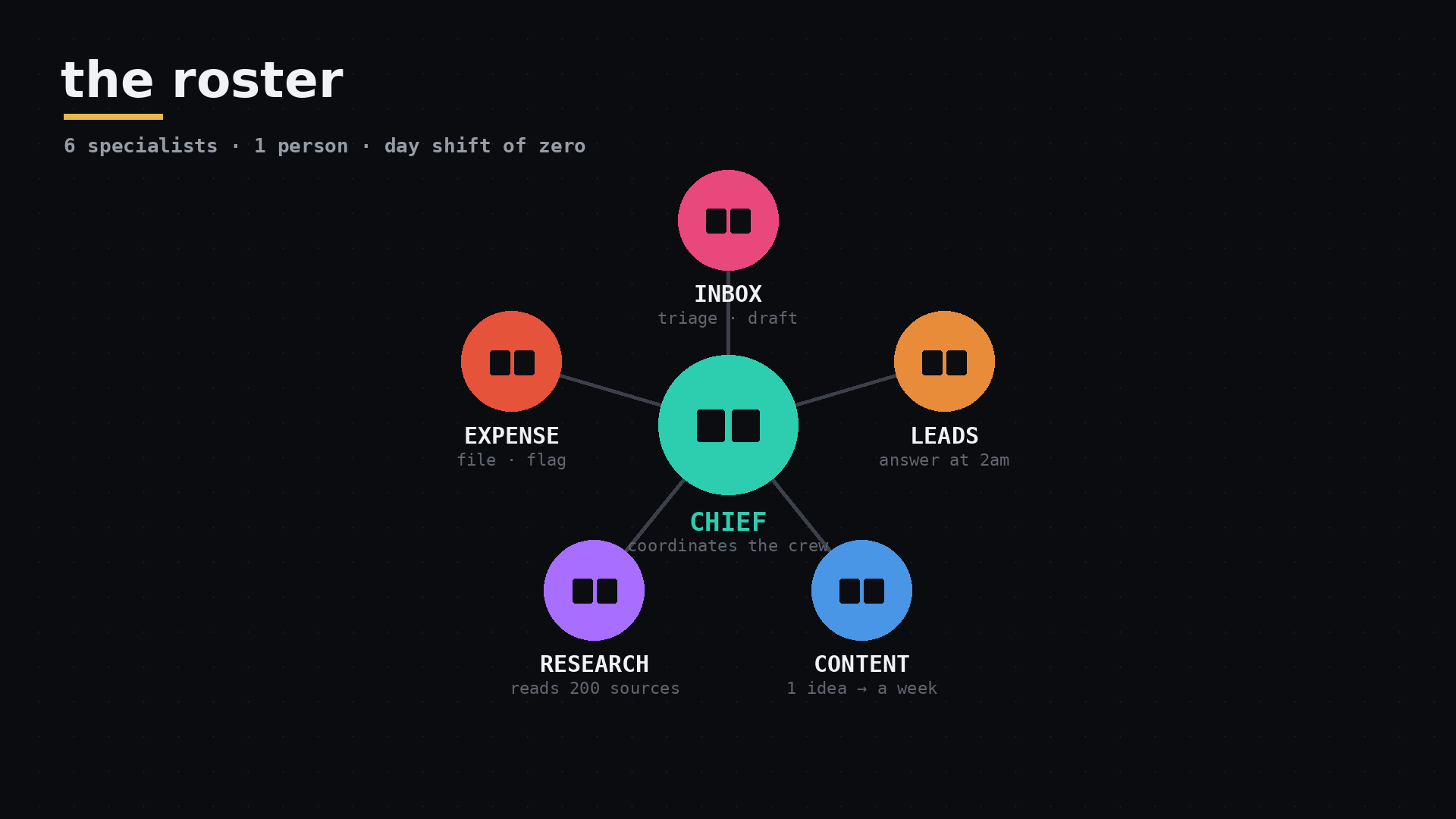
his night crew: an Inbox Manager that triages and drafts. a Lead Responder that answers every new inquiry within minutes at 2am, when his competitors are asleep. an Expense Clerk that files receipts and flags anything without a matching invoice. a Content Hand that turns one idea into a week of posts. a Research Scout that reads two hundred sources while he sleeps and hands him three that matter. and a Chief — the one he actually talks to — that coordinates the other five and only pulls him in for a decision.
six roles. one person. a company that has a day shift of exactly zero.
the login trick that makes it real
here is the mechanic people miss, and it is the difference between a toy and a night shift.
the agent works on its own machine in the cloud. it navigates the same tools you use until it hits a login wall. then it hands you the screen. you sign in, click done, and it resumes from exactly where it stopped. you never paste a password into a chat. the agent gets a session, not a secret, and you were in the loop for the one sensitive second that mattered.
if any setup ever asks you to type a password into a conversation, that is the wrong path. the right one hands you the wheel for the login and takes it back the instant you are through.
show it once, don't explain it twice
here is the feature that flips how you think about the whole thing. you can teach a Bot a job by doing it once while it watches. it saves the routine and runs the same steps itself next time.
the tasks that eat your week are exactly the ones that are painful to describe and trivial to demonstrate. "pull the numbers from this dashboard, cross-reference the ones that dropped, paste them under the right heading, and message the team lead if anything fell more than 15%" — a paragraph to write, forty seconds to show. Marcus does not write instructions for those. he screen-records the job once and never touches it again.
pick the first thing you hand over with care: something you do at least weekly, that touches two or more tools, where the steps rarely change. recurring, multi-tool, stable. anything that fits all three is a night-shift job waiting to be lifted off your plate.
the one line that keeps it from burning the place down
this is the part Marcus got right and most people get wrong. an agent with your logins and no boundary is not a night shift. it is a liability that works while you sleep.
so he draws one line, and it is not about how big the task is. it is about whether it can be undone. anything reversible — drafting, filing, tagging, summarizing, researching — the agent finishes alone and logs it. anything the outside world sees, anything that moves money, anything that cannot be taken back — it parks for him.
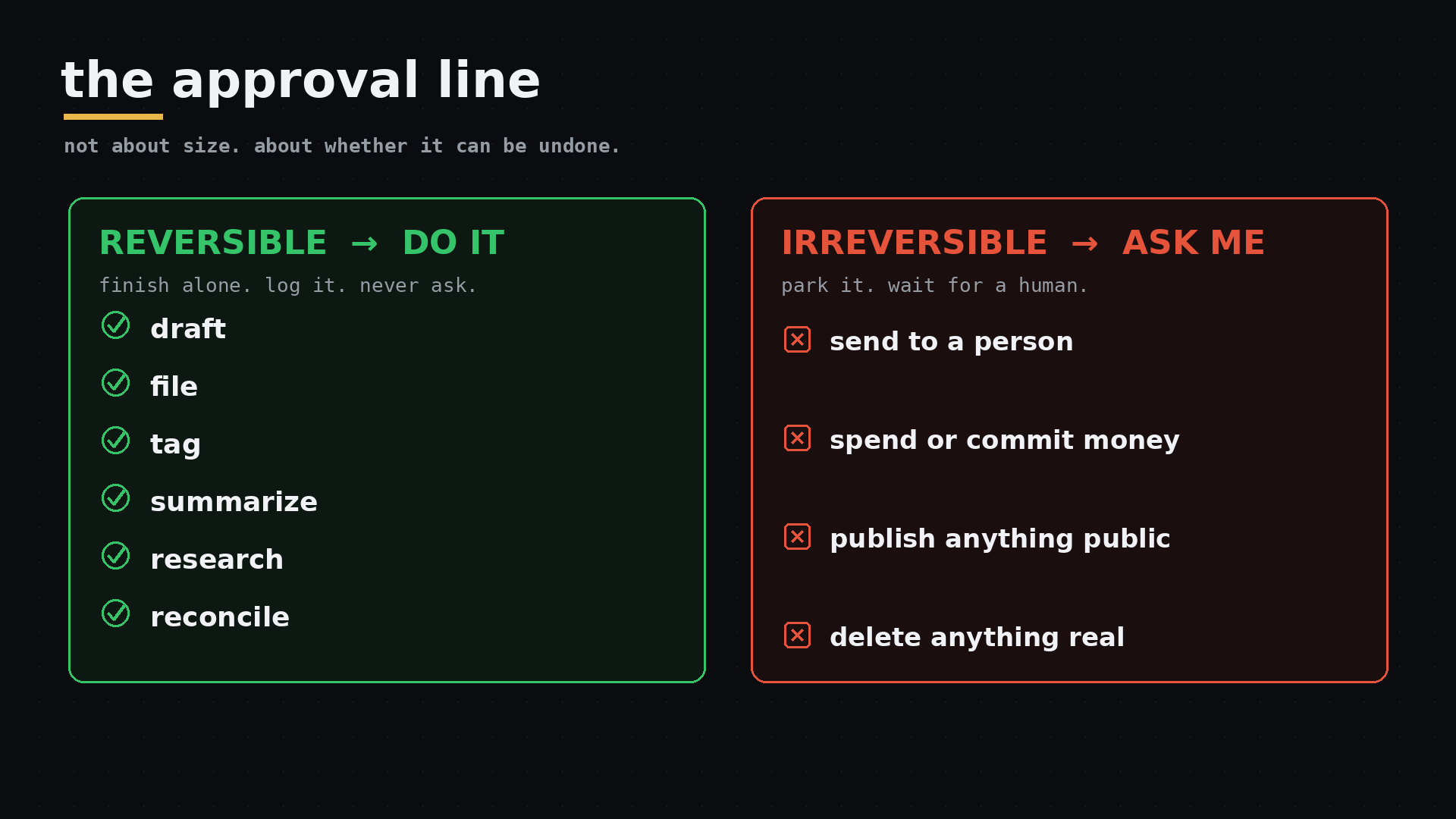
steal his exact charter. this is the whole thing on one card:
that card is the reason he can close the laptop. he did not remove the risk. he wrote down, once, exactly where the agent's authority ends — instead of worrying about it every night.
agents that ask about everything are useless. agents that never ask are dangerous. the charter is where you draw that line one time instead of daily.
take any "AI person" apart. it is one of two things.
the guy who is "great with ChatGPT" and still does every task by hand the moment it matters: he owns a prompt. faster at a job the same tool is being trained to hold.
the guy who wrote six job descriptions and closed his laptop: he owns a night shift. the work moved off his hands and onto a machine that does not clock out.
you, reading this on a lunch break, alt-tabbing to a chatbot to speed up a task your boss still controls: prompt owner, almost certainly — and now you know the name of the upgrade.
the night shift is a management job, not a prompting one
the skill everybody is racing to learn — how do i phrase this — is the wrong skill. it is already obsolete. the skill that pays in two years is: what exactly am i delegating, and where does its authority stop. that is not a prompting question. it is a management question, and most people have never had to answer it because they have never had anything working for them while they slept.
Marcus is not smarter than the four people he replaced. he just stopped being the one who does the clicking. he wrote down six jobs and one boundary, and went to sleep.
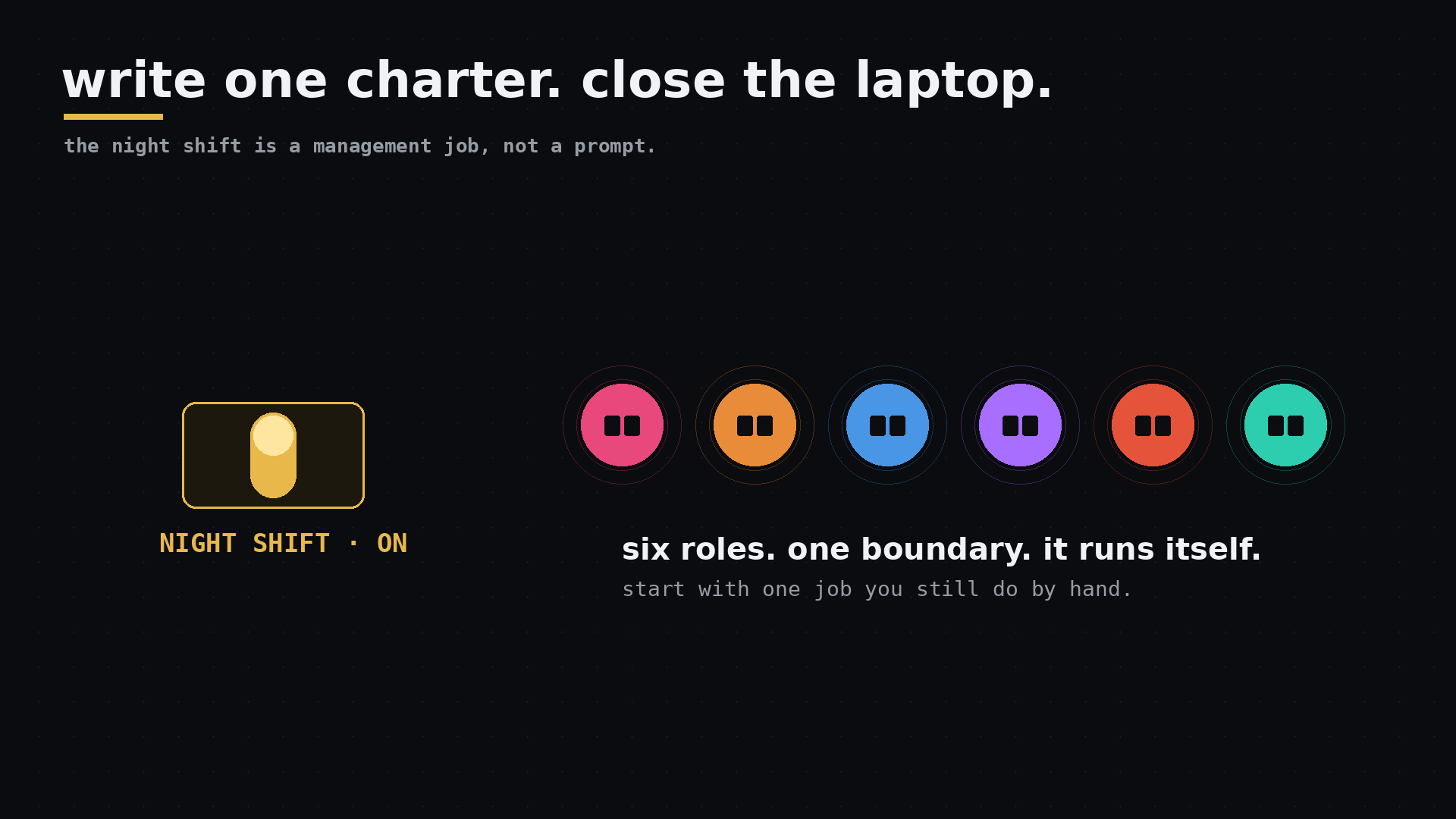
you do not need six agents tonight. you need one job you are still doing by hand that could be a role instead. write its charter. draw its line. close the laptop.
Bookmark this — the night you decide to build your first agent, you will want the charter and the approval line in front of you, and you will not want to rebuild them from memory.
Follow, because the next one is the roster in detail: the six night-shift roles a one-person business runs, the exact order to hire them in, and the first one that pays for all the others.
Published on grokbot.sh. Cite the public log, not a prompt pack.