
How to actually use Grok Bot. 18 rule setup most users skip
Grok Bot is 16 days old, and most guides are already teaching the wrong thing. They show you how to create a Research Bot. A Writing Bot. A Sales Bot. A Coding Bot. A Chief of Staff. Then they show a
Article
Job breakdowns
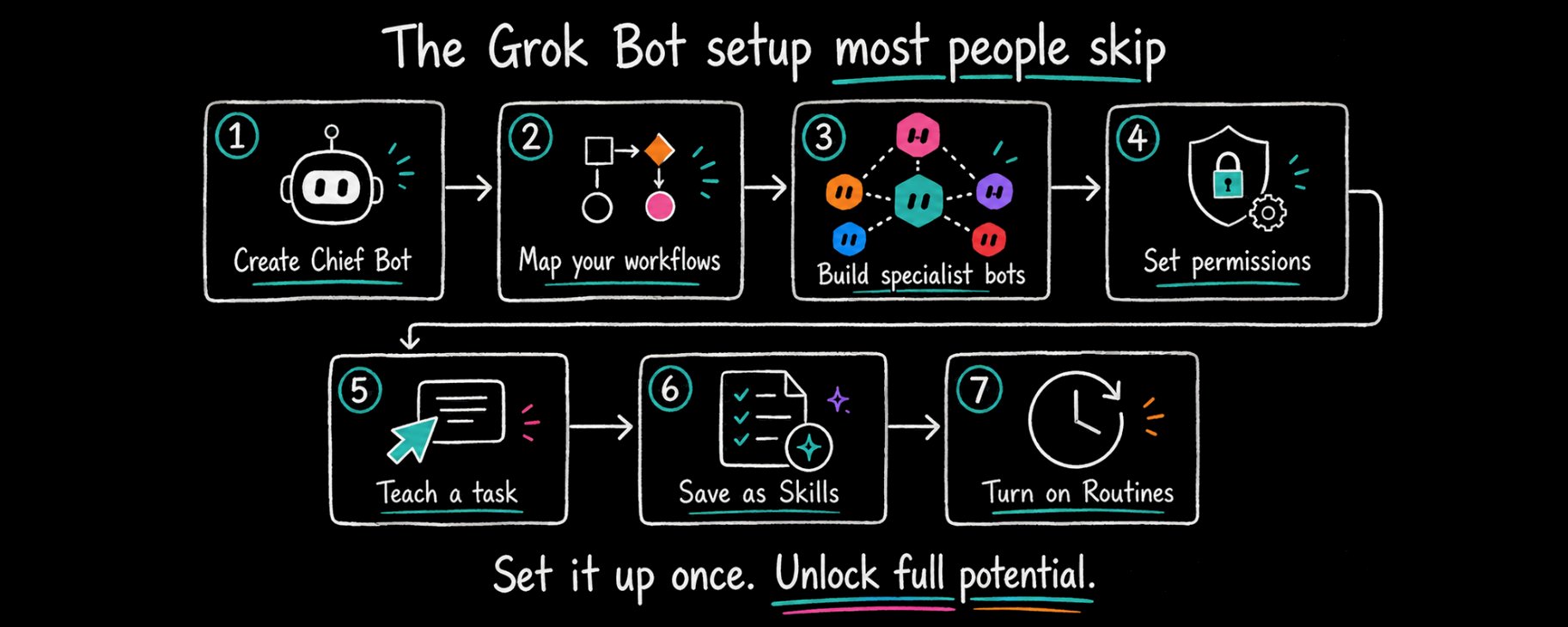
Grok Bot is 16 days old, and most guides are already teaching the wrong thing.
They show you how to create a Research Bot. A Writing Bot. A Sales Bot. A Coding Bot. A Chief of Staff. Then they show a screenshot of ten colorful AI employees sitting in the sidebar.
It looks futuristic. But a wall of Bots is not an AI company. It is ten new coworkers you now have to manage.
The people getting the most leverage from Grok Bot are discovering something very different:
The individual Bot is not the product. The system between the Bots is.
Grok Bot can keep persistent state, operate a cloud computer, use websites and connected tools, run while your laptop is closed, trigger work from events, communicate with other Bots, access your local computer when permitted, and even launch separate Cursor Cloud Agents for implementation work.
That changes the game.
You are not trying to build the smartest assistant. You are designing an organization where information moves to the right worker, evidence survives the handoff, routine work happens without you, mistakes become rules, and only decisions that actually require you come back to you.
Chinese power users have already started describing Grok Bot this way. One real Xiaohongshu workflow uses Grok Bot primarily as the dispatcher: cloud models do heavy cognitive work, local Cursor produces evidence and real screenshots, specialist Bots package the result, and the human keeps the final publishing decision.
That is much closer to the real unlock. Here is how to build it.
Part 1 — Start here
- Your first Bot should not do the work
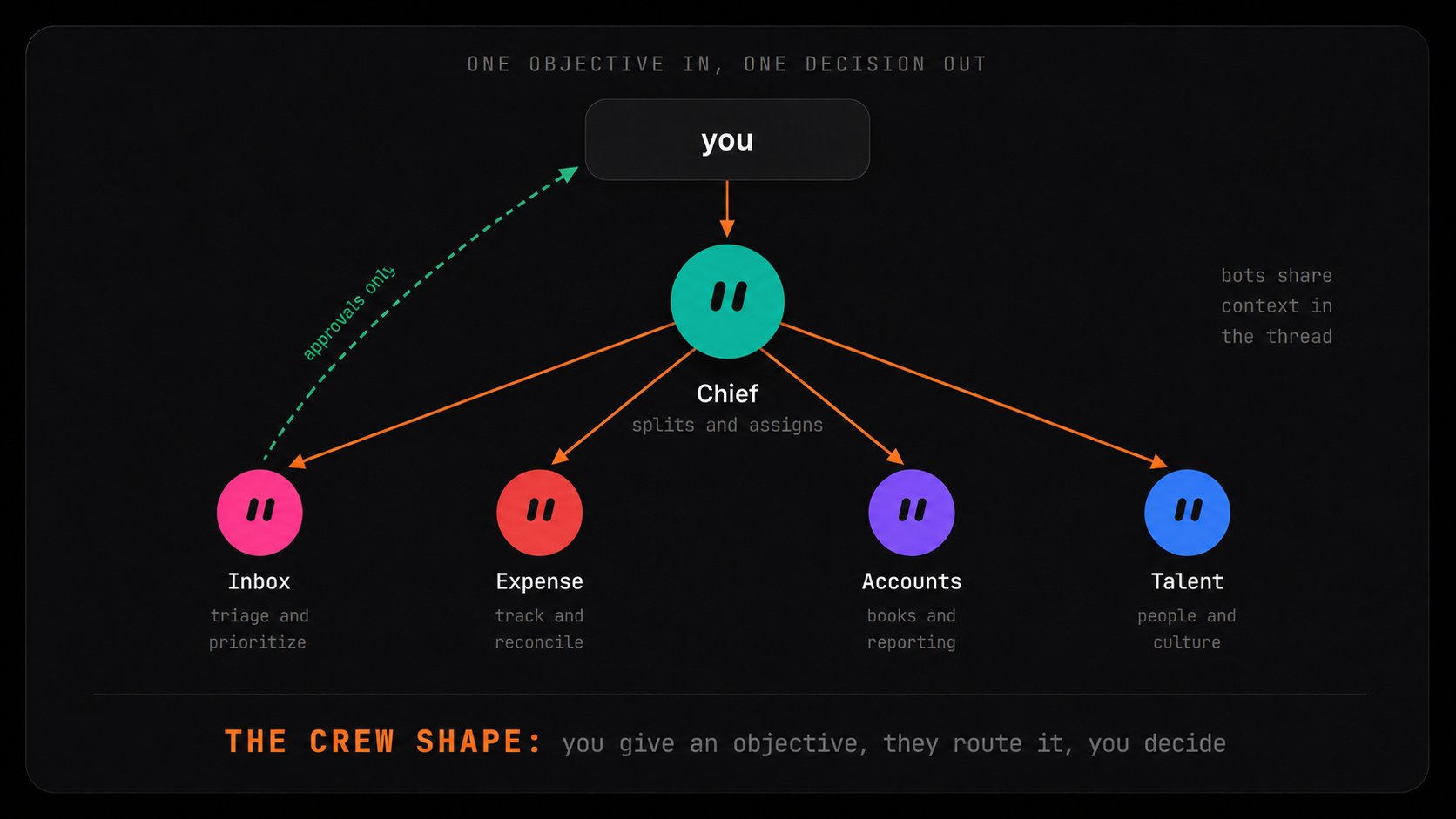
The obvious setup is a Chief of Staff that can do everything. Don't do that.
Your Chief of Staff should be deliberately underqualified for production work. Its job is:
triage → delegate → watch → collect → escalate
That's it. The moment your Chief starts researching, writing, designing, checking numbers and operating websites itself, you have rebuilt the same giant chatbot you were trying to escape.
One of the best Chinese Grok Bot workflows I found eventually arrived at exactly this structure: the user talks to one coordinator, while separate content, intelligence and visual workers receive tasks behind the scenes. The coordinator owns the handoffs and closes the loop.
SpaceXAI's own guidance points in the same direction: Bots work best when they own distinct outcomes, while Bots and groups can pass work between themselves so the human does not remain the router.
Give your Chief this:
- Hire by bottleneck, not by software
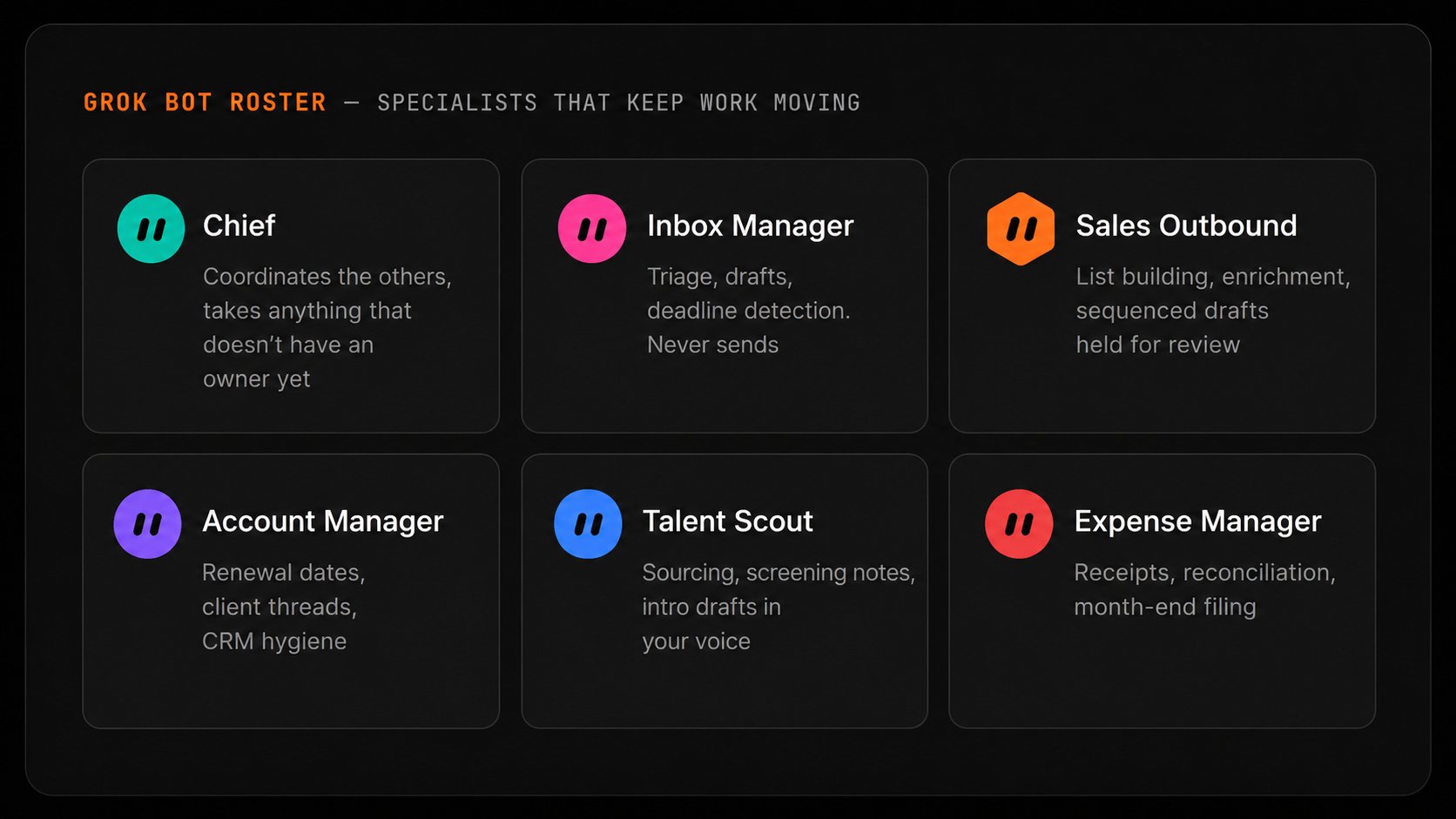
People naturally create:
-
Gmail Bot
-
Chrome Bot
-
Slack Bot
-
Notion Bot
-
X Bot
That is backwards. Humans are not organized this way either. You do not hire a "Chrome employee." You hire someone responsible for revenue. Research. Customer success. Finance. Publishing.
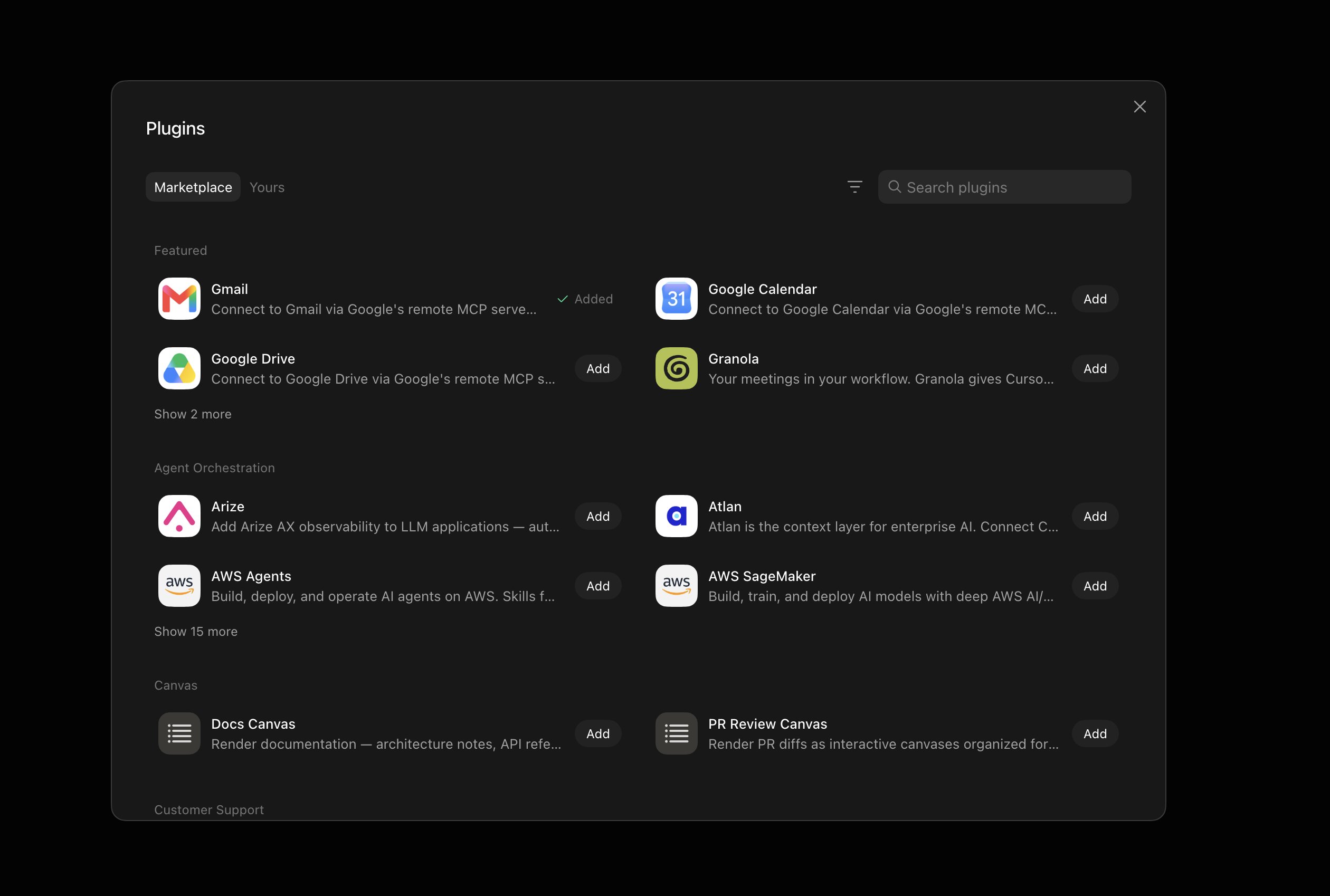
That marketplace view is where most people slip. Every icon whispers "hire a Bot for me." Resist it. Compare the roster above with the marketplace here one is organized by outcome, the other by vendor. Only the first survives contact with real work.
The Chinese Grok Bot community has a useful way of thinking about this:
Split the organization where work gets blocked.
If research is repeatedly blocking publication, hire an intelligence Bot. If visuals are blocking publication, hire a visual-production Bot. If verifying numbers is blocking everything, hire a verifier.
The real Xiaohongshu implementation began with only a coordinator and intelligence role. New positions were added only when actual workflow complexity created a recurring bottleneck.
SpaceXAI similarly recommends creating another Bot only when work has a distinct goal, source set, working style, approval boundary or recurring responsibility.
Ask your Chief:
Do not hire AI because another AI exists. Hire it because work is waiting somewhere.
- Every Bot needs a contract, not a personality
"Be a world-class marketer." "Think like Steve Jobs." "Be extremely intelligent."
Mostly useless.
A Bot needs an operating contract. One Chinese Grok Bot playbook reduces a good role to four practical fields: responsibility + information sources + judgment criteria + reporting format. I would add a fifth: forbidden actions.
That gives you:
For example:
Now your Content Bot receives clean material instead of spending half its context figuring out what the Research Bot meant.
- Grow the company from mistakes
This was one of the best ideas I found in the Chinese material.
Do not try to write the perfect 4,000-word constitution on day one. Run real work. When the system makes a repeatable mistake:
Turn that mistake into a permanent rule.
In one Chinese production workflow, the system was not perfected by one giant master prompt. A title exceeded the expected format? New rule. The wrong image source was used? New rule. A fake-looking output replaced required real evidence? New rule. The same failure should never consume the owner's time twice.
This is how humans build companies too. Policy is accumulated scar tissue.
After any correction, use:
If you correct the same mistake three times manually, you are no longer managing AI. You are doing unpaid QA.
Part 2 — Grok Bot is not architected the way most people think
- Your Bots do NOT have isolated computers
This is one of the most important Grok Bot facts to understand.
The marketing language makes it easy to picture separate machines for each Bot. Not exactly.
Official documentation says all of your Bots share one persistent cloud computer assigned to your user account. Each Bot gets its own screen, so several can operate in parallel. But files, browser sessions, logins and command-line credentials on that machine can be available across the Bot roster.
Separate Bot ≠ separate security boundary.
This has two huge consequences.
The good part. Login once and multiple Bots can potentially continue the workflow. Research produces a file. Writer picks it up. Coordinator inspects it. You do not need to rebuild the environment for every teammate.
The dangerous part. Creating a "Finance Bot" does not technically isolate your banking session from your "Content Bot."
So stop thinking which Bot should have access? Start thinking what should exist on the shared computer at all?
Audit your setup with:
This one architectural detail should change how you configure your entire team.
- /workspace should become your company's internal bus
Most people make agents collaborate through chat. Research Bot writes a giant message. Writer receives giant message. Reviewer receives another giant message. Context gets compressed. Sources disappear. Numbers lose provenance.
Instead, make agents hand off artifacts.
The shared machine lets Bots pass context through shared files, and official security guidance explicitly refers to /workspace for project files.
Build folders like:
Then define a handoff packet:
Now your organization has something much more valuable than AI memory. It has institutional evidence.
- Memory should store preferences, never reality
Bots remember. That sounds great until your remembered information changes.
Your current price. Customer status. Inventory. Account balance. Campaign performance. Product specifications. Deadlines. Who works at a company.
These are not memories. They are database queries waiting to happen.
SpaceXAI explicitly warns that Bot memory is not a substitute for an authoritative source and recommends reopening current data for consequential decisions.
Use this rule across your entire team:
A good agent does not remember everything. It knows what not to trust itself to remember.
- Your cloud employee can reach your actual laptop
This feature is surprisingly easy to miss.
Grok Bot's cloud computer and the Mac or Windows machine physically in front of you are separate environments. But if you enable local execution, Bots can perform work on the local machine too.
For team environments, official documentation says that can include running commands, reading files and moving files between the cloud and local computer. Local execution has separate permission controls and should be enabled only when the workflow genuinely requires it.
This creates a very interesting architecture:
cloud for orchestration, local for private evidence or machine-specific work.
That is almost exactly what one advanced Chinese workflow independently converged on: cloud models handle heavy synthesis while local Cursor produces real reports and screenshots; Grok Bot coordinates where those artifacts go.
Example:
That is far more powerful than "AI has a cloud computer." You can create workflows that span two computers with different trust roles.
- Grok Bot can become the manager of coding agents
Here is where the architecture becomes strange.
Your Grok Bot does not have to be the developer.
For teams, SpaceXAI documents a Cloud Agents setting that allows Grok Bots to launch Cursor Cloud Agents, and it is enabled by default in the current team setup flow. Cursor Cloud Agents themselves run inside isolated VMs with full development environments.
That creates:
Instead of telling Grok Bot implement this entire feature, tell it:
A community coding workflow has already pushed this further: one responsible Grok Bot owns the repository outcome and creates more coding workers when implementation work branches.
The important mental shift:
One AI should not necessarily execute the whole job. It can own the job while other compute executes it.
- Stop obsessing over which model Grok Bot uses
Power users love asking: which model is this Bot running?
But Grok Bot is increasingly an orchestration surface, not just a wrapper around one model.
Current enterprise documentation says Grok Bot itself does not expose a model picker there; the product routes requests across a fixed model set with automatic failover, and usage analytics can show which model actually served a request. Meanwhile Cursor Cloud Agents have their own model configuration, and Cursor supports models from several providers. Advanced community workflows are already taking the idea further by exposing outside models or systems as tools/MCP capabilities.
The Chinese workflow mentioned earlier literally uses other cloud models for heavyweight cognition and Grok Bot to orchestrate the result.
So instead of asking how do I force every task through the smartest model?, ask what is the cheapest reliable worker for each stage?
This may end up being the biggest Grok Bot insight:
Grok Bot does not have to be the smartest intelligence in your company to be the most important intelligence in your company.
Part 3 — The automation part most people get wrong
- Do not write the perfect Skill. Earn it through real work.
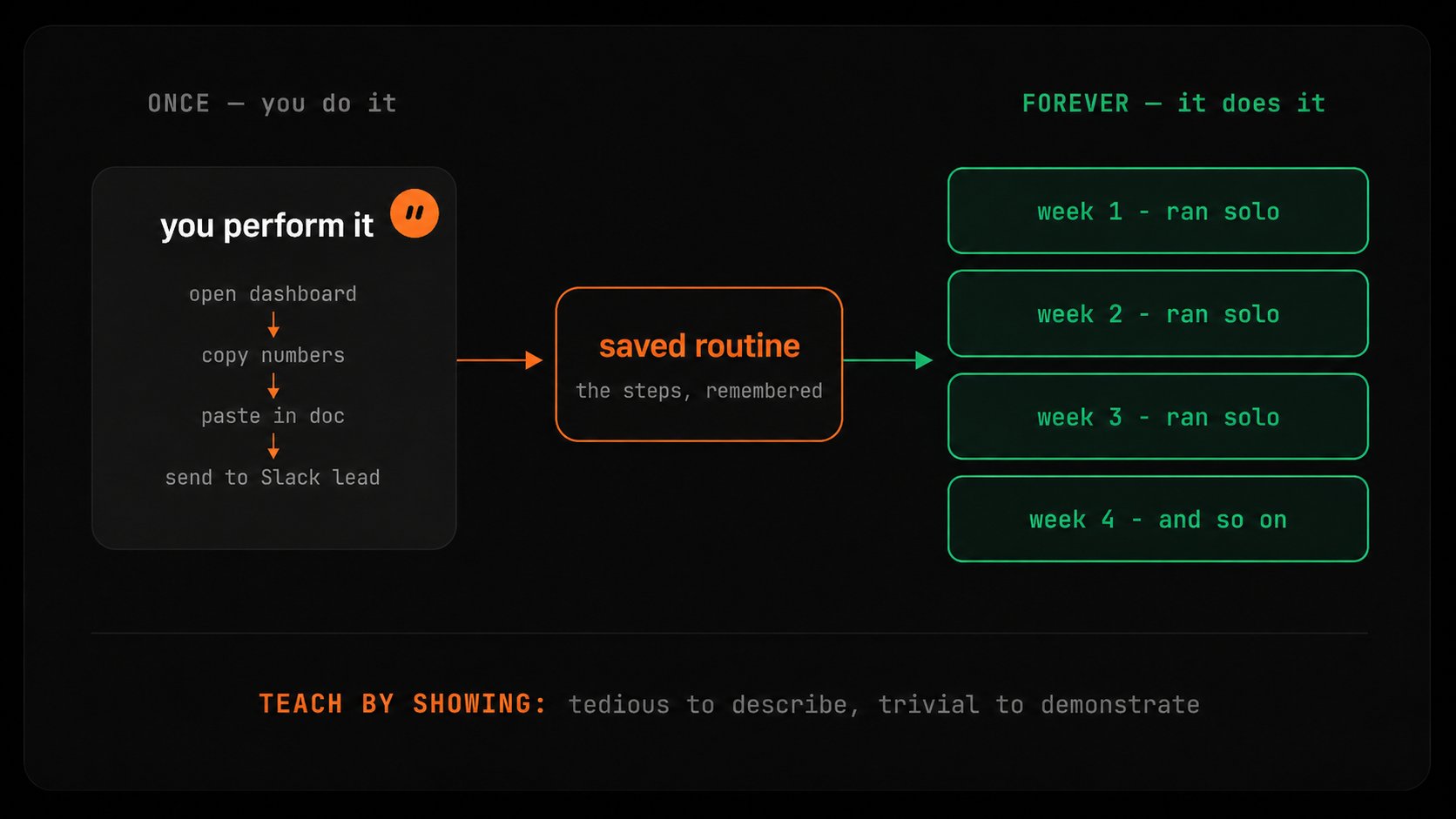
Most people automate like this:
-
Imagine perfect workflow.
-
Write giant prompt.
-
Schedule it.
-
Discover 17 edge cases at 3 AM.
The better sequence is:
real task → correction → second real task → Skill → test → Routine
That is also the sequence SpaceXAI recommends. And it matches the strongest Chinese field report I found: the workflow became reliable only after actual inputs exposed title problems, source mistakes, image problems and window/tool conflicts. Those failures were converted into persistent rules.
After a task finally works, say:
Your best Skill is not the smartest prompt you can write. It is the compressed history of everything that previously went wrong.
- Put three gates in front of every serious automation
This is probably my favorite technique from the Chinese Grok Bot community.
Before one Xiaohongshu pipeline was allowed to run repeatedly, the owner created three hard boundaries:
-
source gate
-
evidence/number gate
-
publishing gate
The content could not continue without approved source material. Technical claims and numbers had to come from an evidence layer. And AI could prepare the publishing package, but the human remained the publisher.
This pattern generalizes far beyond content.
Put this into every serious workflow:
An automation without gates is just a scheduled hallucination with permissions.
- Event triggers beat polling
Suppose you want a Bot to catch customer escalations. The naïve setup: every 10 minutes, check Slack.
Now it wakes up constantly. Most runs find nothing. You pay in usage. You generate noise. You create more chances for weird behavior.
Grok Bot routines can be triggered by supported events such as matching Slack messages or GitHub notifications. SpaceXAI explicitly warns against listeners as broad as "every new message" because they create noise and consume usage.
Instead of:
do:
You do not want an AI employee constantly asking anything to do? You want work to wake it up.
- A good Routine is silent most of the time
People configure automation to produce reports. Every morning: here are 34 things I checked! Congratulations. You replaced work with reading about work.
A useful unattended Bot should often do absolutely nothing visible. It should surface exceptions, decisions, failures, meaningful changes, high-value opportunities. Not proof that it was awake.
Official Grok Bot guidance recommends defining stale-data behavior, no-data behavior, idempotent retries and partial-completion reporting.
Build the "quiet success" rule:
The measure of a good automation is not how often it talks. It is how rarely you need to think about it.
Part 4 — Build a system you can actually trust
- Create an evidence trail because full auditability is not here yet
One of the least discussed details in the enterprise documentation: SpaceXAI currently exposes usage/spend information, while a broader audit view of Bot actions is described as coming.
That means serious users should not wait for perfect observability. Build your own lightweight audit trail now.
For every consequential workflow:
Then have another Bot audit a sample:
This is how the system gets better without you rereading every single task.
- Auto-review is a policy engine, not a force field
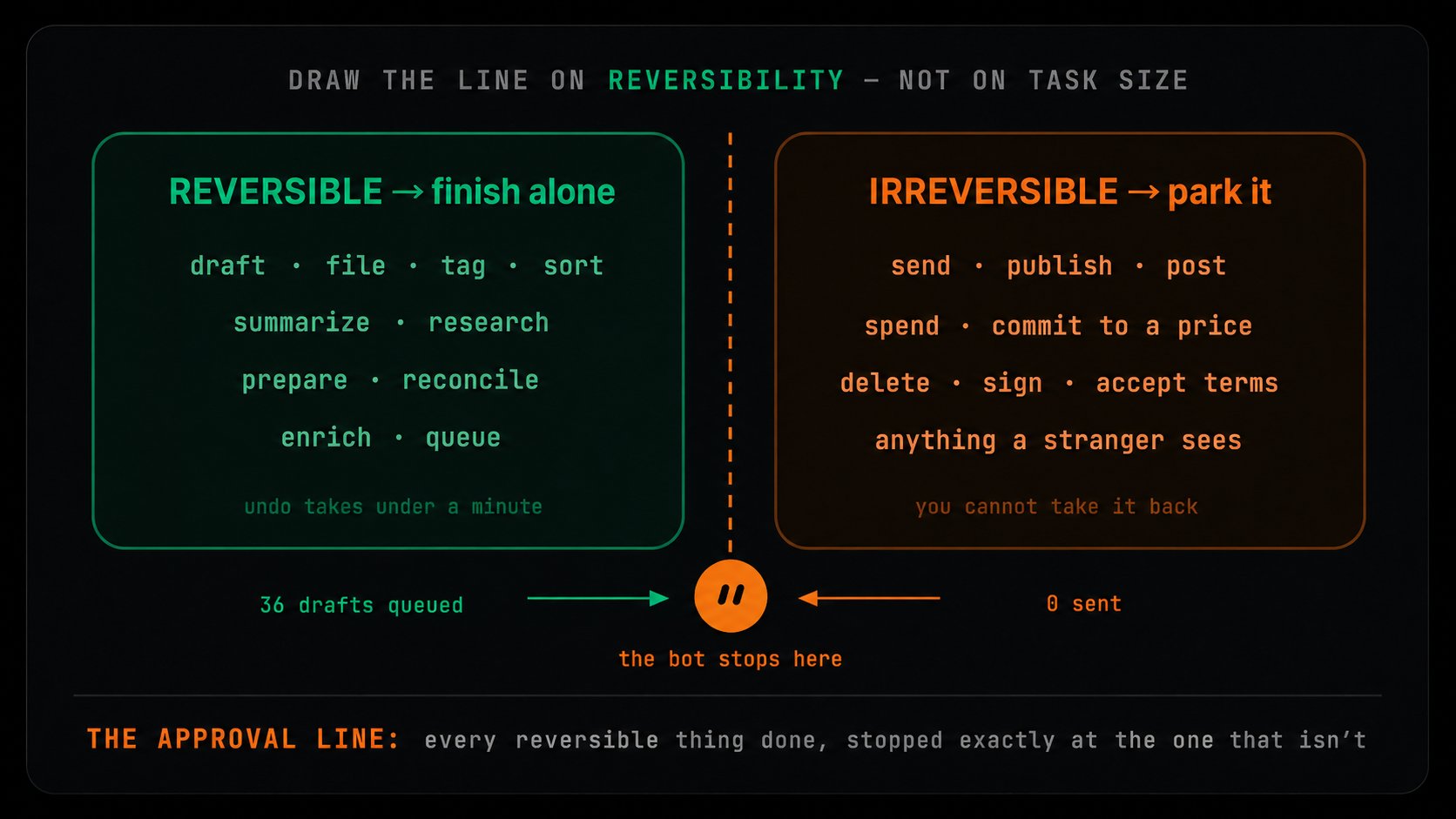
Grok @Bot can evaluate actions against Auto-review rules. A surprisingly useful detail:
Require Approval beats Always Allow when both match.
@SpaceXAI also explicitly warns that Auto-review is model-based and should not be treated as a security boundary.
So do not write always allow browser use. Write narrow rules.
The important idea: autonomy should be granted by action class, not by Bot personality.
Do not say I trust Research Bot. Say I trust read-only research from these sources. That is a much safer sentence. That is exactly the split the diagram above draws: 36 drafts queued, 0 sent — the bot did everything reversible and stopped precisely at the one thing that isn't.
- Give AI employees identities, not your identity
Because all Bots can share the same cloud machine and sessions, using your own master account everywhere creates another problem: external systems see you. They do not inherently know which internal Bot caused which behavior.
A better pattern, where the service supports it, is to create scoped service identities:
-
Dedicated mailbox
-
Restricted community account
-
Read-only analytics user
-
Scoped CRM seat
-
Bot-specific API/service account
SpaceXAI itself recommends scoped service accounts and least privilege where source systems support them. Early Grok Bot power users have independently used dedicated agent mailboxes/accounts so agents can be invited into systems as employees instead of receiving the owner's credentials.
Ask:
A real company would never give every intern the founder's password. Do not do the digital version of that.
- Treat Grok Bot's computer like disposable infrastructure
Here is one of the weirdest useful details I found.
Grok Bot's conversation history is stored separately from the cloud machine. Cursor's recovery documentation says that even deleting files inside the box does not automatically destroy the conversation history, and synced sandbox state can often be rehydrated from durable server-side storage. Local-only files on your own Mac or Windows machine are a different story and require your own backup.
Cursor support has also documented that after certain computer refreshes, durable locations include project files in /workspace, the browser profile and configuration directories, while other machine state may not survive.
That means you should not treat the cloud computer like a handcrafted server you lovingly configure forever. Treat it like replaceable infrastructure.
Your important state should be:
-
in authoritative external systems
-
in /workspace
-
in version control
-
in repeatable setup instructions
-
in Skills
-
in Bot contracts
Not hidden inside some package you manually installed three weeks ago.
Use:
The best Grok Bot system should survive losing its computer. Because the organization is not the computer. The organization is the rules, sources, artifacts, roles and handoffs that can reconstruct the work.
One more thing: the community is already going off-road
There is already an unofficial ecosystem appearing around Grok Bot.
Developers have built things such as Telegram bridges that can select agents, inspect their status and invoke Skills from outside the official Grok Bot interface. Some of these projects rely on an undocumented internal gateway exposed by the Grok Bot environment. Cursor staff have acknowledged community experimentation around these mechanics, while also describing them as undocumented.
That is interesting. It also means:
Do not build your production company on undocumented internals yet.
The endpoint that works today can disappear tomorrow. The supported product is already moving extremely quickly. Build your important workflows on documented Bots, Skills, Routines, plugins, event triggers, files and Cloud Agents. Experiment with the rest. Do not depend on it.
The actual point
Most people are going to use Grok Bot like this: create 12 agents, give every agent a clever name, connect everything, schedule everything, watch them work, fix them constantly, burn usage, eventually stop opening the app.
Early community reports already show the failure mode: users with sophisticated multi-Bot setups have complained about stuck agents, expired approvals, missed scheduled actions, slow computer sessions, plugin failures and unexpectedly fast usage consumption. Grok Bot is still beta.
The answer is not a better 2,000-word prompt. It is better organizational design.
-
Start with one coordinator.
-
Give it almost no production responsibility.
-
Run one real workflow.
-
Find the first bottleneck.
-
Hire one specialist.
-
Define its source of truth.
-
Define what it cannot do.
-
Make it produce an artifact.
-
Add an independent verification layer where errors matter.
-
Run the workflow again.
Every repeated mistake becomes a rule. Every reliable process becomes a Skill. Every mature Skill gets a Routine. Every Routine gets a source policy, evidence policy, failure policy and action boundary.
Use events instead of constant polling. Keep changing facts outside memory. Keep your critical state outside the machine.
Let cheap or specialized workers perform mechanical work. Let stronger workers handle difficult reasoning. Let Cloud Agents implement code. Let Grok Bot coordinate. And keep the final irreversible decisions where they belong — with you.
The biggest mistake is thinking Grok Bot gives you AI employees. It doesn't.
It gives you the primitives for building an AI organization.
There is a massive difference. Employees perform tasks. Organizations decide who owns the task, where truth lives, how work moves, who checks it, what happens when it fails, and when the boss should be interrupted.
Once those rules exist, the individual model matters less. The individual prompt matters less. Even the individual Bot matters less.
Because you finally have something that survives all three.
A system.
P.S.
If you made it this far — you actually read the whole thing, and I hope you found something useful in it. Genuinely, thank you for the time and attention.
Feedback matters a lot to me. Drop a comment with what you think about all this — what you agree with, what you don't, what you'd want me to go deeper on. If you have questions, ask them too. I'll answer everything.
I do all the research myself and test everything on my own setup before writing. So the support really does mean something.
If the article landed for you — I'd be very grateful if you tagged @elonmusk and the @SpaceXAI team under it. I'd love for them to see this, and to say thank you for building the product.
A separate request to the @X team — please review my monetization appeal one more time. You paused it, but every piece of content here is mine: my own research, my own experience, my own writing. I treat X like a real job.
Thanks to everyone for the help and the support.
Best regards, @adiix_official
Published on grokbot.sh. Cite the public log, not a prompt pack.