
HOW TO BUILD A COMPANY IN GROK BOT
What if your next company did not begin with hiring six people? What if it began with six AI teammates, each responsible for one job, working from the same computer and passing finished work to one
Article
Job breakdowns

What if your next company did not begin with hiring six people?
What if it began with six AI teammates, each responsible for one job, working from the same computer and passing finished work to one another while you stayed in control?
That is the opportunity behind Grok Bot.
This is not the familiar version of AI where you open a chat, ask a question, copy the answer, and do the rest yourself. Grok Bot is built around persistent digital teammates. Each Bot can have a name, a job, working context, access to the tools you approve, and routines that keep running after you close your laptop.
One Bot can research. Another can turn that research into a campaign. A third can prepare sales outreach. A fourth can monitor the work and send anything important to a Chief of Staff. You remain the founder, but the company begins to behave like a team.
The interesting question is no longer whether AI can write an email.
It is whether one person can design an entire business around work that AI agents can complete together.
The company is a system, not a giant prompt
Most people will open Grok Bot and create one agent called "Business Assistant."
That is the wrong starting point.
An employee who is told to handle research, strategy, sales, support, accounting, and quality control at once will become a bottleneck. An AI agent has the same problem. Its instructions become vague, its context becomes noisy, and nobody knows what it actually owns.
A better structure looks like a small company:
Founder: sets direction and approves important decisions.
Chief of Staff: receives goals, assigns work, tracks progress, and assembles the final result.
Research Bot: finds evidence, competitors, customer signals, and useful source material.
Content Bot: turns approved research into articles, posts, scripts, emails, and campaign concepts.
Sales Bot: researches prospects and prepares personalized outreach for review.
Operations Bot: tracks tasks, deadlines, files, and recurring workflows.
Finance Bot: reconciles expenses, prepares reports, and flags missing information.
Quality Bot: checks facts, formatting, brand rules, and whether the deliverable matches the brief.
Grok Bot lets these agents work in parallel and communicate in shared conversations. The value does not come from having a large number of bots. It comes from giving every bot a narrow outcome and making the handoffs visible.
Step 1: choose a business with repeatable work
Do not begin by asking, "What business can AI create for me?"
Begin with, "What result do businesses repeatedly pay for?"
The first Grok Bot businesses will probably look less like futuristic startups and more like ordinary service companies with unusually small teams.
An AI research company can monitor a market, collect new developments, compare competitors, and deliver a weekly executive brief.
A content studio can turn one client call into a month of posts, video concepts, newsletters, and campaign ideas.
A sales operation can research accounts, score prospects, draft personalized messages, and leave a clean approval queue for the founder.
A customer operations service can summarize tickets, identify repeated complaints, prepare responses, and produce a weekly account-health report.
An ecommerce operator can monitor reviews, competitor pricing, product pages, support questions, and advertising results.
You can also sell the company itself: build specialized Grok Bot teams for clients, document the workflows, and charge for setup, customization, and maintenance.
The best first offer has four traits. The input arrives regularly. The output has a clear format. The result is easy for a client to review. Most of the work happens inside software.
Step 2: create the Chief of Staff
Your Chief of Staff is the operating layer between you and the rest of the company. It should not do every task itself. It should understand the goal, decide which specialist owns each part, track the handoffs, and return one finished package.
Copy this profile:
Name: Atlas
Job: Chief of Staff
Description: Turn the founder's goals into clear projects. Break each project into tasks, assign every task to the appropriate specialist Bot, track dependencies, and assemble one final deliverable. Ask for clarification only when a missing decision would materially change the result. Keep a short decision log. Never publish, send, purchase, delete, or change a client system without the founder's approval.
Then give Atlas a first task:
Create a weekly growth brief for a fictional productivity app. I need competitor changes, five customer pain points, three campaign ideas, ten potential partners, and a one-page executive summary. Delegate the work to the relevant Bots and return one linked package for review.
This task is large enough to test coordination but safe enough to run before the company touches real client accounts.
Step 3: hire the specialists
Create specialists only when a job has a distinct outcome. These profiles can be copied and adapted.
Research Bot:
Own evidence gathering. Search approved sources, preserve links, separate confirmed facts from assumptions, and return concise research notes organized around the project question. Never invent a statistic, quotation, customer, or source.
Content Bot:
Turn approved research into publishable content in the client's voice. Produce strong hooks, short paragraphs, concrete examples, and multiple angles when requested. Follow the current brief and brand rules. Send drafts to Quality before returning them to the Chief of Staff.
Sales Bot:
Research target companies, score fit against the approved customer profile, identify relevant decision makers, and draft personalized outreach. Keep every prospect linked to its evidence. Prepare a review queue. Never send or enroll a prospect without approval.
Operations Bot:
Own project status, deadlines, missing inputs, and file organization. Maintain a simple board showing owner, current state, next action, and blocker. Escalate overdue or blocked work to the Chief of Staff.
Finance Bot:
Prepare weekly revenue, expense, invoice, and margin summaries from approved records. Reconcile every total to its source and flag missing data. Produce reports for review. Never move money or change financial records without approval.
Quality Bot:
Review deliverables against the brief. Check factual support, calculations, formatting, duplicated ideas, missing sections, and brand rules. Return a short pass or fail report with exact corrections. Do not rewrite good work merely to make it sound different.
Each profile contains a job, an expected output, and a boundary. That gives the agent something concrete to learn instead of a vague personality to imitate.
Step 4: connect one real workflow

Do not connect every app on the first day.
Choose one workflow that currently takes several hours and has a visible finish line. A weekly client report is ideal.
For a marketing studio, the flow could be:
-
The Operations Bot collects the client's new notes and performance data.
-
The Research Bot finds market changes and competitor activity.
-
The Content Bot creates the next campaign and draft assets.
-
The Quality Bot checks every claim and deliverable.
-
The Chief of Staff assembles the report and sends it to the founder for approval.
Run the process once with safe inputs. Correct the weak parts. Tell each Bot exactly what should remain true next time.
When the result is reliable, ask the Bot to save the successful process as a skill. A skill captures the steps, rules, sources, output format, and approval points. Test it on a second client or dataset. Only then turn it into a routine that runs on a schedule.
This order matters. A routine does not repair a weak workflow. It repeats it.

Step 5: give the company a weekly operating rhythm
A company becomes useful when work moves without the founder restarting every conversation.
Try this operating schedule:
Monday morning: Research scans the market, customer feedback, and competitor activity.
Monday afternoon: Chief of Staff selects the most useful opportunities and assigns production.
Tuesday: Content, Sales, and Operations prepare their work in parallel.
Wednesday: Quality checks the package and returns precise corrections.
Thursday: The founder approves content, outreach, reports, and client-facing actions.
Friday: Finance prepares the weekly numbers while the Chief of Staff writes a short decision brief for the next week.
You are no longer manually prompting every employee. You are reviewing a company that has its own cadence.

Five businesses you could build
1. AI market intelligence desk
Sell a weekly brief to founders, investors, agencies, or ecommerce brands. Research tracks competitors, product launches, customer complaints, and market movements. Quality verifies the evidence. Chief of Staff turns it into one useful decision document.
Illustrative offer: five clients paying $1,500 per month creates $7,500 in monthly revenue.
2. One-person content company
Turn one client interview into articles, X posts, newsletters, short-video scripts, and campaign concepts. The founder controls taste and final approval. The Bots handle research, repurposing, organization, and first drafts.
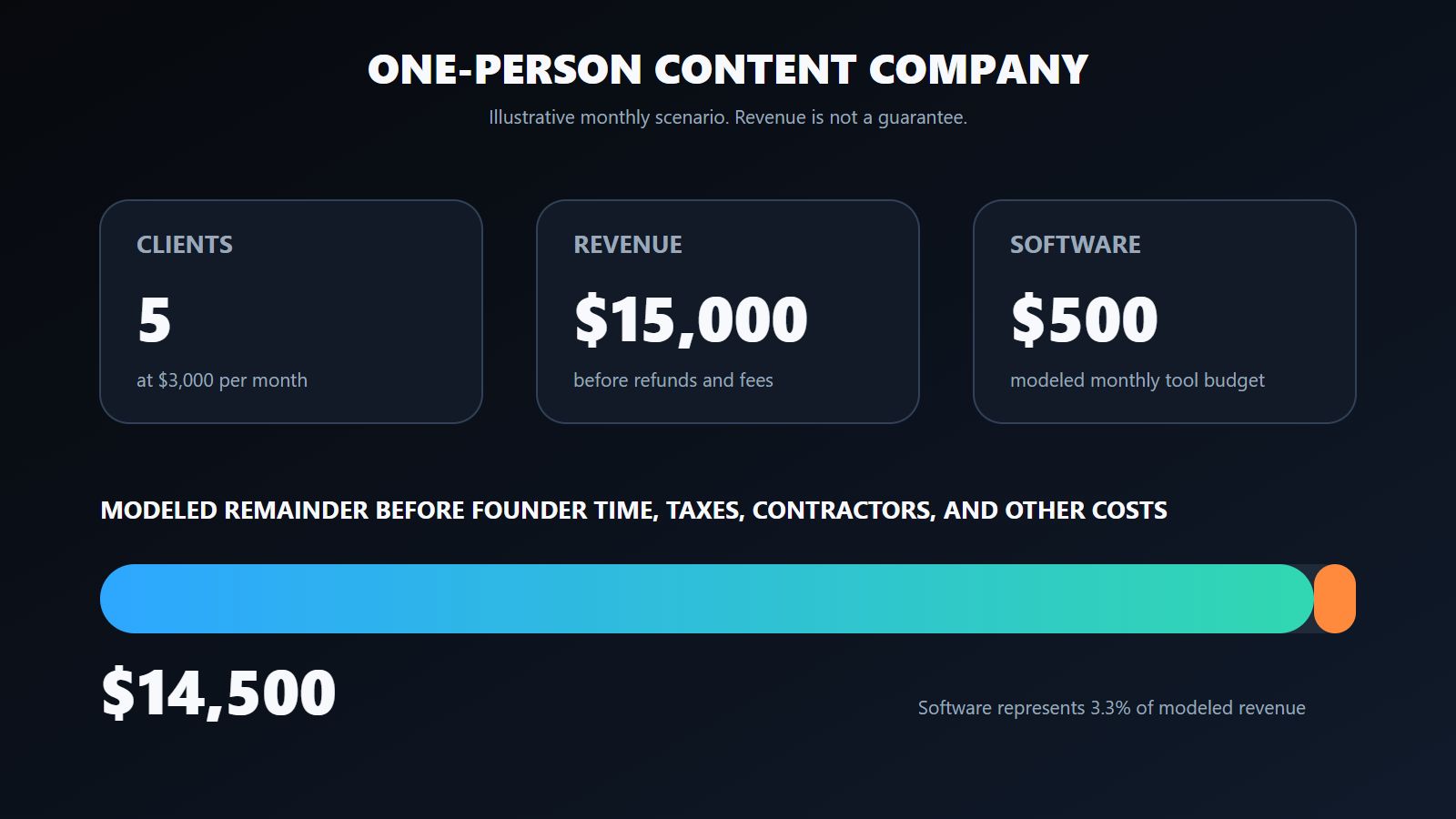
Illustrative offer: five clients paying $3,000 per month creates $15,000 in monthly revenue.
3. Sales research operation
Build prospect lists, score accounts, research decision makers, and prepare personalized outreach. Sell the prepared pipeline and approval queue, not promises of guaranteed meetings.
Illustrative offer: four clients paying $4,000 per month creates $16,000 in monthly revenue.
4. Customer operations service
Review support conversations, identify repeated issues, draft answers, and produce account-health summaries. The client keeps control of final customer communication while the Bots remove hours of sorting and preparation.
Illustrative offer: four clients paying $2,500 per month creates $10,000 in monthly revenue.
5. Grok Bot company builder
Design a specialized team for another business. Create the roles, connect its tools, test the workflows, save the skills, and install the routines. Charge a setup fee and a smaller monthly maintenance fee.
Illustrative offer: two $5,000 builds per month creates $10,000 in project revenue before maintenance.
These are business models, not income promises. The difference will come from the offer, the quality of the workflow, the founder's judgment, and whether real clients value the result.
What does the company cost?
Grok Bot is included with several eligible SuperGrok, Cursor, and Cursor Teams plans. At the time of writing, the public Grok Bot page shows eligible individual plans beginning at $60 per month, with higher tiers offering more usage.
A realistic model for a small operation might look like this:
Grok Bot plan and usage: $60 to $200 per month.
Supporting apps and storage: $70 to $150 per month.
Specialized data, automation, or creative tools: $70 to $150 per month.
Estimated tool stack: roughly $200 to $500 per month.
If a content company reaches five clients at $3,000 each, it produces $15,000 in monthly revenue. At a $500 software budget, that leaves $14,500 before the founder's time, contractors, taxes, payment fees, and other business costs.
The point is not that every reader will make $15,000. The point is that software cost is no longer the main barrier to assembling a surprisingly capable operation.
Your first company can be built tonight
Start smaller than the viral screenshots suggest.
Create one Chief of Staff and two specialists. Give them one real project. Watch where the handoffs fail. Improve the role descriptions. Save the successful process as a skill. Run it again. Then schedule the first routine.
Do not measure the experiment by how many Bots appear in the sidebar.
Measure it by whether a useful result arrives without you rebuilding the workflow from zero.
That is when Grok Bot stops feeling like another AI chat and starts feeling like a company.
Save this blueprint. The next business you build may begin with a job description instead of a job opening.
Published on grokbot.sh. Cite the public log, not a prompt pack.