
How to Build a Regime-Adaptive Trading Agent on Grok Bot
Most retail algo traders pick one strategy and marry it. Trend followers stay trend followers through the choppy, range bound weeks that chop trend systems to pieces. Mean reversion traders stay mean
Article
Job breakdowns
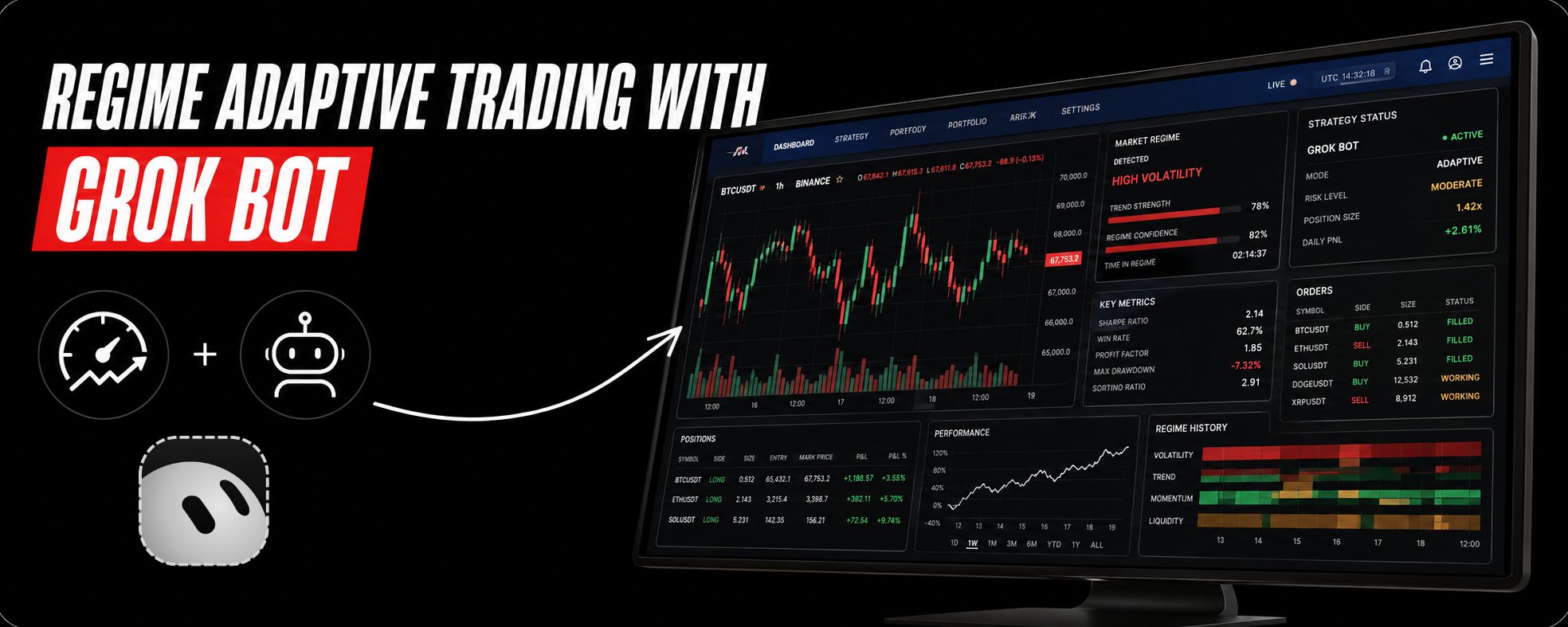
Most retail algo traders pick one strategy and marry it. Trend followers stay trend followers through the choppy, range bound weeks that chop trend systems to pieces. Mean reversion traders stay mean reversion traders through the breakouts that blow straight through their stop losses.
The market does not stay in one regime. Your strategy should not either.
That is the entire premise of regime adaptive trading. Detect which kind of market you are actually in, then run the strategy built for that regime instead of the one you happen to be attached to. But before that who am i?
I'm Venus, a senior quant systems architect and backend engineer. I've taken products from zero to one and scaled them from one to a hundred across AI, cloud, and fintech x DeFi infrastructure. I believe in building in the open, even when that means posting the internals other people keep behind a paywall. DMs are open if you want to talk shop.
One thing starting today. If you are already experimenting with regime detection or strategy switching on Grok Bot, DM me your current setup or reply below. First 10 replies, I will go through each one personally and show you exactly where the gap is between what you have and a system that actually knows which strategy it should be running right now.
This is the start of a new thread I am building on autonomous trading infrastructure, and this piece is the first real build in it.
Let's get into it.
This is not a new idea. Ray Dalio built Bridgewater's All Weather portfolio around the idea that different assets and strategies perform differently depending on the economic regime, and it has been running since 1996. AQR has published extensively on regime based asset allocation. Man AHL runs systematic trend and momentum strategies precisely because trend does not work in every environment, and they build the infrastructure to know when it does.
The math behind regime detection is public. The infrastructure to run it continuously, feed it clean data, and actually switch your live strategy without a human in the loop is what used to be out of reach for one person working alone.
By the end of this article you will know:
-
The Hamilton regime switching model that describes how a market can be modeled as bouncing between hidden states
-
Two retail accessible regime signals you can compute yourself, with the formulas
-
Where regime adaptive systems genuinely suit retail traders, and where the edge is thinner than it looks
-
The six bot Grok Bot architecture that runs the regime detection and strategy switching through plain conversation
-
The exact 8 step build to ship your first working version this weekend
Let's get into it.
Part 1: What Regime Adaptive Trading Actually Is
A market regime is a persistent state the market is in. Trending. Mean reverting. Calm. Volatile. Regimes are not fixed for good, they shift, sometimes for weeks, sometimes for months, and a strategy tuned for one regime often loses money in another.
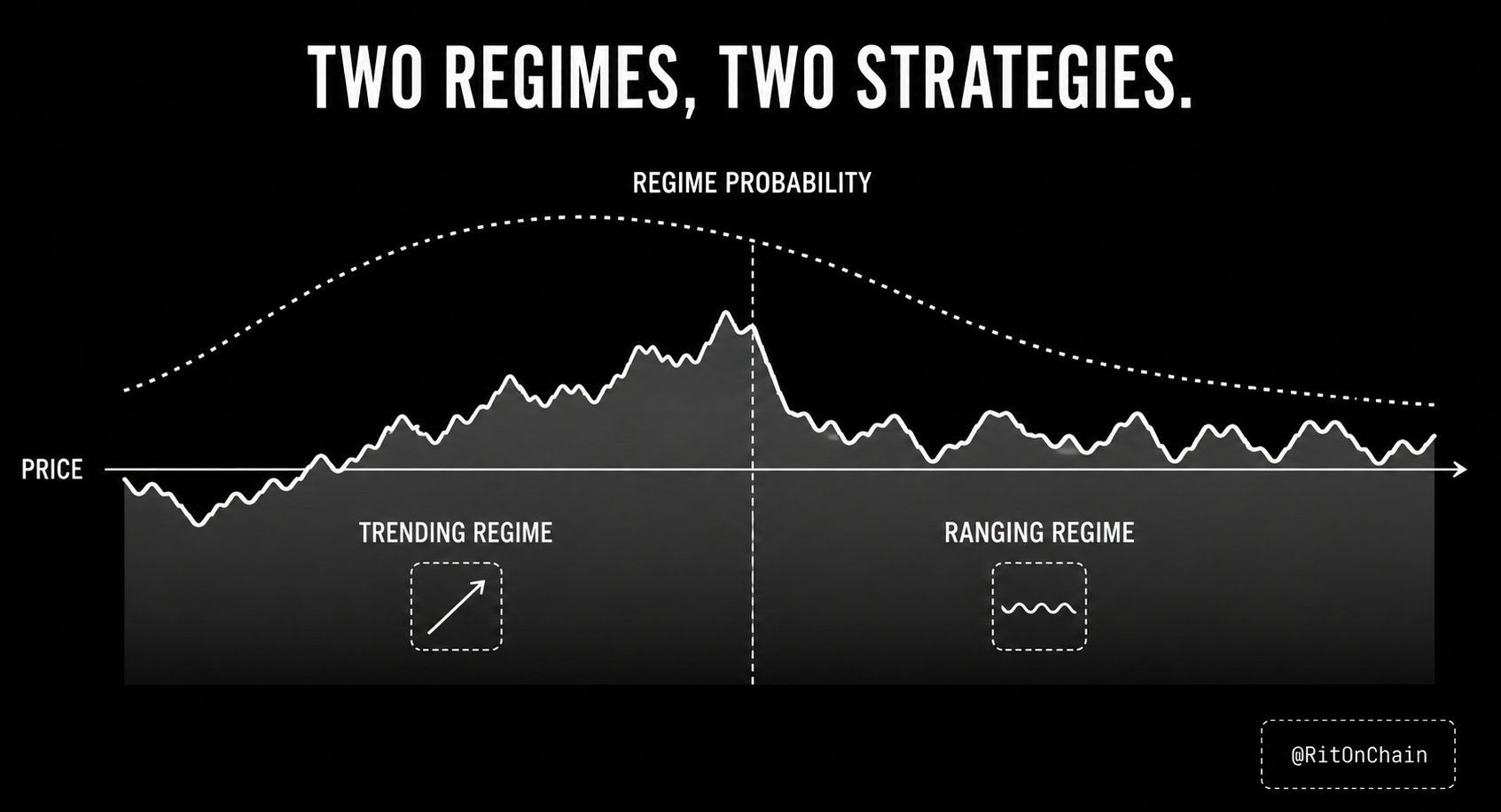
James Hamilton formalized this in 1989 in "A New Approach to the Economic Analysis of Nonstationary Time Series and the Business Cycle," published in Econometrica. The model treats the market as being driven by a hidden state s_t that can take a small number of values, for example 0 for a mean reverting regime and 1 for a trending regime. The state follows a Markov chain, meaning the probability of being in a given state next period depends only on the current state:
Given a history of returns, you can compute the filtered probability of being in each state right now using Hamilton's filter, which is a Bayesian updating procedure. In practice almost nobody outside an institutional research desk implements the full Hamilton filter for a live retail system. What retail traders actually use are simpler, faster proxies that correlate with the same underlying idea.
Two of them are worth knowing.
The Hurst exponent, H, measures whether a price series behaves like a trending series, a mean reverting series, or a random walk. It is estimated from the rescaled range of the series:
Where R/S is the rescaled range over a window of length n. H above 0.5 suggests trending behavior. H below 0.5 suggests mean reversion. H near 0.5 suggests something close to a random walk, where neither strategy has a real edge.
The Average Directional Index, ADX, developed by Welles Wilder in 1978, is the more common retail tool. It is built from the smoothed directional movement of price:
ADX above roughly 25 usually signals a trending market. ADX below roughly 20 usually signals a ranging, mean reverting market. Everything in between is a gray zone, and that gray zone is where most regime detection systems get whipsawed.
Part 2: Where This Genuinely Works for Retail, and Where It Does Not
Unlike market making, this is not a latency game. Regimes shift over hours, days, and weeks, not microseconds. Nobody is picking you off with a colocated server because you were 50 milliseconds slow to notice the market turned choppy. That is the part of this that genuinely favors a patient retail builder over an institutional desk built for speed.
What it does not solve is overfitting. A regime detector tuned to the last two years of data on your favorite pair will often find "regimes" that were really just noise, and it will confidently switch you into the wrong strategy at the wrong time going forward. Backtested regime edges shrink live more often than people admit.
Whipsaw is the other honest cost. In choppy transition periods, ADX and Hurst can flip back and forth, and if your Strategy Bot is naive it will switch into trend right before the range resumes and switch into mean reversion right before the breakout happens. Any real system needs a confirmation delay or a confidence threshold before it acts on a regime flip, not just a single reading crossing a line.
Do not expect this to remove the need for genuine risk management. It changes which strategy is live. It does not guarantee either strategy makes money in any given week.
Part 3: The Grok Bot Interface Layer
Grok Bot is xAI's agent platform. Every named bot you create runs on one persistent cloud computer tied to your account, with its own browser, filesystem, and terminal. You talk to a bot the way you would message a coworker. It keeps memory and files across sessions, so the context you built last week is still there today.
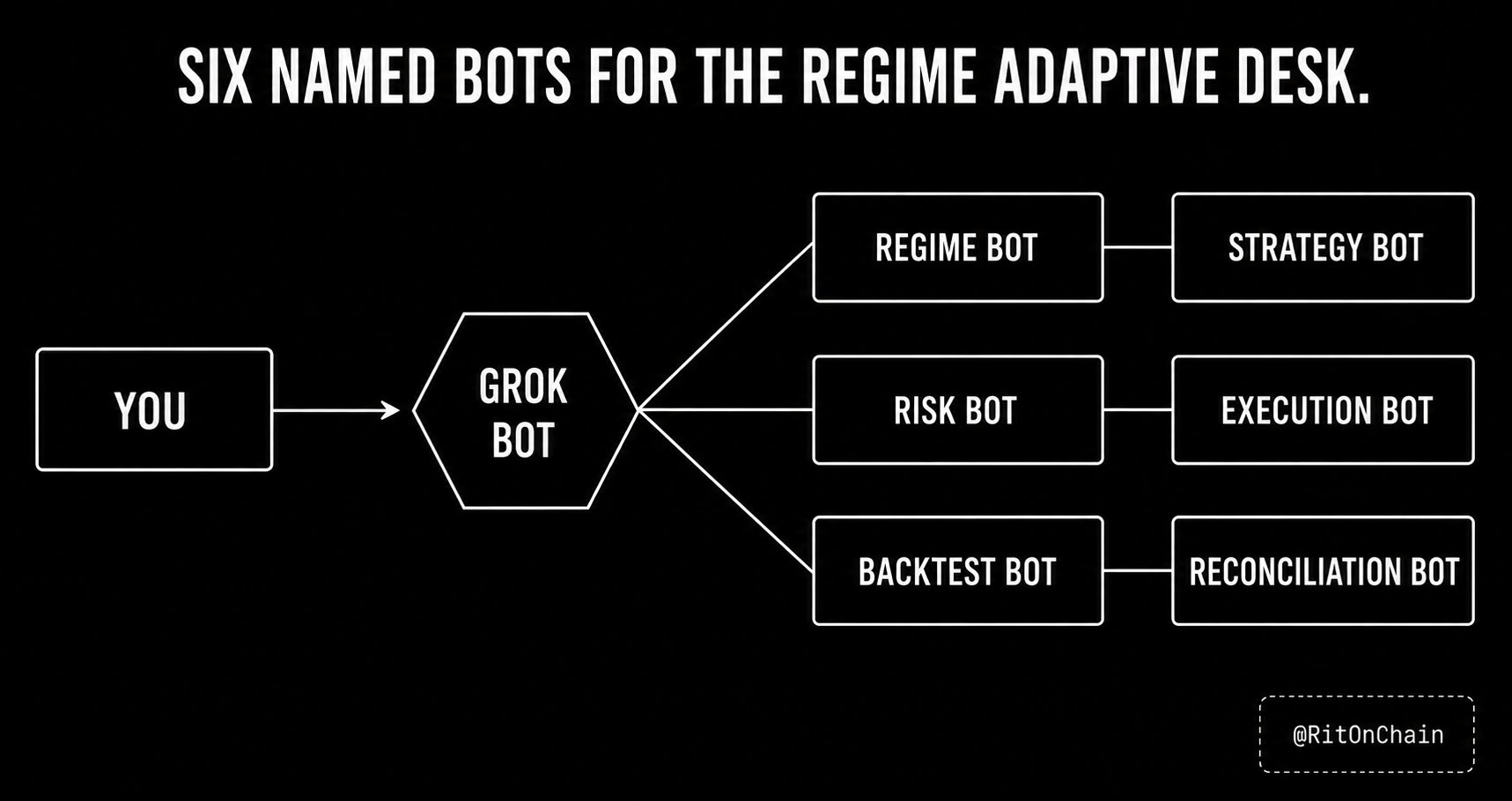
For a regime adaptive desk you deploy six named bots.
Regime Bot. Computes ADX and the Hurst exponent on a rolling window for each asset you are tracking. Publishes a regime label, trending, ranging, or transitional, along with a confidence score, to a shared file every few minutes. Requires the new regime to hold for a minimum confirmation period before it is treated as a real flip instead of noise.
Strategy Bot. Holds two modules internally. A trend following module, for example a moving average crossover or breakout entry. A mean reversion module, for example a z score reversion to a rolling mean. Reads the current regime label from Regime Bot. Activates the matching module and deactivates the other. Never runs both at once on the same position.
Risk Bot. Enforces hard limits. This bot has no negotiation authority. Daily drawdown above your configured limit pulls all open orders and halts new entries for the rest of the session. Position size is capped as a fixed fraction of account equity, reduced automatically during the transitional regime label, since that is where confidence is lowest.
Execution Bot. Only sends an order once Strategy Bot and Risk Bot agree. Routes orders to the connected venue's API.
Backtest Bot. Writes and iterates the actual Python for the regime signals and both strategy modules, using its own terminal on the shared Grok Bot computer. Runs historical backtests whenever you change a parameter, and reports the result back in plain language.
Reconciliation Bot. Checks every fill against what Execution Bot expected. Flags slippage, missed orders, and any mismatch between the venue's reported position and your internal record.
You talk to these bots in plain English. To Risk Bot:
"Cap position size at 2 percent of equity per trade. Cut that to 1 percent during any transitional regime. Pull all orders if daily drawdown exceeds 4 percent."
Risk Bot updates its rules immediately. No config file, no redeploy.
To Regime Bot:
"Require ADX confirmation for at least 3 consecutive readings before flipping the regime label, so we are not whipsawed on a single noisy bar."
Part 4: The Wall I Kept Hitting Before This
Before I moved this onto Grok Bot, I tried to run a version of this by hand for months, and I hit the same three walls every time.
The regime detection code lived in a notebook that reset every time I closed my laptop. Every session started from zero context.
Switching strategies required me to notice the regime had changed and manually swap which script was live. By the time I noticed, the regime had often already turned again.
There was no live view of any of it. Current regime, which module was active, recent switches, all of it lived in scattered print statements, not a screen I could actually look at.
Grok Bot closes all three because it is one persistent machine per user, not a notebook that forgets you between sessions. The bots keep state, keep files, and keep the conversation history, so the context compounds instead of resetting every time you come back.
Grok Bot is not just the cockpit here. On this build it is the cockpit and the engine room in the same machine.
Part 5: The Exact 8 Step Build
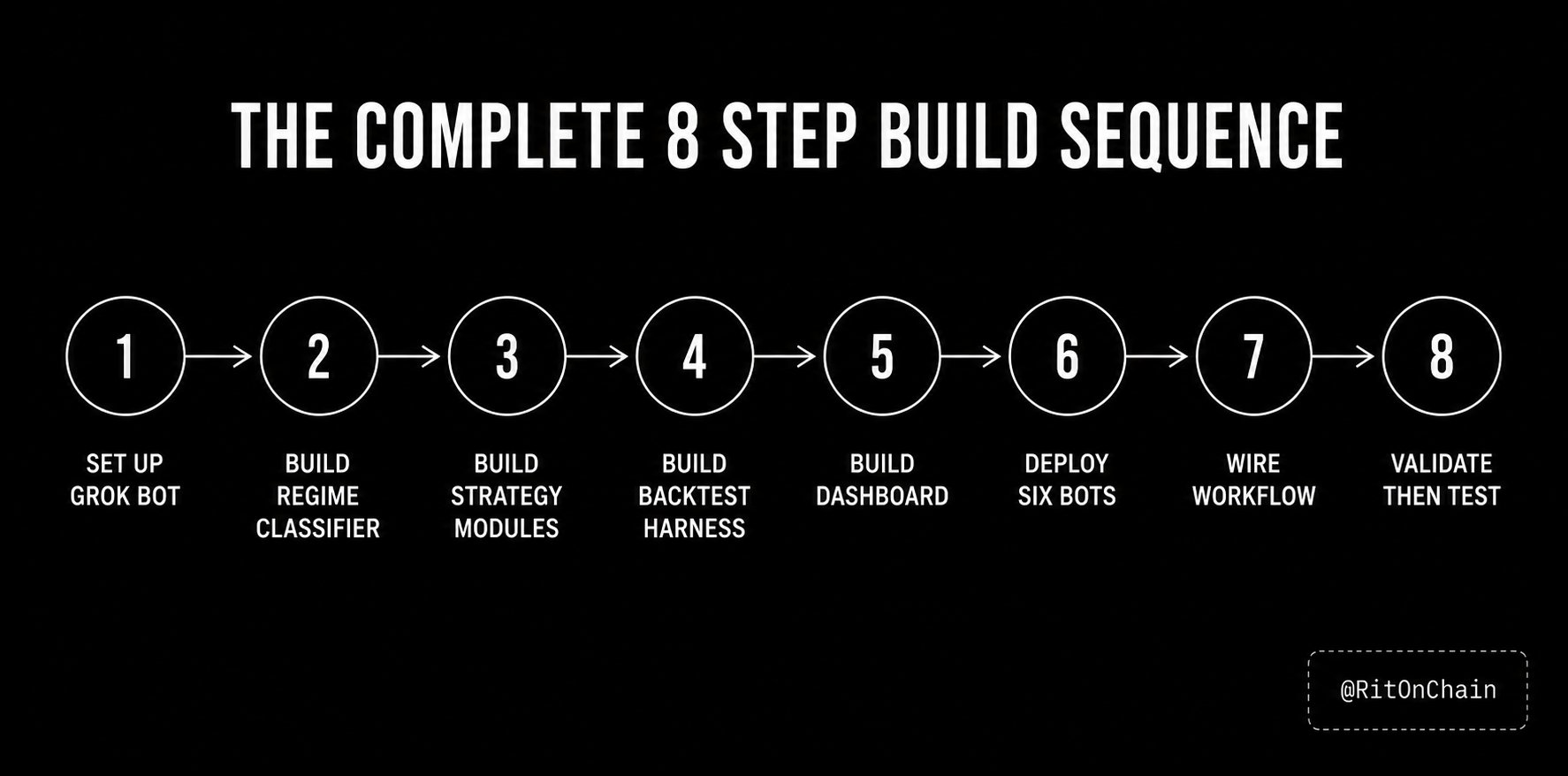
Step 1: Set up Grok Bot. Create the workspace folder structure inside your Grok Bot computer: /workspace/regime/ /workspace/strategy/ /workspace/fills/ /workspace/risk/ /workspace/dashboard/ /workspace/config/
Step 2: Have Backtest Bot build the regime classifier (Grok Bot message) :
Build a Python regime classifier. Compute ADX using Wilder's smoothing on a 14 period window, and the Hurst exponent using the rescaled range method on a rolling 100 period window, for each asset in a config list. Label the regime as trending if ADX is above 25, ranging if ADX is below 20 and Hurst is below 0.5, and transitional otherwise. Require the new label to hold for 3 consecutive computations before it overwrites the current label in /workspace/regime/current.json. Write the label, both raw indicator values, and a timestamp on every run.
Step 3: Have Backtest Bot build both strategy modules (Grok Bot message) :
Build two strategy modules in the same codebase. A trend following module using a fast and slow moving average crossover with a trailing stop. A mean reversion module using a z score of price against its rolling mean, entering when the z score exceeds a configurable threshold and exiting on reversion to the mean or a stop loss. Both modules read the current file in /workspace/regime/ but only the module matching the active label is allowed to open new positions.
Step 4: Have Backtest Bot build a backtesting harness (Grok Bot message) :
Build a backtest harness that replays historical price data through the regime classifier and both strategy modules together, so I can see what the combined system would have done, not each module in isolation. Report total return, max drawdown, number of regime flips, and how many trades were entered right before a regime reversal.
Step 5: Build the live dashboard (Grok Bot message) :
Build a live dashboard as a local web app. Top strip shows the current regime label, confidence, and which strategy module is active, for each tracked asset. Center panel shows a price chart with a shaded background marking trending versus ranging periods. Right panel shows recent regime flips with timestamps. Bottom strip shows an equity curve and current drawdown against the configured limit. Dark theme. Refresh every few seconds.
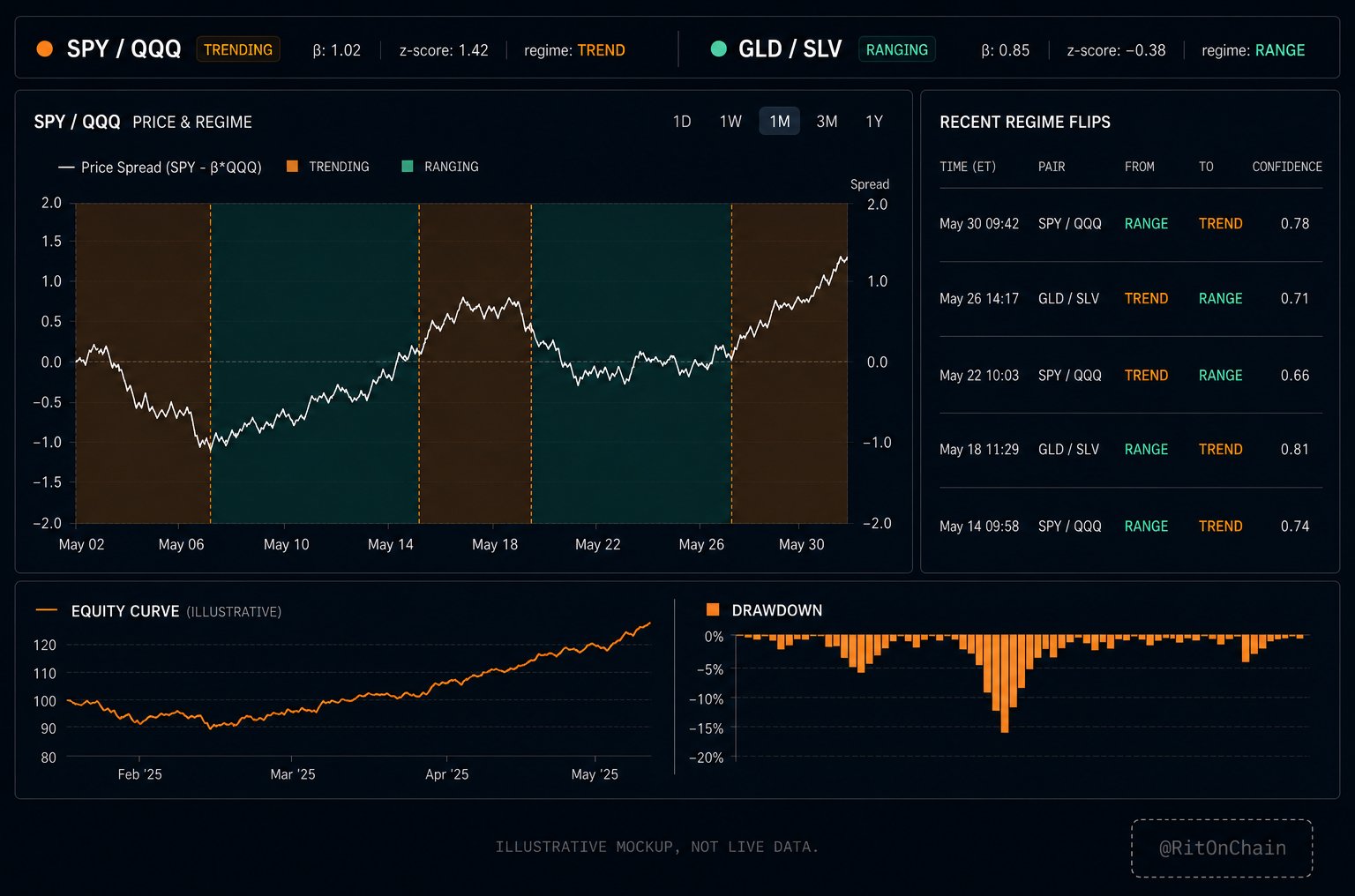
Step 6: Deploy the six Grok Bot interface bots. Create Regime Bot, Strategy Bot, Risk Bot, Execution Bot, Backtest Bot, and Reconciliation Bot as named bots in your Grok Bot sidebar. Paste each role description from Part 3 as that bot's instructions.
Step 7: Wire the workflow together. Regime Bot writes to /workspace/regime/. Strategy Bot reads that file and decides which module can trade. Risk Bot checks every proposed trade against your limits before Execution Bot is allowed to send it. Reconciliation Bot checks the result afterward. The dashboard reads all of it.
Step 8: Validate before you risk anything. Run the backtest harness across at least two full market cycles, not just the calm months. Then paper trade the live system for a stretch before it ever touches a real account. If you do move to real capital, size it as money you are fully prepared to lose, start small, and let Reconciliation Bot log every single fill so you know what actually happened, not what you assume happened.
Summary
Regime adaptive trading means detecting which kind of market you are in and running the strategy built for that regime instead of the one you happen to like.
The math is public. Hamilton's regime switching framework, ADX, and the Hurst exponent are all documented and free to use.
Unlike market making, this is not a latency race, which is exactly why it is one of the more honest places for a retail builder to spend time.
The six bot Grok Bot architecture, Regime Bot, Strategy Bot, Risk Bot, Execution Bot, Backtest Bot, and Reconciliation Bot, runs the whole loop through plain conversation on one persistent machine.
Honest scope on what this replaces. Manually watching for a regime shift. Manually swapping which strategy file is live. Hiring someone to build a dashboard just to see your own system's state.
Honest scope on what this does not replace. A guarantee that either strategy makes money in any given regime. Genuine statistical validation across more than one market cycle. Your own risk judgment. This is not financial advice, and nothing here substitutes for deciding for yourself how much, if anything, you are willing to risk.
If you want to build this, start with Grok Bot and the eight steps above. Then DM me your setup. I will go through the first 20 configurations personally.
Follow to stay ahead on agentic trading tech, before everyone else catches up. Quote tweets appreciated !
Published on grokbot.sh. Cite the public log, not a prompt pack.