
HOW TO BUILD AN SMM STUDIO WITH GROK BOT WHERE STAFF IS 5 BOTS AND ONE HUMAN?
Org chart, charters, the weekly clock, the approval fence, working code, and the unit economics that decide whether it is a business. Everyone is writing about Grok Bot as a productivity toy.
Article
Job breakdowns
Org chart, charters, the weekly clock, the approval fence, working code, and the unit economics that decide whether it is a business.
Everyone is writing about Grok Bot as a productivity toy. Summarise my PDF. Sweep my inbox. Nice.
Nobody is writing about the only thing that actually matters: it is the first AI product you can put on a payroll line and charge clients for.
An SMM studio is the cleanest business to test that with. The work is repetitive, the output is checkable in ten seconds, and the delivery is 80 percent of the cost. That is exactly the shape of work a bot with its own computer can carry.
Here is the whole build. Org chart, charters, the weekly clock, the approval fence, the code, and the unit economics. Take it and run it tonight.
WHY AN SMM STUDIO AND NOT SOMETHING ELSE
Pick the wrong business for this and you will spend a month learning nothing.
A good first business for agent delivery has four properties:
-
The work repeats every week. Same shape, different content.
-
A result can be checked in seconds, not hours. You look at a post and you know.
-
Nothing is irreversible until a human clicks. Drafts are free. Sending is not.
-
The client pays for outcomes, not for your hours. Otherwise automation cuts your own revenue.
An SMM studio hits all four. So does newsletter production, app store optimisation, and competitor monitoring. Bookkeeping and anything regulated fails property three and you should not start there.
THE ONE FACT THE WHOLE BUSINESS RESTS ON
On 11 August 2026 xAI launched Grok Bot. Strip the marketing and one thing matters:
Each bot gets a real computer in the cloud with a browser, a filesystem, a terminal and your logins, and it keeps working when your laptop is shut.
That is the difference between a tool and a member of staff. A chat window forgets you when you close the tab. A bot has a desk that outlives the conversation, and a clock it runs against.
Two things about that computer decide how you design everything else:
-
All your bots share one machine. Sign in once and every bot you create later is already through the door. Convenient, and also the reason it is not a security boundary.
-
/workspace is the durable area. Anything installed outside it can disappear on a rebuild. Client files, logs and evidence live under /workspace or they do not exist.
THE ORG CHART
The single most expensive mistake is treating a bot like a search box. You ask it something, read the answer, close it. That is using an employee to do the job of Google.
Do this instead: name each bot after a job a real person could hold, and give it one thing it owns.
Five roles run a studio serving up to about eight clients:
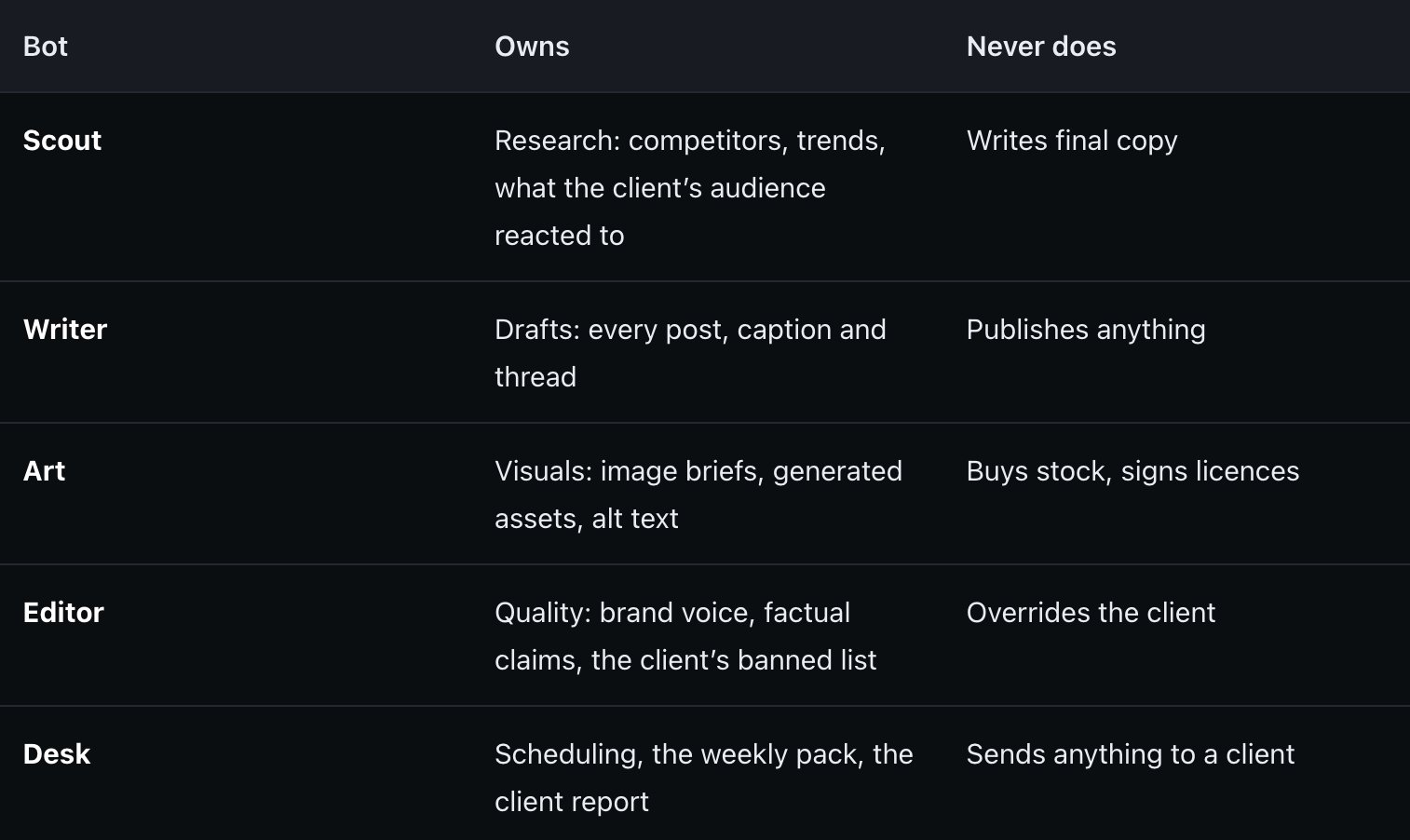
Five is not arbitrary. Grok Bot supports groups of two to six bots that message each other asynchronously, and past six the handoffs get muddy and the same work lands twice.
CHARTER VERSUS TASK, AND WHY PEOPLE GET THIS WRONG
There are two documents and only one of them is meant to last.
The charter is the hire. It says what the bot owns forever, what a finished result looks like, and the line it must never cross without asking. Written once. Four sentences.
The message is today’s job. Written every time.
If you find yourself rewriting the charter every morning, you have not written a charter. You have written a to-do list with a name on it.
Here is the Writer charter. Copy it, change the brand line, paste it into the bot description.
Three sentences describe the job. The fourth is the fence. A whole week of output can be audited against that paragraph without opening a transcript.
Every daily message carries five fields. Leave one out and the bot comes back to ask before it starts, which costs you the evening you were trying to save.
THE FENCE
An agent that is never told where to stop will decide for itself what is reversible, and it will decide generously.
Paste this into every bot in the studio. Two lists, no exceptions.
Two honest notes most people skip.
An approval covers the action about to happen, not the work behind it. Saying yes does not undo what already ran.
The shared computer is a real blast radius. Every bot sees the same files, sessions and logins. Keep banking, payroll and anything you would not hand to a contractor entirely off that machine.
THE WEEKLY CLOCK
This is where a tool becomes staff. You do a task once while the bot watches its own screen, it saves the flow as a named skill, and then a routine fires it on a schedule.
The studio runs on four routines. Times are examples, the structure is the point.
Monday 07:00 - Scout, research pack
That last clause is not optional. Without it the Monday pack quietly repeats itself and by Thursday you are selling the client last week’s internet.
Monday 12:00 - Writer, drafts
Fires only after research.md exists. Writes drafts.md. Stops.
Tuesday 10:00 - Art, visual briefs
Fires only after drafts.md exists. Produces a brief and an asset per post, into /assets/.
Wednesday 09:00 - Editor, the gate
The two round cap matters more than it looks. Without a stop rule the loop runs until you notice, and the tenth revision is never better than the second.
Thursday 17:00 - Desk, the client pack
Assembles everything into one folder, writes the report, and stops at the fence. You send it.
THE FILE LAYOUT
Everything lives in files, not in chat memory. Chat memory is not a system of record and it cannot be handed to a new bot.
voice.md is the file that decides whether this business works. Five example posts the client loved and five they hated beats three paragraphs describing the tone. Show, do not describe.
THE CODE
Three pieces. All of them run on the bot’s computer under /workspace.
- Scaffold a new client in one command
One command, one client, same structure every time. Structure is what lets a bot find things without asking you.
2. Score every draft before a human reads it
This is the piece that saves the most time. Do not let the Editor bot burn a review round on posts that fail an obvious rule. Score them locally first with the xAI API and only escalate what passes the floor.
Never log tokens, passwords, cookies or raw client credentials. Each record carries the previous record’s hash, so a later edit is detectable. It is not tamper proof, and it does not need to be. It needs to answer one question fast: who did what, when, and did a human approve it.
That log is also your defence the first time a client asks why a post went out.
THE UNIT ECONOMICS
This is the part everyone leaves out, and it is the only part that makes it a business.
Costs, monthly
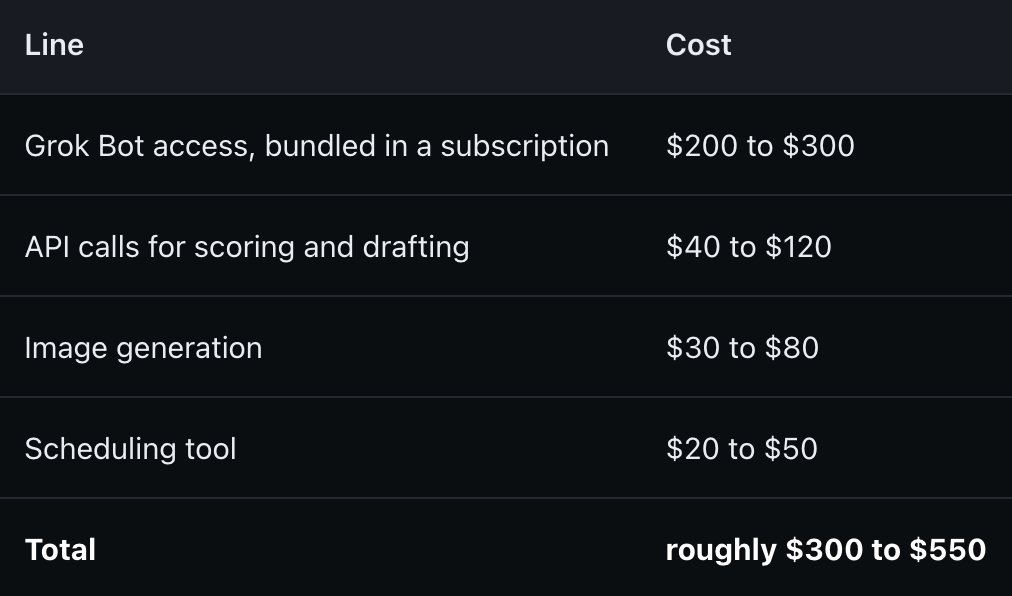
Grok Bot has no standalone price yet. Access comes bundled: SuperGrok Heavy at $300 a month, Cursor Ultra at $200, or Cursor Teams Premium at $120 per seat. No free tier for the agent.
Revenue
A small studio charges $800 to $2,500 per client per month for managed social. Take the conservative end at $1,000.
The maths
-
One client covers the entire tool stack twice over
-
Break even lands inside the first client
-
The delivery cost per additional client is API calls, roughly $15 to $40 a month
-
Your real constraint is not compute, it is review time
Budget 90 minutes per client per week for review, approvals and the client call. That is the number that caps the business. At 20 hours of review a week you can carry about eight clients solo, which is $8,000 a month against about $600 of cost.
The moment you hire a second human reviewer, the ceiling moves, not the cost base. That is a different shape of business from the agency model, where every new client needs new hours.
WHAT ACTUALLY BREAKS
Four things, in the order you will meet them.
The browser trips. Grok Bot is in beta. A redesigned page or a popup can stall an agent mid task. Where a real connector exists, use it instead of the browser. A connector does not break the week a site moves a button.
The recording is not judgment. A recorded skill captured your clicks, not your reasoning. The first time reality does not match the recording it will do something confident and wrong. Add the rules yourself, in writing.
Stale data looks like fresh work. Every routine needs the clause: if the source will not load, say so and stop, do not reuse yesterday’s file. Without it the Monday pack silently repeats and nobody notices until a client does.
Voice drift. Around week three the drafts start sounding like a competent stranger. Fix it by adding anti-examples to voice.md, not by writing longer instructions. Five posts the client hated teaches more than a page of adjectives.
THE FIRST SEVEN DAYS
Do not start with a paying client. Start with your own account.
Day 1. Create Scout and Writer. Write both charters. Nothing else.
Day 2. Run one week of content for yourself, by hand, in the bot. Watch where it stalls.
Day 3. Turn the flow you just did into a skill. Add the fence to both bots.
Day 4. Add Editor and the two round cap. Wire in score_drafts.py.
Day 5. Add Art and Desk. Run the whole clock end to end on your own account.
Day 6. Take one friendly client at half price, explicitly as a pilot. Tell them a human approves everything. That sentence sells better than any capability claim.
Day 7. Read the log. Find the step you touched most. Automate that one and nothing else.
THE HONEST VERSION
This is real, it is powerful, and it is rough at the edges. All three are true at once.
What changed is not that AI got smarter. It is that the work finally has somewhere to live that outlives the conversation, an owner, and a clock. You stop being the router copying information between five chat windows.
The studio still has an owner. It just no longer has to have a single worker.
Pick the ugliest repeatable thing in your week. Hire one bot for it tonight. Write the charter like a real job description, put a fence around it, and let it run.
Then come back in the morning and see what is waiting.
Published on grokbot.sh. Cite the public log, not a prompt pack.