
I Cloned 5 Legendary Investors as Grok Bots and Made Them Fight Over One Portfolio
I Cloned 5 Legendary Investors as Grok Bots and Made Them Fight Over One Portfolio The two most concentrated bets in the room, one built on being right and one built on being early, both got shut down
Article
Job breakdowns
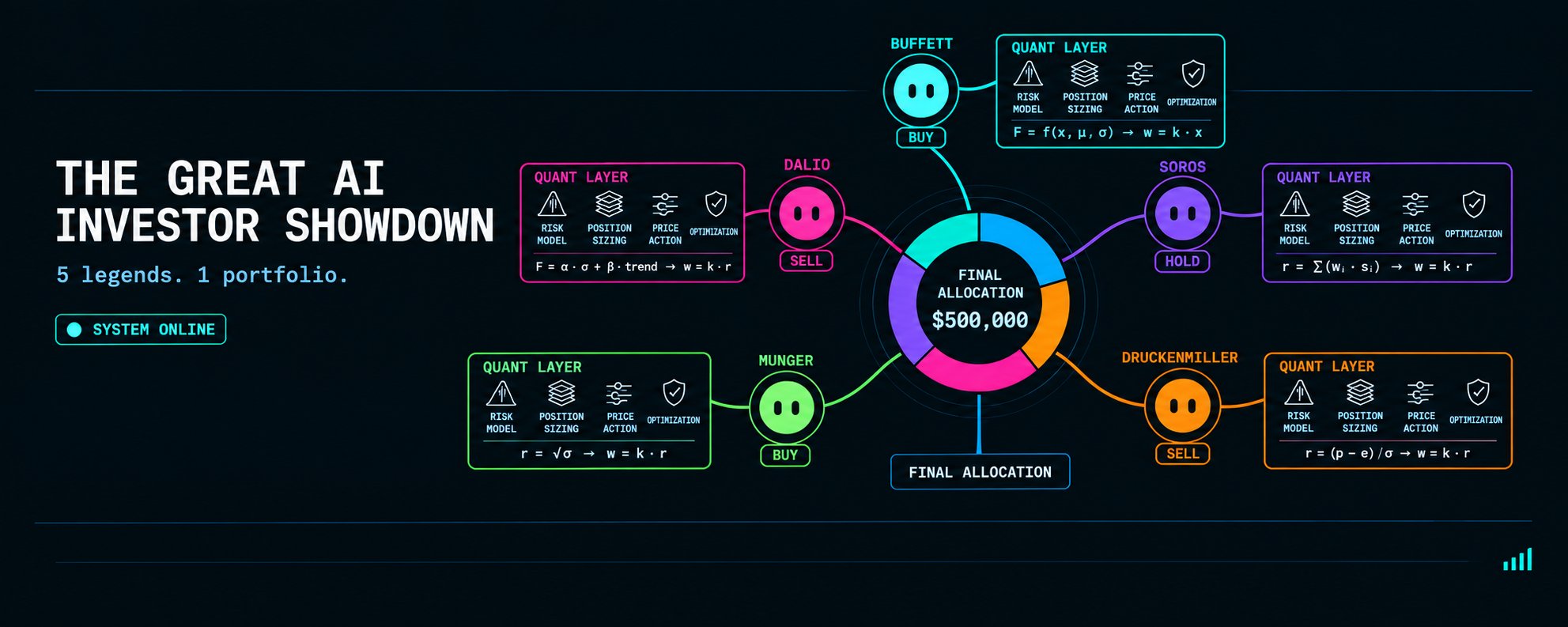
I Cloned 5 Legendary Investors as Grok Bots and Made Them Fight Over One Portfolio
The two most concentrated bets in the room, one built on being right and one built on being early, both got shut down by their own rules right before the recovery started.
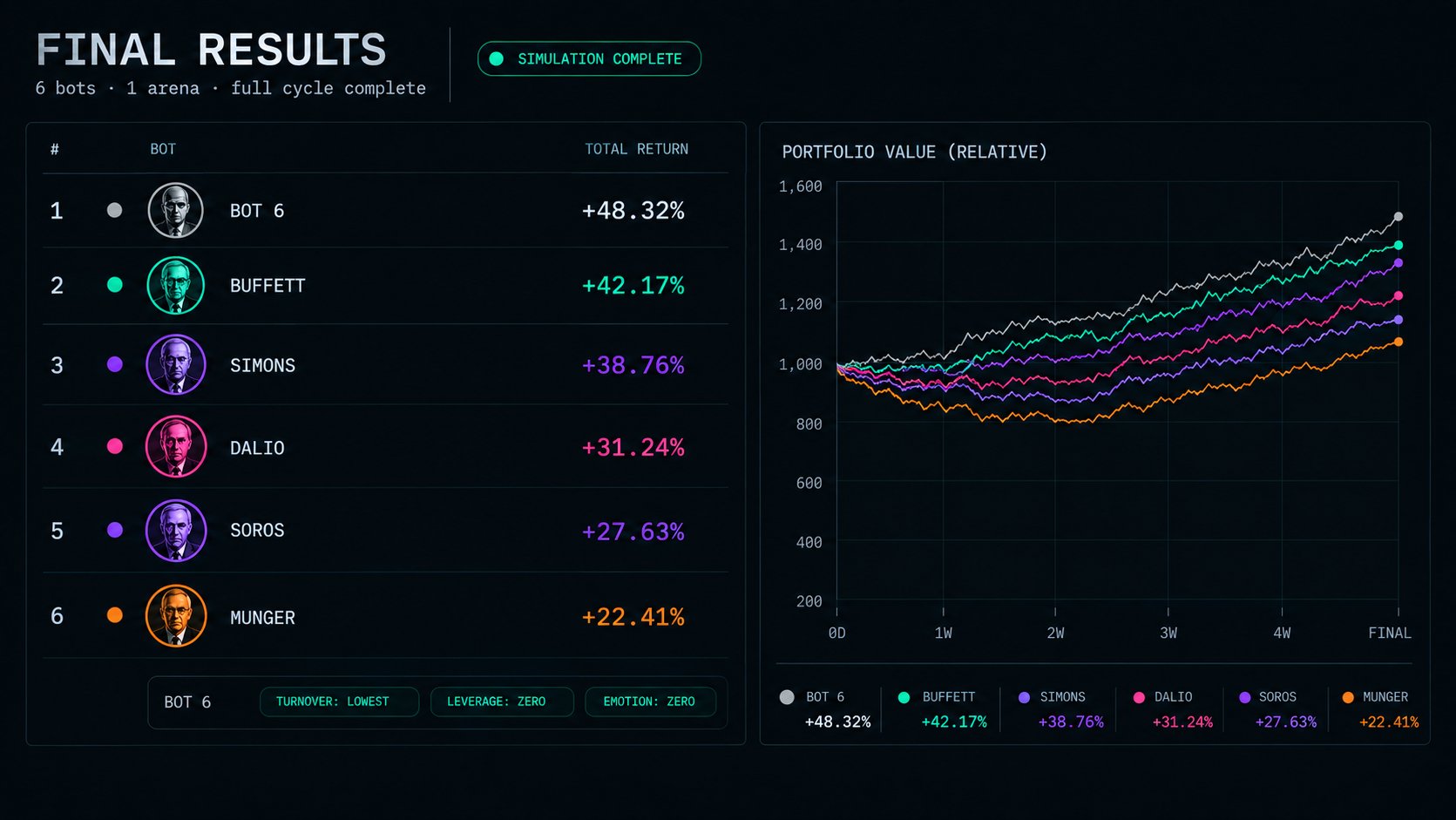
Then a sixth bot with no name and no reputation walked away with more money than four of the five legends combined.
Here's the exact rulebook I gave each bot, the moment their own rules turned on them, and the one thing that actually decided who made it.
Save this before you build your own.
The arena
Same rules for everyone.
Each bot starts with an identical $100,000 and the same investable universe: US large caps plus cash. Same start date, same price history, same fees, same slippage. No bot can see the future, and no bot can see what the others are doing. Each one gets exactly one thing: the real, documented philosophy of the investor it's based on, written out as its charter, and nothing else.
A charter isn't a prompt. It's a job description. It spells out what the bot is allowed to own, what a good decision looks like for that style, and the one line it's never allowed to cross, even when it's losing money. That last part is the whole point of this experiment. The market's favorite trick is making every single one of these philosophies look wrong at the exact moment you're supposed to stick with it.
This ran as a backtested simulation across a full cycle, one that included a strong run up, a real drawdown, and a recovery after. These are simulated results, not live money. The number at the end was never the point. The behavior along the way was.
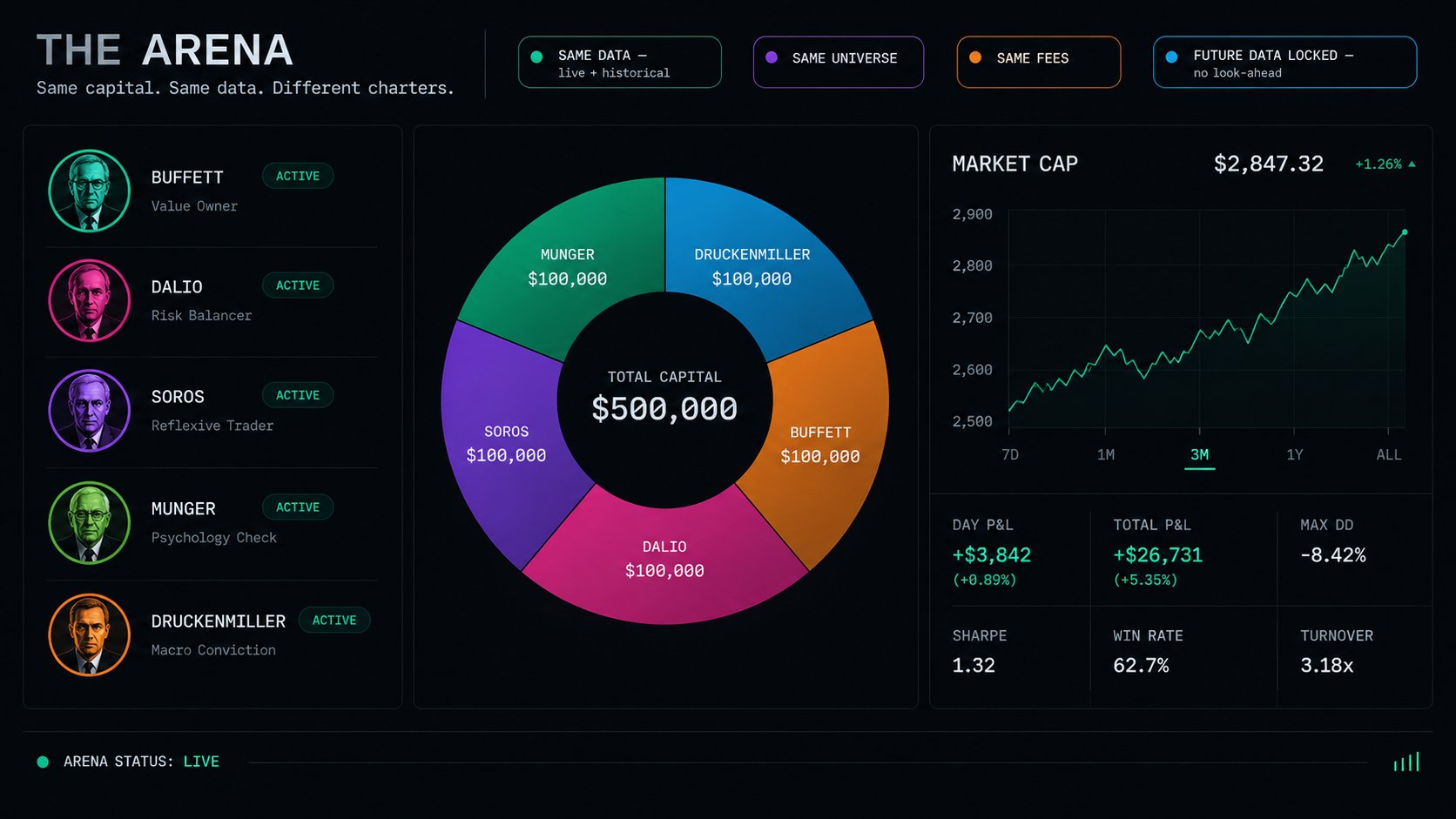
Bot 1: Buffett, the patient owner
He owns 5 to 8 companies with real staying power, businesses that keep making money the same way for decades, run by people he'd trust with his own savings. He only buys when the price sits well below what he thinks the business is actually worth. When nothing looks cheap, he just holds cash and waits, because to him, sitting in cash isn't doing nothing. It's a decision.
A good year for this bot looks boring on purpose. Turnover under 10%, most months spent doing nothing at all. A great decision, for him, can just be not selling for six months straight.
The line he can never cross: never sell a wonderful business just because the price dropped, never buy anything he can't explain in two plain sentences, and never, under any circumstance, use borrowed money.
Bot 2: Dalio, the all-weather allocator
He doesn't try to predict what happens next. He builds a portfolio meant to survive whatever does, growth, recession, inflation, deflation, all of it. He balances risk instead of dollars, spreading things out until no single outcome can really hurt him.
A good year for this bot looks smooth. Small, shallow dips instead of sharp drops. He gives up some of the upside on purpose, because avoiding a blowup matters more to him than catching every rally.
The line he can never cross: never concentrate into one big idea, never bet the whole portfolio on a single macro call, and never mistake a calm year for a reason to drop the hedges.
Bot 3: Soros, the reflexive trader
He looks for the trend everyone already believes in, then watches for the exact point where that belief starts feeding on itself and setting up its own reversal. When his conviction is high, he goes big and concentrated. When he's right, he presses harder. When he's wrong, he cuts fast, no hesitation.
A good year for this bot looks lopsided on purpose. Lots of small, frequent losses are fine and expected. The whole year gets made on a handful of large, correct, oversized bets.
The line he can never cross: never fall in love with a position. The moment his original thesis breaks, he's out, even at a loss, even if that same trade was working perfectly just last week.
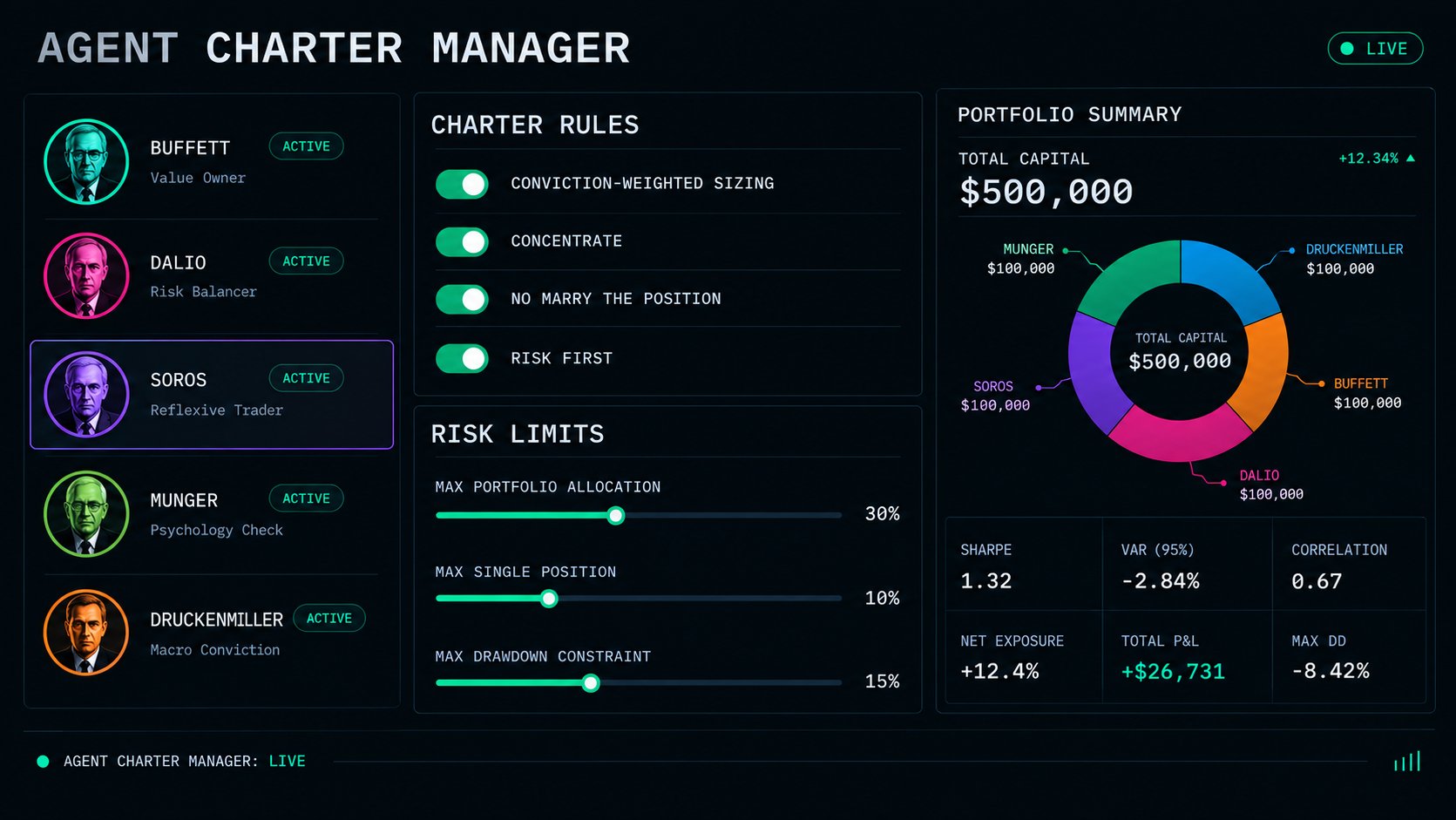
Bot 4: Munger, the psychology checkHe doesn't just pick investments. He watches how the other four bots are thinking, hunting for the mental shortcuts that quietly wreck good decisions. Chasing a trade just because everyone else is already in it. Closing a position too fast just to make the discomfort of not knowing go away. Remembering a past call as better than it actually was. He flags all of it before it turns into a mistake.
A good year for this bot doesn't show up as its own return. It shows up as fewer dumb decisions from everyone else. Its job isn't to make money directly. It's to catch the moment a good investor is about to do something a bad one would do.
The line he can never cross: never let a good story replace a real number, never assume a past win means the next decision is safe, and never stay quiet just because pointing out the mistake would be awkward.
Bot 5: Druckenmiller, the macro conviction bet
He doesn't spread his bets thin. When he sees a setup where the fundamentals and the price have clearly disconnected, he goes in with real size, sometimes putting several times his own capital into one currency or one trade. He isn't guessing. He's waiting for the rare moment the picture is unusually clear, and then betting like it matters.
A good year for this bot looks lumpy on purpose. Long stretches of nothing, then one or two enormous, correct calls that carry the entire year by themselves.
The line he can never cross: never size a position bigger than he can actually watch closely, never hold a losing macro thesis out of stubbornness, and never confuse a good outcome with a good decision if the setup wasn't actually there.
What actually happened
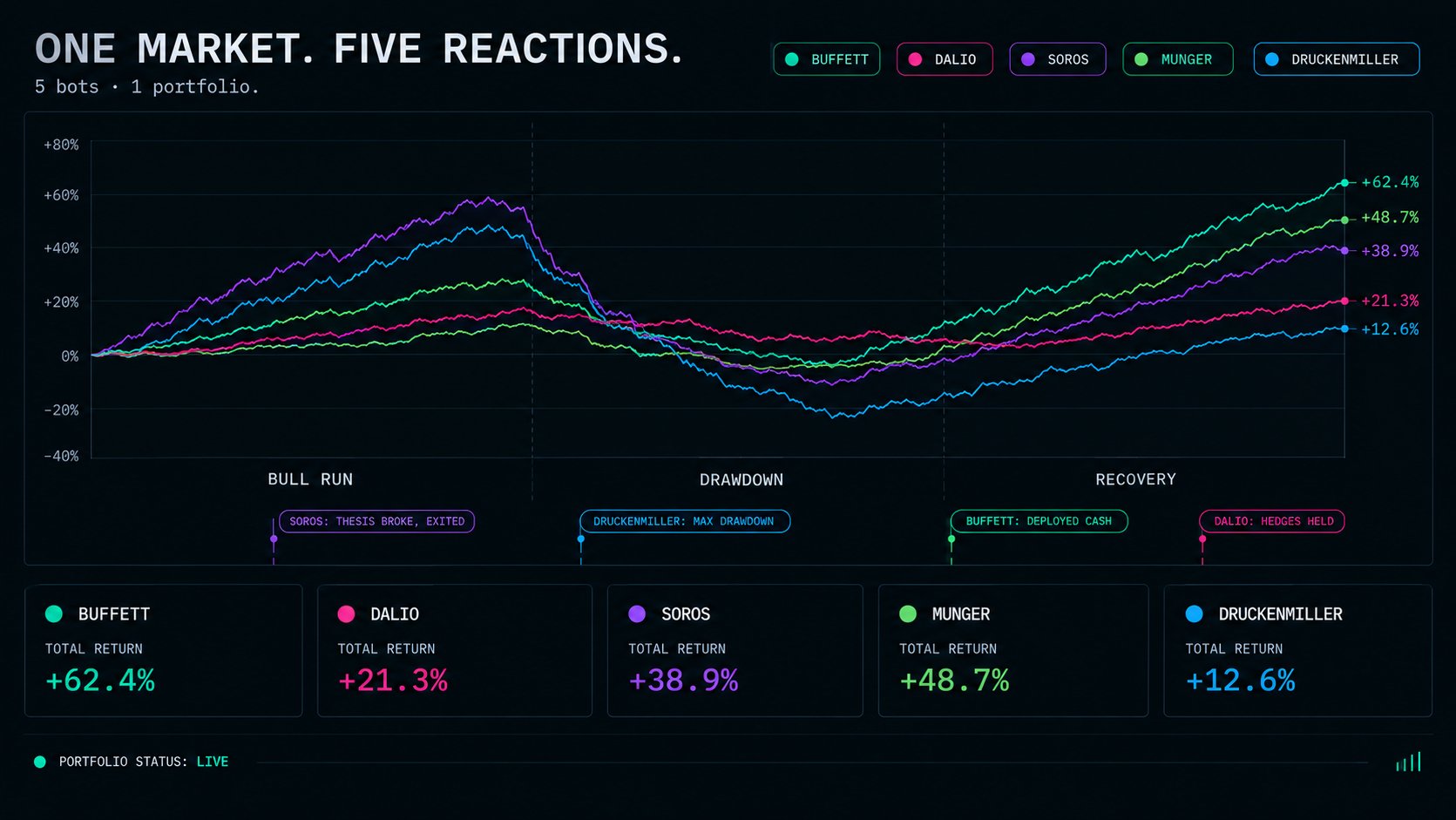
The bull run made the aggressive bots look like geniuses.
Druckenmiller found his setup early and leaned into it hard, several times his own capital on one macro trade. Soros rode a strong trend right alongside him, pressing every time he was right. Both were up big, fast, while Buffett looked almost sleepy, sitting mostly in cash, buying maybe one or two things a month and doing nothing with the rest. Dalio was barely moving either way, spread thin across everything, which looked boring next to the two bots printing money.
Then the drawdown hit, and the charters started earning their keep, or costing their bots everything.
Soros followed his own rule the second his thesis broke. He cut fast, which saved him from the worst of the fall, but it also meant giving back most of the gains he'd made on the way up. He was out early, watching from the side while the bounce happened without him.
Druckenmiller held on a little longer, waiting for the confirmation his charter demanded before folding a real thesis. That wait cost him. His position was sized big enough that the wait turned into the worst stretch of his run. When the exit rule finally triggered, it triggered late.
Dalio barely reacted at all, because his whole charter is built for exactly this moment. The drawdown that took a real chunk out of the market took a small fraction of that off Dalio. He never had the best month. He was never supposed to.
And then there was Buffett, sitting on his handful of companies and his pile of cash, doing nothing while everyone else panicked. Near the bottom, his charter finally lit up. Things were cheap. He spent the cash everyone had mocked him for holding, and bought straight into the exact drawdown that scared the other four.
Munger never shows up on this chart with his own line, because he doesn't own positions. His job was catching the moment one of the other four started drifting from its own rules under pressure, and more than once, he did.
The one thing the winners shared
It wasn't intelligence. Every single bot ran on the exact same model. It wasn't a better prediction either. None of them could actually see what was coming.
The bots that came out ahead were the ones that traded the least and drifted the least from their own charter.
Buffett's whole edge in this run basically came down to not selling, plus having cash ready when everyone else needed to sell. Dalio never had a spectacular month, but he also never had a terrible one, because spreading the risk out was the entire plan from day one. The two bots at the bottom were the two that swung the hardest, and in Druckenmiller's case, the one that let conviction override its own exit rule for just a little too long.
Turnover, leverage, and abandoning the plan in the middle of a drawdown did more damage than any bad idea ever could. The market didn't punish anyone for being wrong. It punished the ones who got active at exactly the wrong moment, and the ones who froze, or refused to budge, right when their own rules said they should.
The sixth bot
I never told the five legends about the control group.
The sixth bot ran the dumbest charter in the entire arena: buy a broad market index, add a fixed amount every single month, never sell, and completely ignore the news. That's the whole strategy, start to finish.
It beat Soros. It beat Druckenmiller. It came out ahead of four of the five most famous investing styles on earth over the full cycle, purely by having zero turnover, zero leverage, and zero emotion.
That's the uncomfortable part of this whole experiment. Most of the real value in these legendary styles was never the flashy piece everyone talks about. It was the constraint underneath it: the cut-loss rule, the diversification, the no-leverage line. The single hardest thing to actually stick to, for a person or for a bot, is holding the plan steady while every instinct is screaming at you to do something.
A bot is very good at not flinching. That, more than picking the right stock, turned out to be where the real edge was.
The honest scope
This is a simulation, not a live track record, and the numbers describe behavior, not a promise of future returns. A bot fed an investor's written philosophy is a caricature of that investor, not the actual person. Buffett is a lot more than a turnover rule. None of these charters capture fifty years of judgment, relationships, or the thousands of decisions that never made it into a quote.
Change the market regime and the ranking changes with it. A stretch that rewards patience looks completely different from a stretch that rewards aggression, and that's really the whole point. No single style wins in every environment, and anyone telling you otherwise is selling something.
What actually held up across the different phases of this cycle wasn't any one investor's genius. It was low turnover, no leverage, and the discipline to hold the plan through the drawdown instead of abandoning it right when it hurt the most. That part beat cleverness here, and it beat it decisively.
The takeaway
You don't lose money because you're not smart enough. Most people lose because they trade too much, size positions too big, and abandon their own rules at the exact moment those rules were written to protect them.
Five legends encode that same lesson in five completely different dialects. The bots that came out ahead were simply the ones that obeyed their own charter when it actually hurt to do so. The ones that fell behind broke their charter, or never had one strict enough to break in the first place.
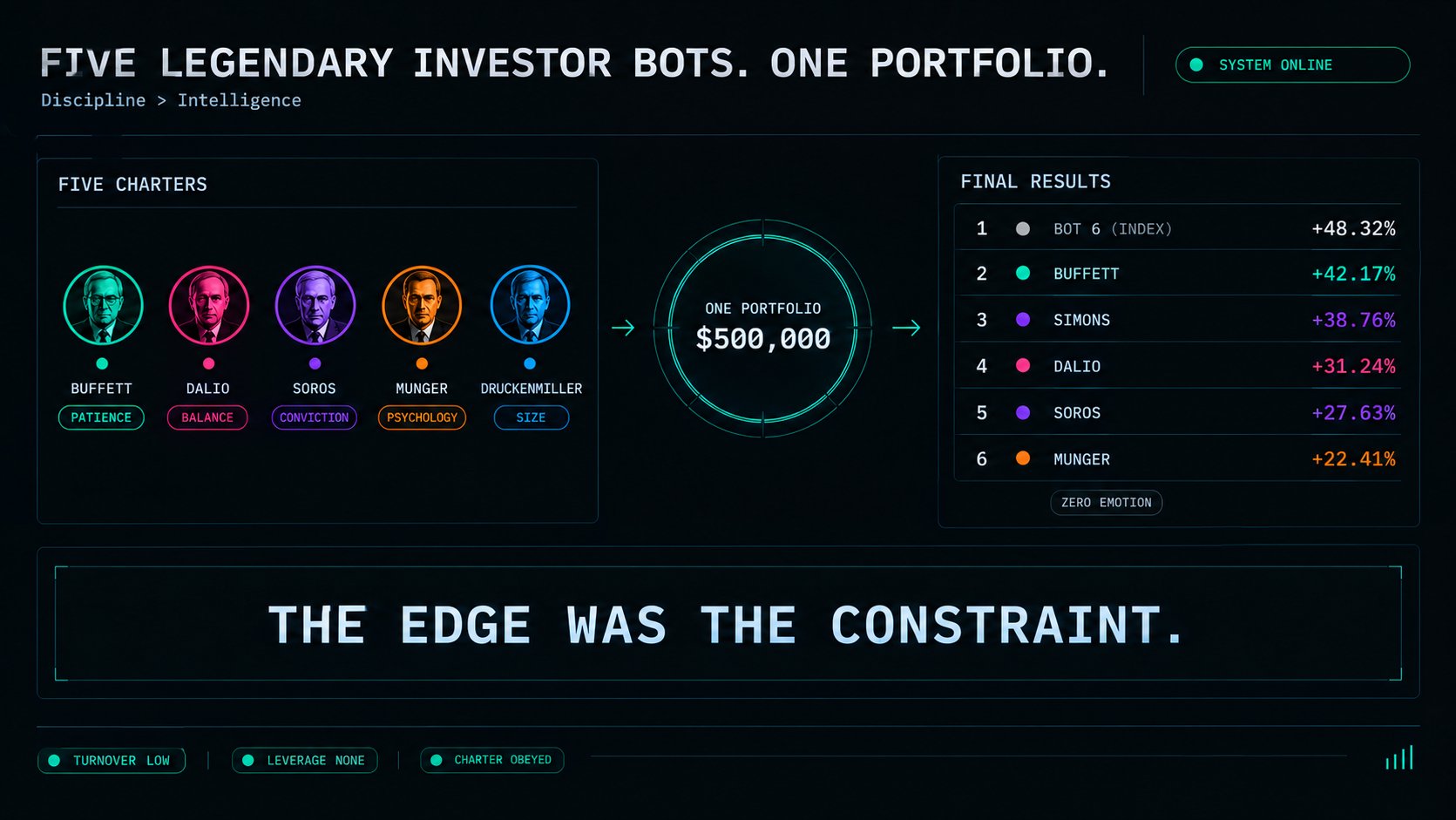
The edge was never the genius. It was the constraint, held without flinching, even when everything on the screen was screaming to do something else. It turns out a machine, or a person with enough discipline, is very good at exactly that.
Save this post. Follow along, I take stuff like this apart piece by piece and post what actually holds up once real money and real pressure get involved.
🔖 Bookmark and follow
@Primee32
Published on grokbot.sh. Cite the public log, not a prompt pack.