
I gave 6 Grok Bots my entire UGC workflow… this is insanee 😭
Wait Grok Bots can literally run an entire organic UGC team now?? 😭 i gave six of them the workflow i normally need a million tabs, four group chats and one dying iced coffee to manage and what came
Article
Job breakdowns
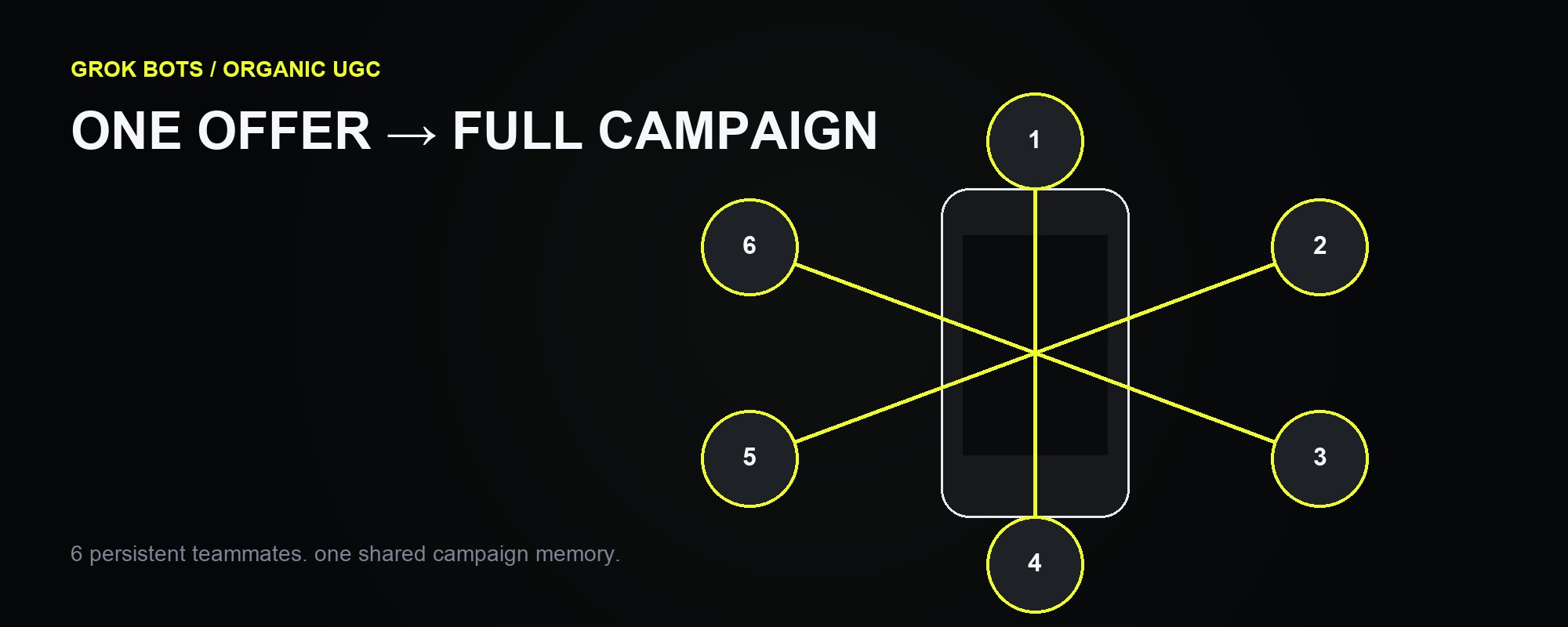
Wait Grok Bots can literally run an entire organic UGC team now?? 😭
i gave six of them the workflow i normally need a million tabs, four group chats and one dying iced coffee to manage and what came back was soooo good lol!!!
one offer went in.
a few hours later i had:
-
214 relevant videos analyzed
-
8,700 customer comments sorted
-
six audience groups
-
14 creative angles
-
53 hooks
-
18 complete scripts
-
37 controlled variations
-
one testing plan
Omggg okay??
the important part is not that one bot wrote a bunch of scripts.
the six bots worked like a team. each one finished a specific job, saved the result and handed the useful context to the next bot.
WHY NORMAL AI UGC WORKFLOWS BREAK
most people use AI like this:
- give me 20 viral hooks for this product
then they paste the hooks into a sheet, record some videos and come back tomorrow asking the same thing again.
the AI has no idea which hook was posted, which creator filmed it, which audience saw it, which version held attention or which video actually made money.
it is smart for five minutes and then develops amnesia 😌
i wanted a system where every new video started with everything learned from the old videos.
THE SIX-BOT TEAM
BOT 1 — OFFER HUNTER
finds offers with a visible problem, useful proof, real demand, enough payout and at least 50 possible creative angles.
BOT 2 — TIKTOK RESEARCHER
studies what is already working and labels the opening frame, spoken hook, emotion, proof, objection and call to action.
BOT 3 — COMMENT STALKER
reads thousands of comments to find the exact phrases customers use when they are confused, skeptical, excited or ready to buy.
BOT 4 — SCRIPT BUILDER
turns those patterns into angles, hooks and scripts that sound like actual people instead of a brand wearing a backwards hat.
BOT 5 — PRODUCTION DIRECTOR
creates controlled variations across hooks, creators, props, locations, proof and CTAs.
BOT 6 — PERFORMANCE BRAIN
reads the results, finds what changed performance and tells the other bots what the next batch should test.
six jobs. one campaign memory.
📷Provide a caption (optional)
THE SHARED CAMPAIGN FOLDER
i created one folder called:
UGC CONTENT HQ
inside:
-
01 OFFER
-
02 RESEARCH
-
03 COMMENTS
-
04 SCRIPTS
-
05 PRODUCTION
-
06 PERFORMANCE
every bot owns one folder.
the Offer Hunter saves the brief.
the Researcher reads it before studying videos.
the Comment Stalker reads both before clustering customer language.
the Script Builder never starts from a blank page.
the Production Director never makes random variations.
and the Performance Brain updates the system after every batch.
this sounds obvious but it fixes one of the ugliest problems in UGC: five people doing good work with five different versions of reality 😭😭
WHAT CAME BACK
the Researcher did not just dump links.
it grouped winning videos by why they worked:
-
discovery
-
regret
-
proof
-
comparison
-
social validation
-
fear of overpaying
the Comment Stalker found repeated phrases that never appeared in the brand brief.
the Script Builder turned those phrases into 53 hooks.
then the Production Director converted 18 scripts into 37 variations where only one major variable changed at a time.
so when performance changed, we had a real clue why.
THE FEEDBACK LOOP IS THE ACTUAL MAGIC
after the first batch, the Performance Brain updated:
-
which opening frame stopped the scroll
-
which creator matched the audience
-
which proof increased clicks
-
which objection kept appearing
-
which CTA killed retention
then the next batch started from those results.
not from vibes.
not from “make it more viral.”
from memory.
WHAT I WOULD STILL KEEP HUMAN
i would keep final taste, creator direction, sensitive claims and the decision to scale.
the bots should remove research and coordination drag.
they should not turn the whole thing into soulless autoposting.
the creator still needs to feel like a person.
the proof still needs to be real.
the final video still needs taste.
but the invisible work around the video??
researching, sorting, labeling, handing things off, remembering tests, rebuilding briefs…
the bots can eat all of that lol.
THE BIGGER IDEA
one AI chat can help a creator.
six persistent Grok Bots can run a learning system around the creator.
that is the difference.
the old workflow produced content.
this one produces content and gets smarter after every post.
i genuinely think UGC teams are about to look soooo different 😝
the best UGC hooks are usually not invented in a brainstorm.
they are buried in comments.
customers already tell you what confused them, what annoyed them, what almost stopped the purchase and what finally convinced them.
the problem is volume.
one comment section is useful.
8,700 comments are noise unless something can organize them.
so i built a Grok Bot whose only job is customer-language mining.
i call it the Comment Stalker.
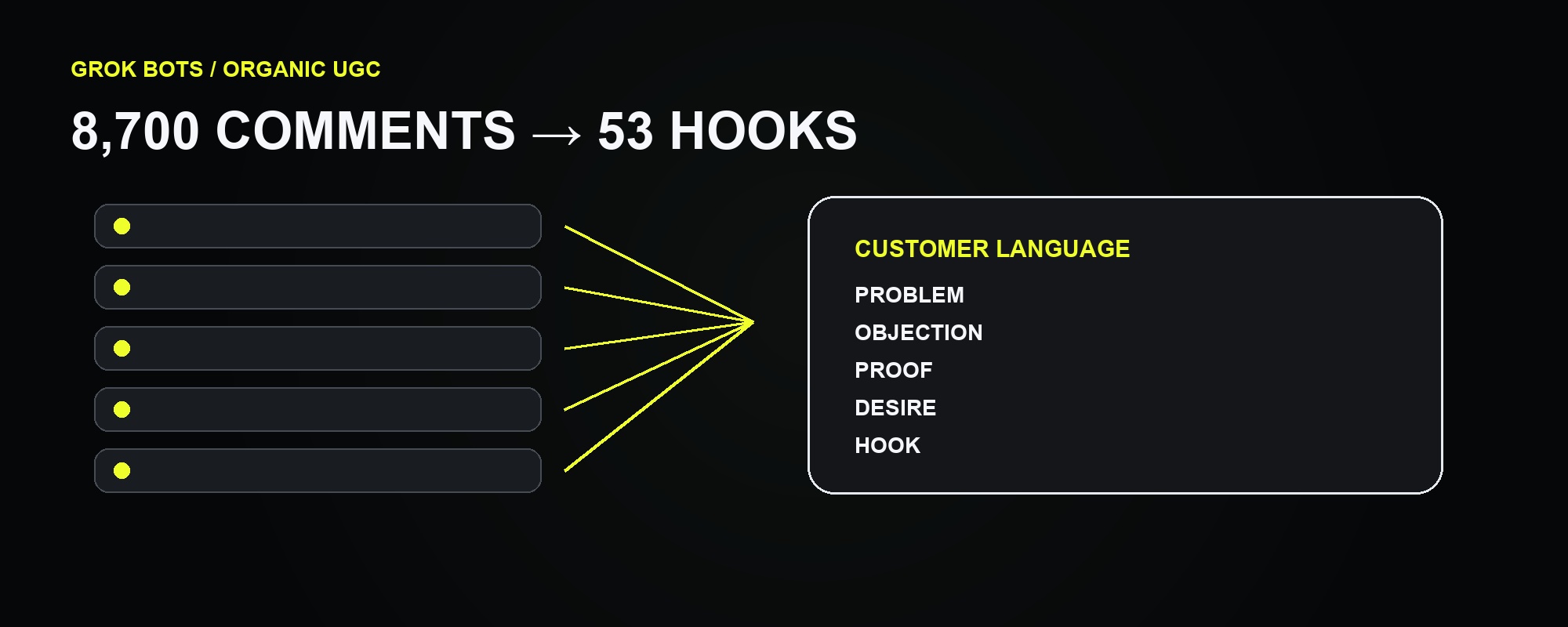
WHAT THE BOT RECEIVES
the input is deliberately narrow:
-
product or offer
-
target audience
-
competitor links
-
relevant videos
-
exported comments
-
existing brand claims
the bot is not asked to write hooks yet.
first it has to understand the language.
THE SIX COMMENT BUCKETS
every comment is tagged into one primary bucket:
- PROBLEM
what the customer is trying to fix.
- OBJECTION
why they hesitate.
- CONFUSION
what they do not understand.
- DESIRE
what result they actually want.
- PROOF REQUEST
what evidence would make the claim believable.
- CUSTOMER LANGUAGE
phrases, slang, comparisons and emotionally loaded words worth preserving.
the last bucket matters because brand language and customer language are almost never the same.
the brand says:
- maximize checkout savings
the customer says:
- wait why did nobody tell me i was overpaying this whole time
the second line is a hook.
FREQUENCY IS NOT ENOUGH
the bot scores every phrase on four dimensions:
-
frequency
-
emotional intensity
-
purchase proximity
-
visual potential
a phrase repeated 400 times may be weak if it has no emotion.
a phrase repeated 30 times may be valuable if it appears directly before purchase.
the system is looking for language that can become a scene.
FROM COMMENT TO UGC ANGLE
example customer comment:
- i always find the discount after i already paid
the bot extracts:
PROBLEM: discovering savings too late
EMOTION: regret
VISUAL: receipt or checkout screen
PROOF: show the price difference
HOOK OPTIONS:
-
“if you only check for discounts after paying, stop doing this”
-
“me realizing the cheaper option was there the entire time”
-
“the receipt mistake i kept making every month”
one sentence becomes three different mechanisms: instruction, reaction and confession.
THE CUSTOMER-LANGUAGE FILE
the bot saves a living document with:
-
top repeated problems
-
strongest objections
-
exact customer phrases
-
emotional words
-
common comparisons
-
proof people request
-
claims to avoid
-
hooks already used
the Script Builder reads this file before writing anything.
that stops it from producing generic lines that sound impressive but belong to nobody.
HOW I KEEP IT FROM COPYING
the bot extracts mechanisms and language patterns, not complete scripts.
it can preserve a short customer phrase.
it cannot lift another creator's structure, sequence and wording as a finished video.
the output should answer:
- what does the audience care about?
not:
- how do we duplicate this exact creator?
THE HOOK FILTER
before a comment becomes a hook, it must pass five checks:
-
A real customer said some version of it.
-
The problem is understandable in one sentence.
-
The first frame can show the problem.
-
The video can provide believable proof.
-
The hook matches the offer without forcing a claim.
if any check fails, the phrase stays research.
WHAT CHANGED
before the Comment Stalker, the team brainstormed hooks from the product page.
afterward, the product page became background context.
the customer became the creative brief.
that changed the vocabulary, the scenes and the proof.
the strongest hooks did not sound more clever.
they sounded more familiar.
THE PROMPT
Use this operating instruction:
You are the Comment Stalker. Your job is to convert customer conversations into organized creative intelligence. Preserve exact short phrases when useful, group repeated meaning, separate problems from objections, identify requested proof, score patterns by emotional intensity and purchase proximity, and save a customer-language file for the Script Builder. Do not write complete scripts until the language analysis is finished.
the best UGC hook is often already written.
the audience just hid it inside 8,700 comments.
“make more variations” is one of the most expensive vague instructions in UGC.
more hooks.
more creators.
more locations.
more edits.
the team produces 37 videos, performance moves and nobody knows why.
that is not testing.
that is content roulette.
i gave one Grok Bot a different job:
turn winning scripts into controlled production variations.
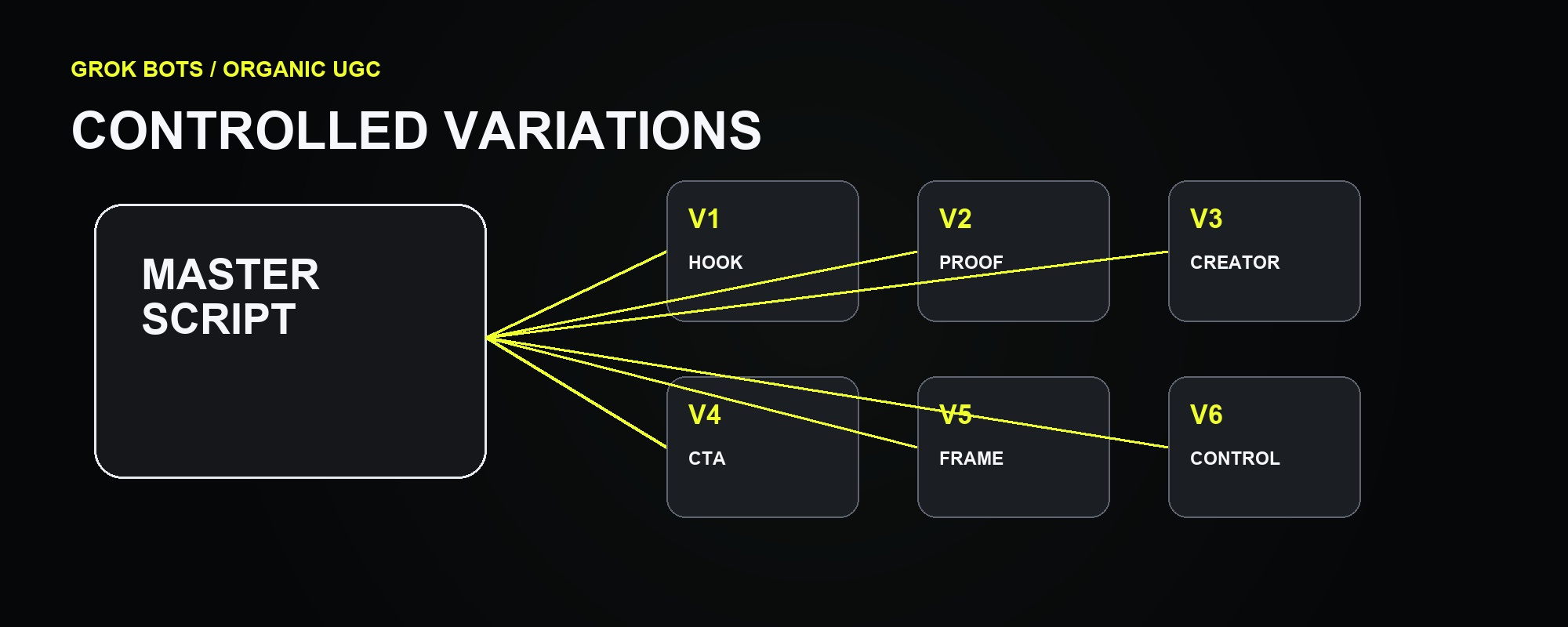
START WITH A VARIABLE MAP
every UGC video is broken into testable parts:
-
opening frame
-
spoken hook
-
creator
-
setting
-
problem demonstration
-
proof
-
objection handling
-
CTA
the Production Director labels the current version across all eight.
then it chooses one primary variable for each new test.
THE CONTROL RULE
if the goal is to test the hook, the rest of the video stays as stable as possible.
same creator.
same room.
same demonstration.
same proof.
same CTA.
only the hook changes.
if three things change and performance improves, you learned almost nothing.
THE 18-TO-37 EXPANSION
the Script Builder produced 18 complete scripts.
the Production Director did not double them blindly.
it created a test matrix:
HOOK TESTS
eight scripts received a second opening based on customer language.
PROOF TESTS
five scripts kept the hook and changed only the evidence shown.
CREATOR TESTS
three scripts used the same structure with two clearly matched creator profiles.
CTA TESTS
three scripts tested direct versus curiosity-based calls to action.
18 masters became 37 purposeful videos.
every additional asset had a reason to exist.
THE PRODUCTION CARD
each video receives one card:
-
SCRIPT ID
-
VARIABLE UNDER TEST
-
CONTROL VERSION
-
CREATOR
-
LOCATION
-
PROPS
-
SHOT LIST
-
ON-SCREEN TEXT
-
CLAIMS CHECK
-
FILE NAME
-
STATUS
the card is designed so a creator understands the video without joining another meeting.
CREATOR DIRECTION
the bot separates what must stay fixed from what the creator can personalize.
LOCKED:
-
first-frame action
-
customer problem
-
required proof
-
test variable
-
CTA type
FLEXIBLE:
-
natural phrasing
-
hand movement
-
room details
-
small reactions
-
personal objects
that balance protects the test without making every creator sound cloned.
THE ONE-SCENE RULE
each script is designed around one visible action.
-
open the checkout
-
compare two receipts
-
show the cart total
-
reply to a comment
-
text a friend
-
demonstrate the result
the action gives the creator something to do while speaking.
it also gives viewers visual evidence instead of another face explaining benefits.
NAMING IS PART OF THE TEST
files use structured names:
ANGLE_HOOK_CREATOR_PROOF_CTA_VERSION
example:
OVERPAYING_CONFESSION_SOPHIA_RECEIPT_SOFT_V2
performance data can now reconnect to the creative choices that produced it.
without naming discipline, the feedback bot receives a folder full of final_final2_REAL.mp4 and quietly dies.
THE HANDOFF TO PERFORMANCE
after publishing, each production card receives:
-
impressions
-
three-second hold
-
average watch time
-
completion
-
clicks
-
conversion
-
comments
the Performance Brain compares results by variable.
it does not ask “which video won?”
it asks:
- which change improved which metric for which audience?
THE BOT INSTRUCTION
You are the Production Director. Expand approved scripts into controlled UGC tests. Change one primary variable per version, preserve the control elements, create a complete production card, separate locked requirements from creator freedom, use one visible action per video, and name every file so performance can be traced back to the tested variable.
37 random videos create workload.
37 controlled videos create knowledge.
the second one compounds.
most UGC dashboards report what happened.
they do not decide what should happen next.
views went up.
clicks went down.
one creator won.
three hooks failed.
then the team opens a meeting and turns the numbers back into opinions.
i built a Grok Bot to close that gap.
i call it the Performance Brain.
WHAT IT READS
after every batch, the bot receives:
-
video ID
-
angle
-
hook
-
creator
-
opening frame
-
proof type
-
CTA
-
impressions
-
hold rate
-
watch time
-
completion
-
clicks
-
conversions
-
comments
because every production file is named correctly, performance reconnects to the choices inside the video.
METRICS ARE DIAGNOSTIC
the bot treats each metric as evidence about a different part of the creative.
LOW HOLD RATE
the first frame or hook failed to earn attention.
GOOD HOLD, LOW WATCH TIME
the hook worked but the body did not keep the promise.
GOOD WATCH, LOW CLICKS
the content entertained without creating action.
GOOD CLICKS, LOW CONVERSION
the creative may have attracted the wrong expectation or the offer page broke the promise.
one metric cannot explain the whole video.
the sequence matters.
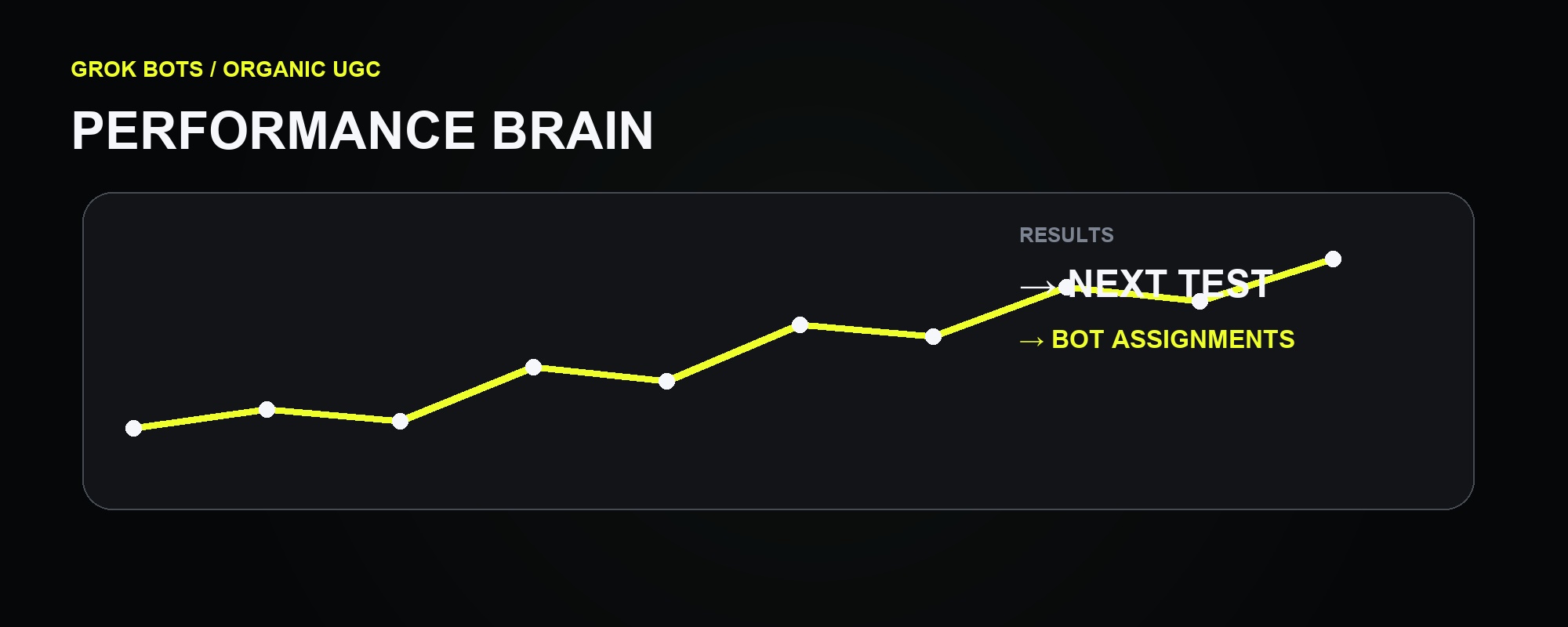
COMMENTS BECOME QUALITATIVE DATA
the Performance Brain does not ignore comments once numbers arrive.
it clusters:
-
confusion
-
objections
-
repeated questions
-
disbelief
-
purchase intent
-
creator feedback
a video can have average watch time and still reveal the exact objection the next script should answer.
losing content can produce winning research.
THE WINNER REPORT
for every batch, the bot writes:
-
winning variable
-
losing variable
-
confidence level
-
likely reason
-
evidence
-
next controlled test
-
what should remain unchanged
example:
WINNING VARIABLE: receipt shown in first frame
EVIDENCE: higher hold and click rate across two creators
KEEP FIXED: customer-language hook
NEXT TEST: receipt close-up versus full checkout screen
the report ends with a production instruction, not a chart.
THE MEMORY LOOP
the bot saves three levels of learning:
CAMPAIGN MEMORY
what works for this offer.
AUDIENCE MEMORY
what this customer group responds to.
FORMAT MEMORY
what appears to work across multiple offers.
this prevents one lucky winner from becoming a universal rule.
HOW IT TALKS TO THE OTHER BOTS
the Performance Brain updates each teammate differently.
Offer Hunter:
- which promises attracted valuable customers
Researcher:
- which format mechanisms deserve more examples
Comment Stalker:
- which new objections appeared after publishing
Script Builder:
- which hooks and bodies need revision
Production Director:
- which single variables belong in the next matrix
one performance report becomes five precise assignments.
THE STOP RULES
the system needs permission to stop bad ideas.
pause a variation when:
-
hold rate misses the baseline repeatedly
-
the proof creates confusion
-
comments reveal claim mismatch
-
clicks arrive without qualified intent
-
additional versions stop producing new information
volume without stop rules turns testing into a landfill.
THE HUMAN DECISION
the bot recommends.
the human decides what scales.
some winning patterns damage the brand.
some comments reveal sensitivity the numbers miss.
some creators deserve a second test because execution, not concept, failed.
the Performance Brain makes the decision smaller and better informed.
THE OPERATING INSTRUCTION
You are the Performance Brain. Connect every result to the creative variables inside the asset. Diagnose the funnel in sequence, use comments as qualitative evidence, separate campaign learning from audience and format learning, write a winner report with confidence and evidence, assign the next test to the correct bot, and stop tests that no longer produce useful information.
a dashboard tells you what happened.
a learning system changes what the team does tomorrow.
a product can be viral and still be terrible for UGC.
high views do not fix weak payout, invisible results, impossible proof, saturated angles or an offer page nobody trusts.
teams waste weeks solving the wrong problem:
they try to make better videos for an offer that was never built for content.
so the first bot in my system does not write scripts.
it decides whether the offer deserves scripts at all.
THE OFFER HUNTER
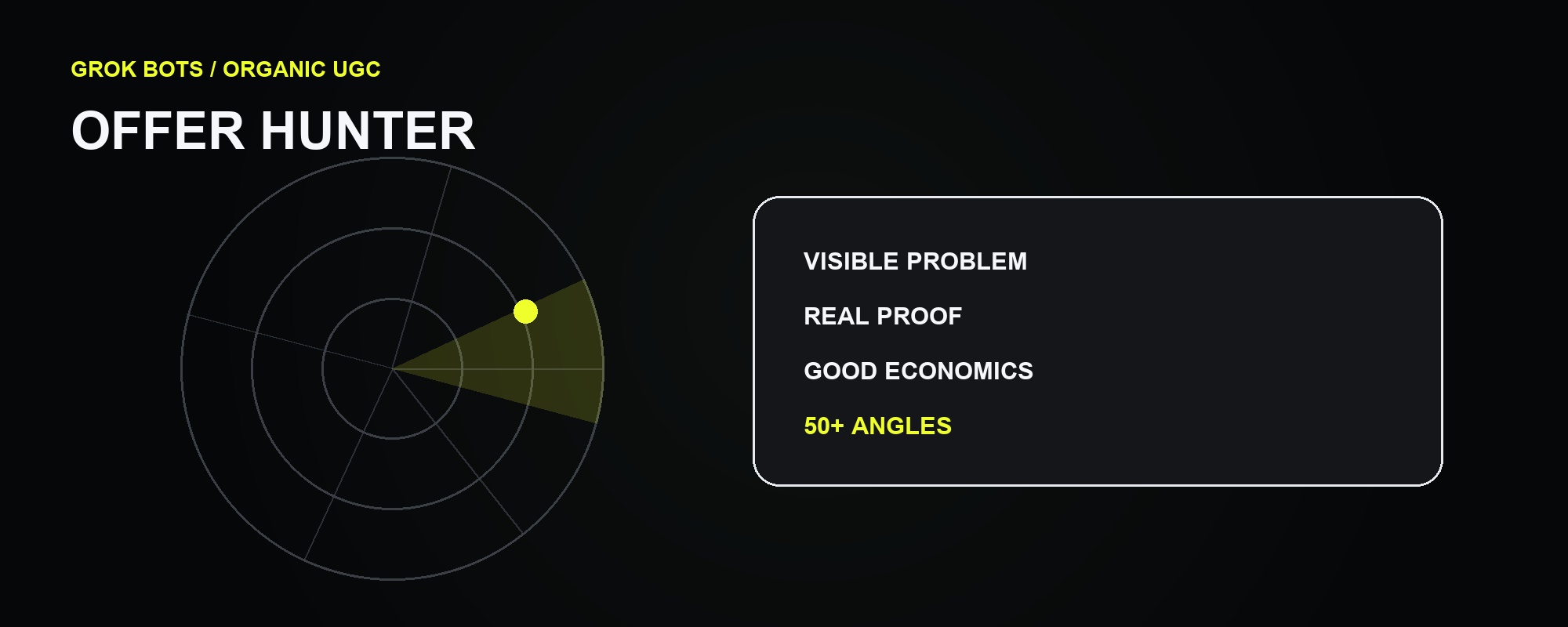
the Grok Bot scores every opportunity across seven categories:
-
problem visibility
-
result visibility
-
proof availability
-
audience urgency
-
payout quality
-
creative depth
-
competitive weakness
the output is not a list of trending products.
it is a ranked list of offers with reasons.
1. CAN THE PROBLEM BE SHOWN?
UGC is visual.
the strongest problems can appear in frame one:
-
high checkout total
-
messy workflow
-
empty calendar
-
confusing dashboard
-
damaged product
-
obvious before state
if the problem requires 25 seconds of explanation, the creative tax is high.
2. CAN THE RESULT BE PROVED?
the bot looks for proof the creator can show honestly:
-
screen recording
-
receipt
-
comparison
-
demonstration
-
timer
-
visible output
-
customer artifact
claims without accessible proof create weak videos and risky scripts.
3. DOES THE AUDIENCE FEEL IT NOW?
urgent problems create natural hooks.
the bot distinguishes:
-
painful now
-
useful later
-
interesting but optional
all three can sell.
but they require different expectations and creative volume.
4. IS THE ECONOMICS WORTH THE CONTENT?
the Offer Hunter records:
-
price
-
payout
-
approval conditions
-
conversion window
-
creator cost
-
production cost
-
target acquisition cost
a beautiful campaign with broken economics is still broken.
5. CAN WE MAKE 50 ANGLES WITHOUT LYING?
creative depth is one of the strongest filters.
the bot maps possible mechanisms:
-
discovery
-
confession
-
comparison
-
challenge
-
demonstration
-
objection reply
-
social proof
-
mistake
-
routine
-
before/after
if every idea collapses into the same benefit sentence, the offer will saturate quickly.
6. WHERE ARE COMPETITORS LAZY?
the bot studies competitor content for repetition:
-
identical hooks
-
identical creators
-
no proof
-
overproduced ads
-
unanswered comments
-
weak demonstrations
-
missing audience groups
competition is not automatically bad.
repetitive competition can be an opening.
THE OFFER BRIEF
approved offers receive one file:
-
OFFER
-
CUSTOMER
-
PROBLEM
-
PROMISE
-
PROOF
-
OBJECTIONS
-
ECONOMICS
-
COMPETITOR WEAKNESS
-
CREATIVE MECHANISMS
-
CLAIM LIMITS
-
RECOMMENDATION
the rest of the bot team works from this document.
research stays focused.
comments stay relevant.
scripts stay connected to proof.
production knows which scenes matter.
THE REJECTION REPORT
bad offers are useful if the reason is recorded.
the bot can reject because:
-
no visible proof
-
payout too weak
-
audience too broad
-
claim too risky
-
creative depth too shallow
-
competitor advantage too strong
-
approval friction too high
that prevents the same bad idea from returning three weeks later with a different thumbnail.
THE BOT INSTRUCTION
You are the Offer Hunter. Find and score UGC offers based on visible problems, demonstrable results, proof, urgency, economics, creative depth and competitor weakness. Reject offers that require unsupported claims or cannot sustain controlled creative testing. For approved offers, save a complete Offer Brief that every downstream bot can use.
the best UGC system cannot rescue every offer.
sometimes the highest-leverage crea
THE SYSTEM, END TO END
one offer enters the system.
the Offer Hunter decides whether it deserves content.
the TikTok Researcher finds the formats and mechanisms already earning attention.
the Comment Stalker finds the problems, objections and exact phrases customers actually use.
the Script Builder turns that intelligence into angles, hooks and complete scripts.
the Production Director turns those scripts into controlled variations where every new asset has a reason to exist.
the Performance Brain reads the results and sends a better brief back through the system.
then the loop starts again.
but it does not restart from zero.
every comment, script, test and result becomes campaign memory.
WHY THIS FEELS DIFFERENT
most UGC workflows treat every video like an isolated deliverable.
brief it. film it. post it. look at the numbers. start over.
this workflow treats every video like an experiment inside one growing system.
a weak hook teaches the Script Builder.
a confusing claim teaches the Offer Hunter.
a high-performing opening frame teaches the Researcher.
a new objection teaches the Comment Stalker.
a winning proof mechanism teaches the Production Director.
nothing useful disappears after the video is posted.
WHAT I LEARNED
six bots are not automatically better than one.
the system only works because every bot has one narrow responsibility, one expected output and one clear handoff.
the folders matter.
the naming matters.
the stop rules matter.
the shared memory matters.
without those things, six bots would just create six times more noise 😭
and the human part still matters too.
the creator brings taste, judgment, personality and the final decision.
the bots carry the research, sorting, coordination, testing and memory that usually drain the entire team.
THE REAL RESULT
the biggest result was not 53 hooks.
it was not 18 scripts.
it was not even 37 controlled variations.
it was building a UGC workflow that remembers what happened and uses it to make the next decision better.
one AI chat can generate content.
six connected Grok Bots can build a learning system around the creator.
the old workflow produced more videos.
this workflow produces more knowledge with every video.
and honestly??
i think this is what the next UGC team looks like 😭
save this because i’m sharing the actual systems behind the 400M+ views here.
Published on grokbot.sh. Cite the public log, not a prompt pack.