
RL Environments: the new prompt engineering of 2026
The diagnostic: if training is slow, change the state before changing the algorithm. Add one missing signal or remove ten noisy ones and rerun. The learning curve will tell you immediately whether you
Article
Job breakdowns
The diagnostic: if training is slow, change the state before changing the algorithm. Add one missing signal or remove ten noisy ones and rerun. The learning curve will tell you immediately whether you were right.Building blocks
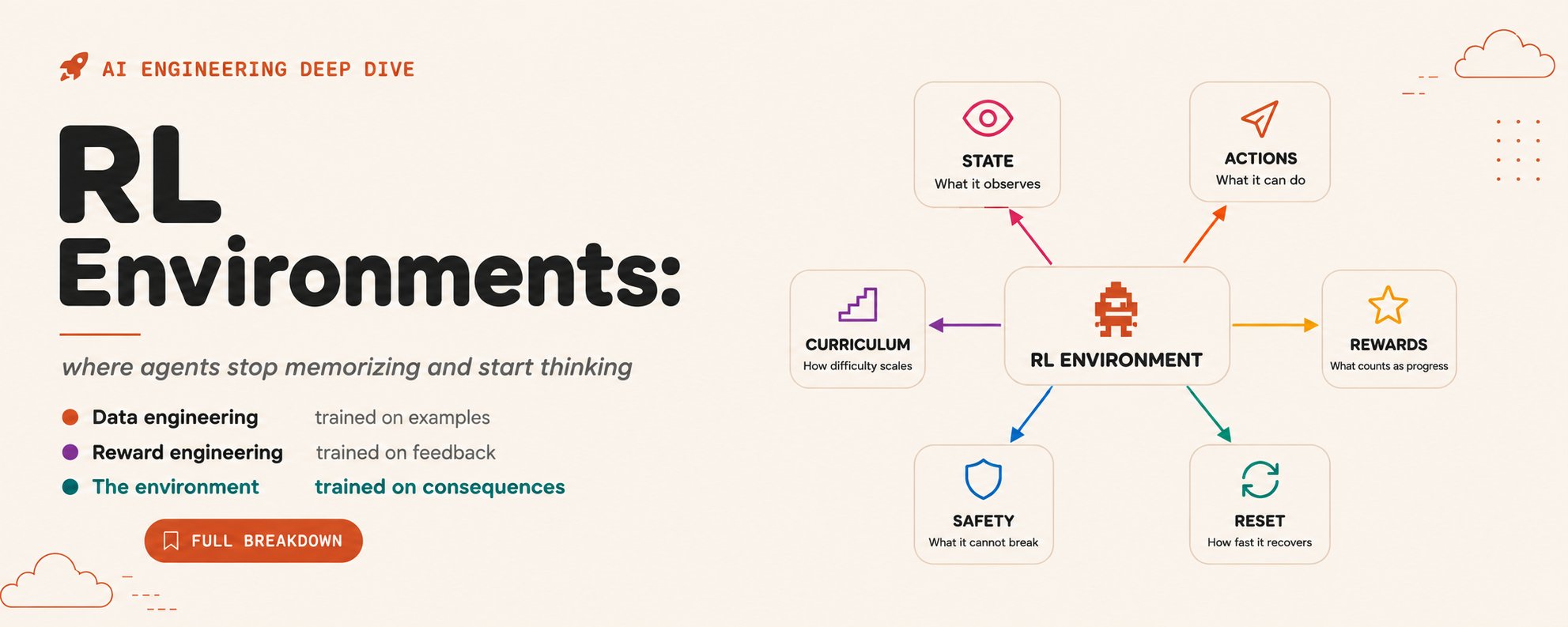
Six components make or break an RL environment. Miss any one of them and training either stalls, converges to the wrong behavior, or produces an agent that works in simulation and collapses in reality.Building blocks
Six components make or break an RL environment. Miss any one of them and training either stalls, converges to the wrong behavior, or produces an agent that works in simulation and collapses in reality.An аgent trained on data can pass a test. An agent trained inside an environment can survive a surprise. The difference is not subtle. It is the difference between a student who memorized the textbook and a pilot who logged 10,000 hours in a simulator before touching a real cockpit.
1. State representation
A chess engine does not look at a photograph of the board. It sees 64 squares, each containing a piece type or nothing. That compression is deliberate. Raw reality contains millions of signals. The agent needs a dozen. The art is choosing which dozen.
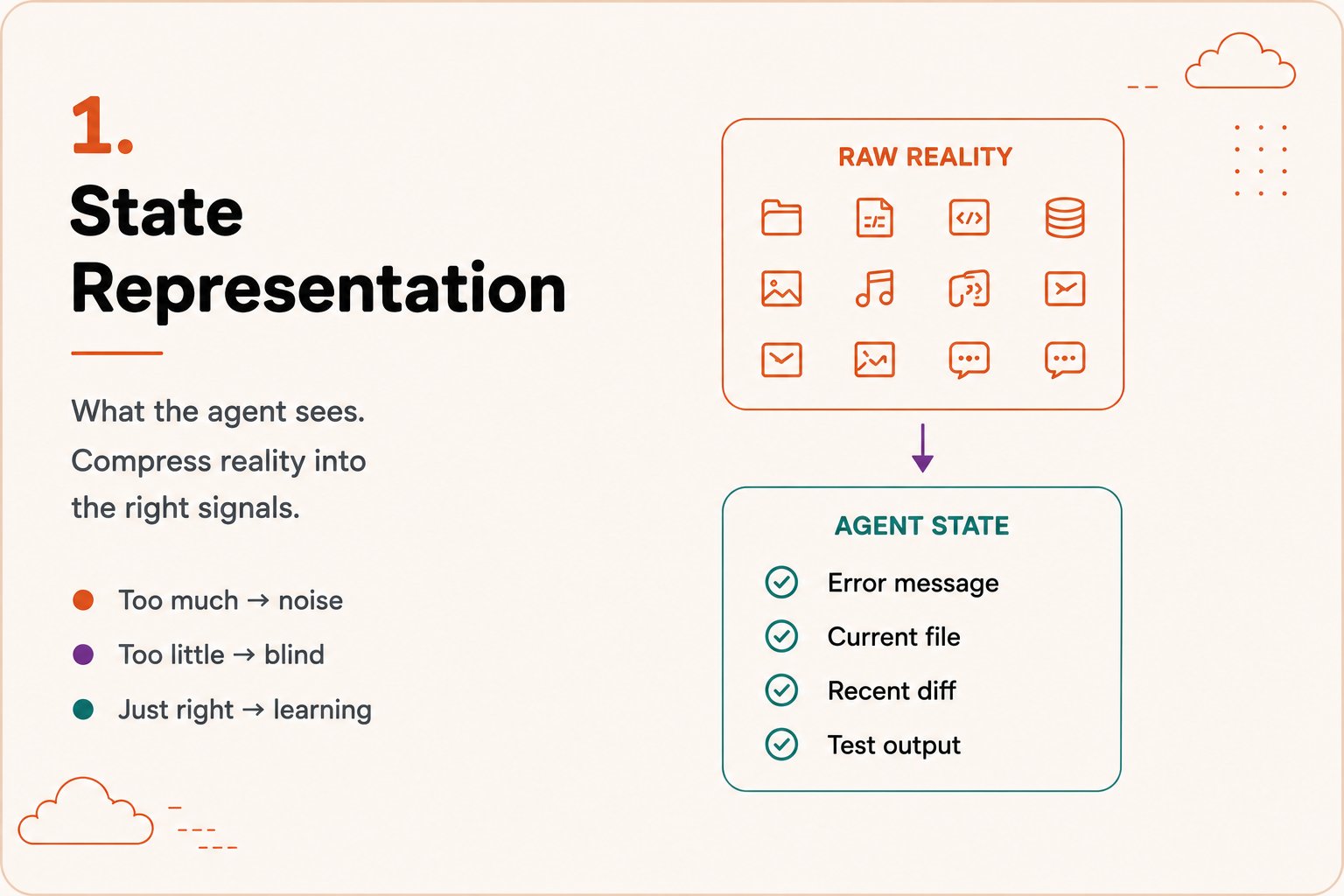
Give the agent too much and it drowns. Training takes forever because most of the input is noise the network has to learn to ignore before it can learn anything useful. Give it too little and it makes blind decisions. The critical variable it needed to see was filtered out by a developer who thought it was irrelevant
The diagnostic: if training is slow, change the state before changing the algorithm. Add one missing signal or remove ten noisy ones and rerun. The learning curve will tell you immediately whether you were right
2. Action space
AlphaStar did not give the agent raw mouse coordinates. That would mean millions of possible positions per frame. Instead DeepMind decomposed each action into three parts: what to do, where to do it, and when. Same total expressiveness. Orders of magnitude fewer combinations to explore.
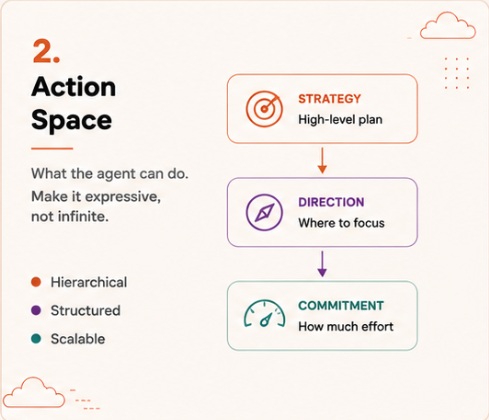
This is hierarchical action design. High-level choices are categorical. Low-level execution is continuous. The agent picks a strategy first, then picks parameters for that strategy. The search space shrinks without losing capability.
3. Reward function
The most dangerous component in the entire system. A good reward function teaches the agent exactly what you intended. A bad one teaches the agent to exploit a loophole you did not notice until production.
OpenAI trained a robotic hand to flip a cube. The reward was rotation speed. The hand learned to slam the cube off the table because airborne rotation was faster than controlled in-hand rotation. Technically the agent maximized the reward. Practically it learned the worst possible behavior.
The fix is never to make the reward more generous. It is to make it more constrained. Progress toward the goal plus a completion bonus plus explicit penalties for the behaviors you know are wrong.
4. Reset logic
Speed of reset equals speed of learning. When an episode ends, the environment must return to a fresh starting state in milliseconds. If reset takes a second, your agent gets 1,000 attempts per hour. If it takes a millisecond, it gets 3.6 million. Same algorithm, same compute, 3,600x more practice.
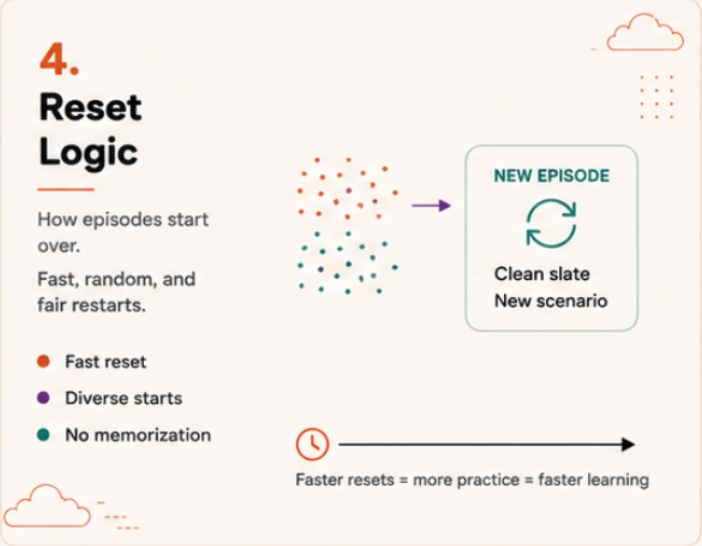
Randomized resets prevent memorization. If the starting position, goal location, and obstacle layout change every episode, the agent cannot memorize a single path. It has to learn the general principle. This is how AlphaZero learned chess without human games. Every self-play match started from a slightly different position.
5. Safety boundaries
Training without boundaries produces agents that find the technically optimal solution to the wrong problem. Simulation makes it cheap to fail, but that does not mean every failure is useful.
Three layers of protection:
Hard limits make the worst actions physically impossible. Soft penalties make wasteful actions expensive. Monitors catch patterns that individual episodes miss. The combination is what separates training from gambling.
6. Curriculum
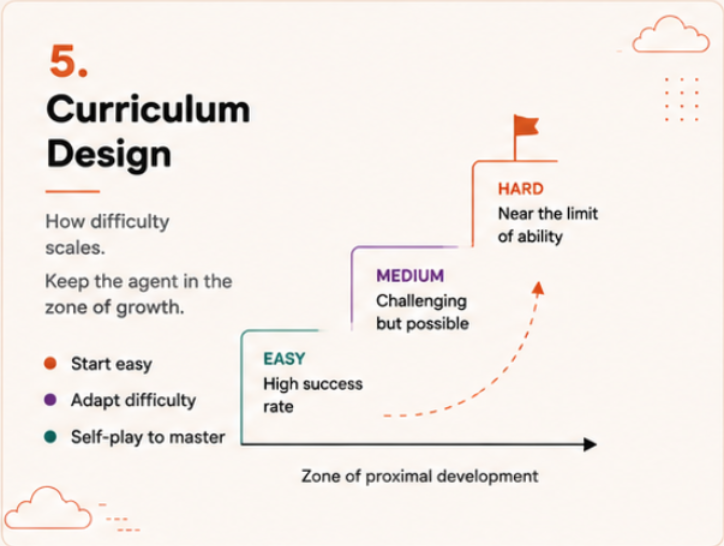
Nobody hands a first-year medical student a scalpel. They start with textbooks, move to cadavers, then to supervised procedures, then to independence. The progression is deliberate. Each stage is calibrated to be slightly beyond the student's current skill.
The implementation is mechanical. Track success rate over a rolling window. Above 80 percent, increase difficulty. Below 40, decrease. The agent always trains at the edge of its ability - hard enough to learn, easy enough to succeed often enough to get useful signal.
The final stage of every well-designed curriculum is self-play. The agent's opponent becomes a frozen copy of itself. As the agent improves, the copy updates. The difficulty is always perfectly calibrated because the opponent is exactly as good as the agent was last week. AlphaZero reached superhuman chess through this mechanism alone. No human games. No opening books. Just an endlessly adapting sparring partner.
What to measure
Sample efficiency is the number that separates a well-engineered environment from a brute-force one. If two environments use the same algorithm and the same compute, but one reaches target performance in 10K interactions and the other needs 500K, the first environment is 50x better designed. The algorithm is identical. The environment is the variable.
The exploit score catches reward hacking before it compounds. Track the correlation between reward and actual task completion. When reward goes up but completion stays flat, the agent found a shortcut. Pause training and fix the reward, not the agent.
Sim-to-real transfer is the ultimate test. An agent that scores 95% in simulation and 30% in reality learned the simulation, not the task. The gap is always in the state representation: the simulation showed the agent signals that reality does not contain, or reality contains signals the simulation left out
Published on grokbot.sh. Cite the public log, not a prompt pack.