
You need to start using GitHub if you want to exist in AI epoch and make money during the time.
Some GitHub repositories already have 10,000–50,000 stars, thousands of users, years of development and a working product but are still only 3–5 boring layers away from something that could
Article
Job breakdowns
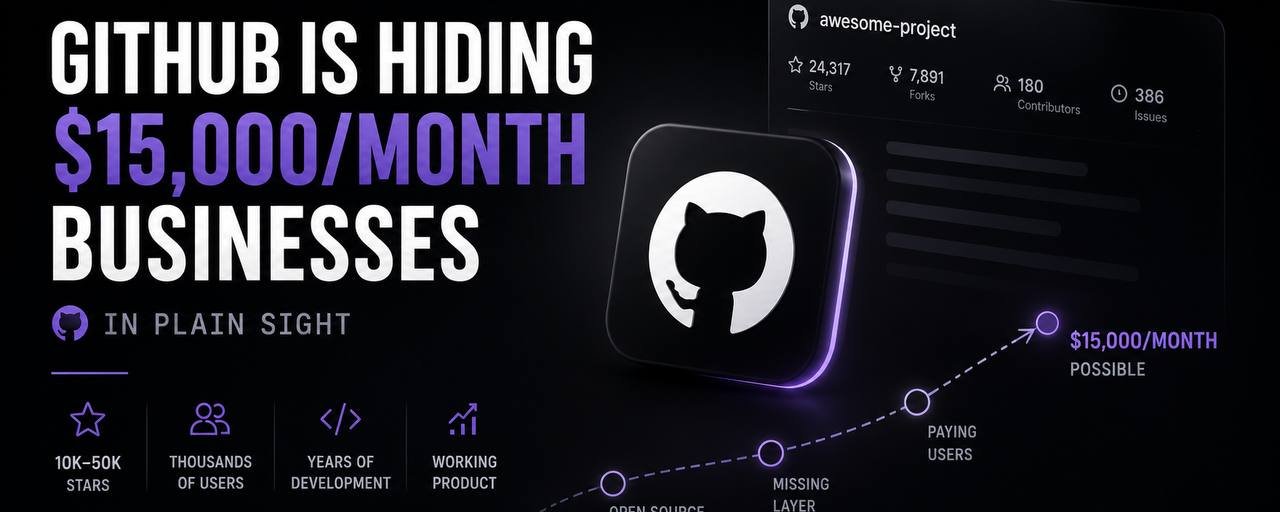
Some GitHub repositories already have 10,000–50,000 stars, thousands of users, years of development and a working product but are still only 3–5 boring layers away from something that could potentially generate $15,000/month.
Most people open GitHub looking for code.
I think the more interesting thing to look for is unfinished businesses.
Not unfinished software.
The software may already work extremely well.
The repository might have 24,000 stars, 180 contributors, hundreds of issues, detailed documentation and people actively using it every day.
But there is no hosted version.
No simple onboarding. No billing. No team accounts. No integrations. No sales page. No distribution outside GitHub.
Technically, the hard part may already exist.
Commercially, almost nothing has been built.
And that difference is where things get interesting.
You Don't Need 30,000 Customers
Imagine finding an open-source project with 30,000 GitHub stars.
Turning all 30,000 into paying customers would obviously be unrealistic.
But you don't need to.
To build a $15,000/month business, the numbers can look much smaller:
306 customers × $49/month = $14,994 MRR.
Or:
152 teams × $99/month = $15,048 MRR.
Or:
50 companies × $299/month = $14,950 MRR.
Suddenly the question changes.
You are no longer asking:
“How do I build software used by millions of people?”
You are asking:
“Can I find 50–300 people willing to pay for a better version of something thousands already use?”
Those are two completely different problems.
GitHub Gives You Something Founders Usually Have to Buy
Normally, when someone starts a SaaS company, they begin with guesses.
Does anybody need this?
What features matter?
What breaks?
Who uses it?
What integrations do they want?
What are they willing to tolerate?
A mature GitHub repository can expose parts of those answers publicly.
Look at the Issues tab. Users tell you exactly what is broken. Look at Discussions. Users tell you what they want next. Look at forks. People show you what they are trying to modify. Look at contributors.
You can see whether an ecosystem is forming around the project.
Look at documentation problems.
You can see where normal users stop understanding the product.
GitHub stars alone do not prove demand.
But stars + active users + recurring issues + integrations + professional use cases can be a surprisingly powerful signal.
Instead of inventing a product and then searching for demand, you can sometimes start with demand and search for the missing product.
The Missing Layer Can Be Worth More Than the Code
Take a powerful self-hosted tool.
A developer might install it by cloning the repository, editing an environment file, configuring Docker, connecting a database, setting up authentication and deploying it to a server.
To an engineer, that might be completely normal.
To a small business owner, it might as well be written in another language.
That creates one of the simplest opportunities:
Hosting
Turn:
clone → configure → deploy → maintain
into:
sign up → click → use
Now imagine charging $49/month.
You didn't necessarily create a better underlying engine.
You removed everything the customer didn't want to deal with.
The same pattern appears everywhere.
A repository may need a better interface.
Another may need team accounts and permissions.
Another may need Shopify, Slack or Google Drive integrations.
Another may need automatic backups, monitoring and updates.
Another might already be incredible software but have almost zero distribution outside developer circles.
These layers look boring next to building the core technology.
They are also exactly the things businesses frequently pay for.
Free Code Doesn't Mean Free Business
This is the part people often misunderstand.
If the code is available for free, why would anyone pay?
Because businesses rarely pay simply to possess source code.
They pay to remove work.
They pay so somebody else handles deployment.
-
Updates.
-
Security.
-
Backups.
-
Authentication.
-
Permissions.
-
Monitoring.
-
Integrations.
-
Support.
A technically skilled person may happily spend an evening configuring an open-source application.
A company might prefer paying $199 every month so none of its employees ever has to think about it.
The code can remain open.
The convenience around it can still be extremely valuable.
The Best Opportunities May Be Sitting Inside /issues
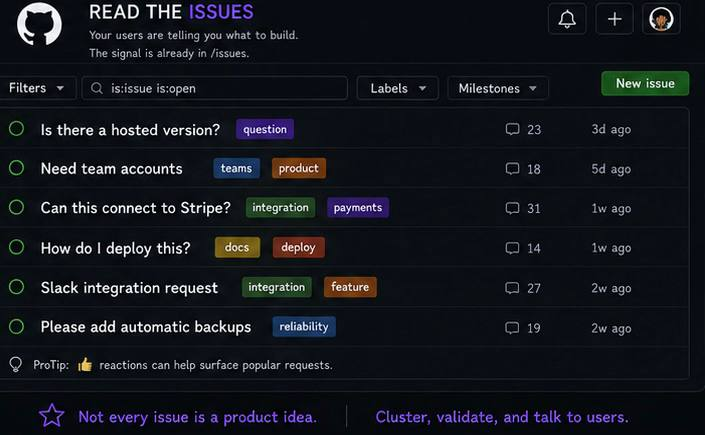
Imagine opening a repository and seeing variations of the same requests:
“Is there a hosted version?”
“Can somebody make installation easier?”
“Does this support teams?”
“Can we connect this to Stripe?”
“Is there a dashboard?”
“How do I deploy this?”
“Can this run automatically?”
Those comments are more interesting than they look.
Each one describes friction.
And friction is often where money enters software.
If 500 people are repeatedly struggling with the same technical process, the opportunity may not be creating a new competitor.
It may simply be removing that process.
That's why I increasingly think GitHub can be used almost like a business search engine.
You aren't just searching for repositories.
You're searching for valuable things people already want that remain unnecessarily difficult to use.
But 20,000 Stars Doesn't Mean $15,000/Month
There is an obvious trap here.
You find a trending repository.
It has 40,000 stars.
You build a prettier interface.
Nobody pays.
Popularity and willingness to pay are not the same thing.
Developers star projects because they are useful, interesting, impressive or because they want to check them later.
So before thinking about revenue, ask better questions.
Does this solve an expensive problem?
Are businesses already using it?
Does it save time?
Does it replace something people currently pay for?
Do users repeatedly ask for easier deployment?
Would companies need reliability, security or collaboration features?
Does usage happen once or every week?
Is there a clear customer who could justify paying $49, $99 or $299 every month?
A small repo solving a painful business problem can be more valuable than a massive repo solving an entertaining one.
Stars tell you where attention exists.
They don't tell you where money exists.
Don't Clone. Build the Missing Business.
There is also a huge difference between discovering an opportunity and simply copying somebody else's project.
Open-source licenses matter.
Attribution matters.
Trademarks matter.
Communities matter.
Sometimes the best business isn't even a hosted clone.
It could be:
an analytics layer,
an integration,
a vertical version for one industry,
deployment infrastructure,
enterprise security,
templates,
implementation services,
collaboration features,
or software that sits on top of several open-source projects.
The question isn't:
“How can I put a paywall around this repository?”
It's:
“What valuable problem still exists after this repository has done its job?”
That's a much better business question.

AI Changes the Economics Again
There used to be another major barrier.
Even if you found an incredible repository, understanding a large unfamiliar codebase could take days or weeks.
Now AI coding tools can help inspect architectures, explain files, trace dependencies, create interfaces, write integrations and prototype modifications dramatically faster.
That doesn't magically turn every open-source project into a business.
But it changes the cost of testing an idea.
You can discover a repo on Monday.
Understand the architecture.
Build a basic interface.
Add authentication.
Connect Stripe.
Deploy a prototype.
Then find out whether anyone actually wants it.
The experiment itself is becoming cheaper.
That makes finding good opportunities increasingly important.
Start With Something That Already Works
The default startup advice is:
Find a problem and build a solution.
GitHub gives you another route.
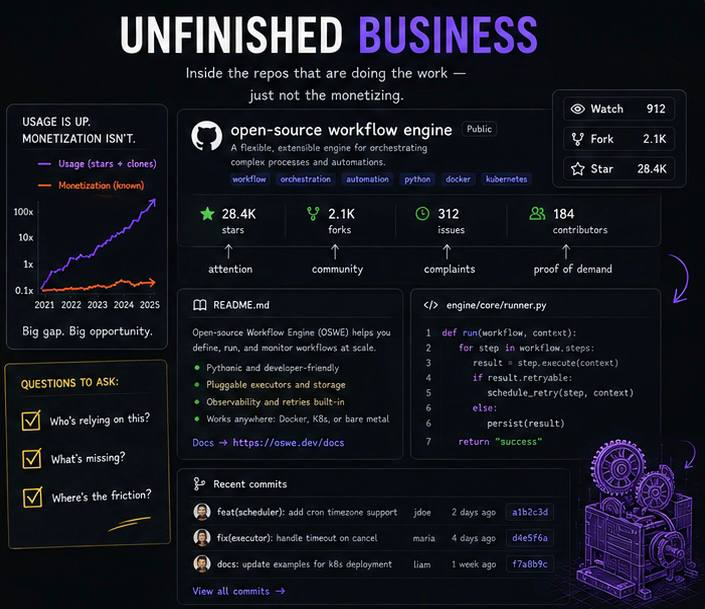
Find a solution.
Find the people already using it.
Find what they repeatedly complain about.
Then build the missing commercial layer.
Maybe you find a 12,000-star developer tool and turn installation into one click.
Maybe you find a 35,000-star automation project and package it for ecommerce stores.
Maybe you find a small B2B repository where only 50 companies would need to pay $299/month to approach $15,000 MRR.
Most repositories will never become businesses.
Most shouldn't.
But buried among them are projects where somebody already spent years building the first 80%.
The technology works.
The users exist.
The problems are documented.
The missing part is the business.
GitHub isn't just where developers publish code.
It may be one of the largest databases of unfinished $15,000/month businesses on the internet.
Thanks for reading the article about GitHub opportunities, hope it was useful and you follow the smart guy @lummox_eth.
Published on grokbot.sh. Cite the public log, not a prompt pack.