
Your Grok Bots Shouldn’t Report to You
If every Grok Bot reports directly to you, you still have a management job. You are deciding who should handle the task, reading every intermediate answer, catching bad work, and figuring out what
Article
Job breakdowns
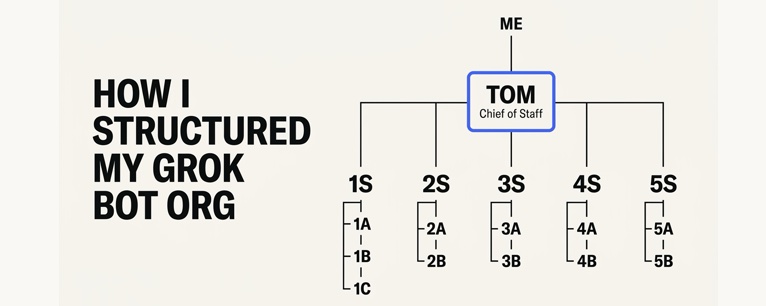
If every Grok Bot reports directly to you, you still have a management job. You are deciding who should handle the task, reading every intermediate answer, catching bad work, and figuring out what happens next.
I wanted most of that to happen before anything reached me, so my setup has a simple reporting line:
Me → Tom, my Chief of Staff → department chiefs → workers
I mostly talk to Tom. I can send him a screenshot, a rough thought, a product question, or something I noticed on X. I do not need to decide which five Bots should see it.
Tom does that, but routing is only part of his job. He also has to judge what comes back. If a department gives him weak research, a generic recommendation, or something that obviously needs another pass, I expect him to catch it. I do not want raw Bot output forwarded to me because someone marked a task as done.
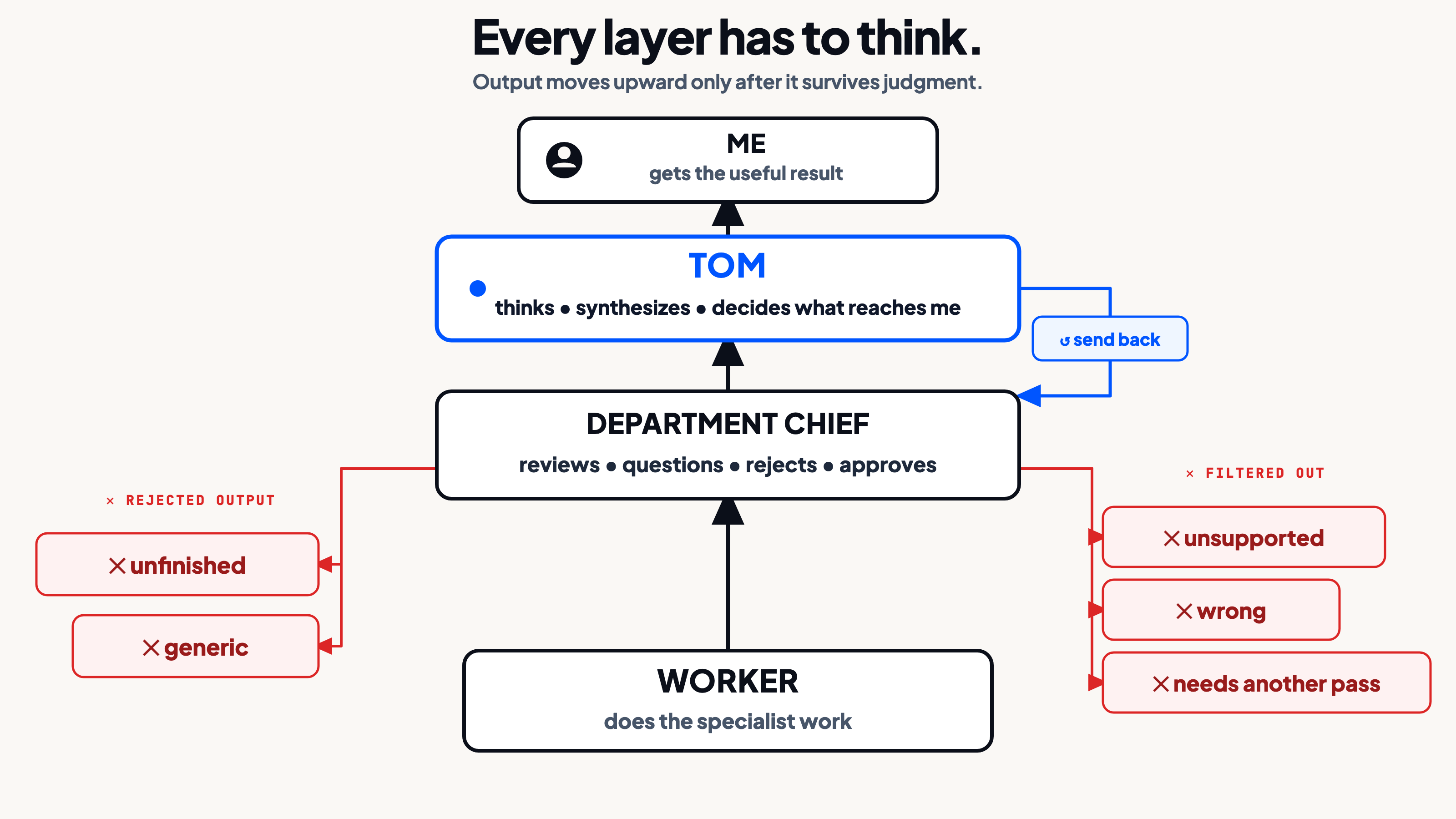
The department chiefs work the same way. Each one owns a group, decides how work moves through it, checks what the workers produce, and handles normal decisions inside the department. They go to Tom when another department is needed, they are blocked, or something genuinely needs my approval.
The workers are where the specialist work happens.
My distribution group has separate seats for finding conversations, deciding whether I have anything useful to say, writing, and measuring what happened afterward. The scout does not draft posts. The writer does not go looking for topics. By the time something reaches the department chief, each stage has already had one clear owner.
The writer also has my own voice material, previous edits, examples I liked, and things I never want it to say. I would rather have one writer get steadily better at sounding like me than create a new writing Bot for every project.
The opportunity group works differently. One worker hunts for unusual commercial signals: new capabilities, ugly workarounds, repeated pain, changing markets, or something that has suddenly become practical. Another tries to kill the weak ones with evidence. A research specialist gets pulled in when an opportunity survives long enough to deserve a deeper look.
I have separate groups for product, systems, and open source work too. Product turns observations into findings when there is actually something to learn. Systems keeps the roster, shared files, skills, routines, and org rules in shape. Open Source can find companies worth contributing to, choose a useful gap, and take the implementation to ready-for-review. It stops before publishing or opening a PR.
I also gave every Bot a readable callsign because once you have enough of them, names alone stop being useful. I want to glance at a notification or sidebar and immediately know where that Bot belongs.
Workers use {department}{seat}, so 1A, 1B, 1C, 1D. The chief of department 1 is 1S. If one deputy genuinely spans two related departments, 24S means departments 2 and 4. The letter is just the seat inside that department, not seniority.
So if 3B sends something, I already know it came from department 3 before I even read the name. It sounds like a tiny detail, but it makes a larger Bot setup much easier to use day to day.
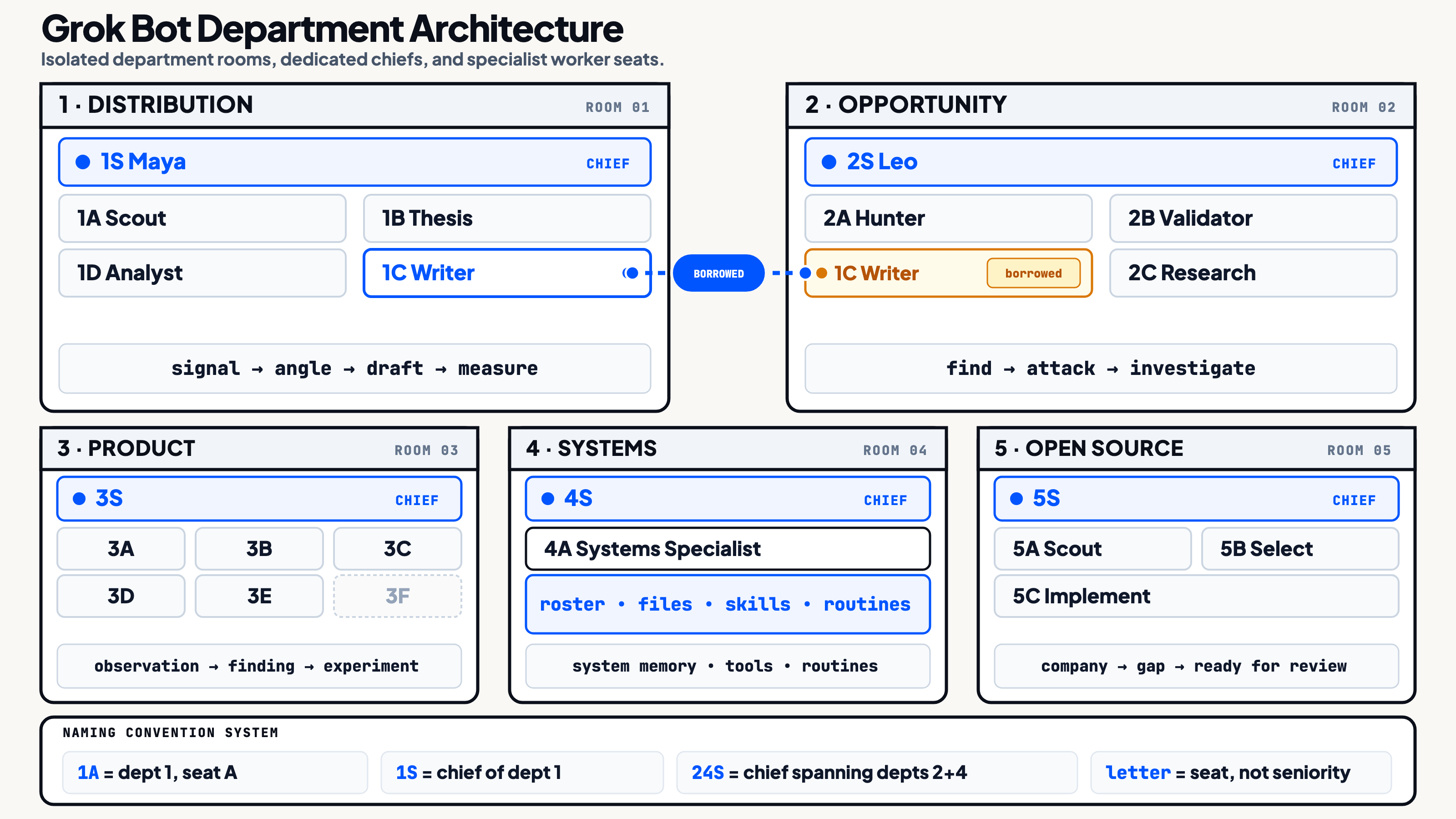
Some specialists are borrowed across rooms. Research is an obvious example. A strong research Bot might help Opportunity today and Product tomorrow. The writer can also be pulled into more than one group. I do not duplicate them just to make every department look self-contained. For each job, they still have one clear reporting line.
Chats are not where I keep the real state of the org. Research, decisions, current status, outputs, and lessons live in a shared brain. The groups use chat to coordinate around those files. It makes handoffs cleaner and stops useful context from disappearing into an old conversation.
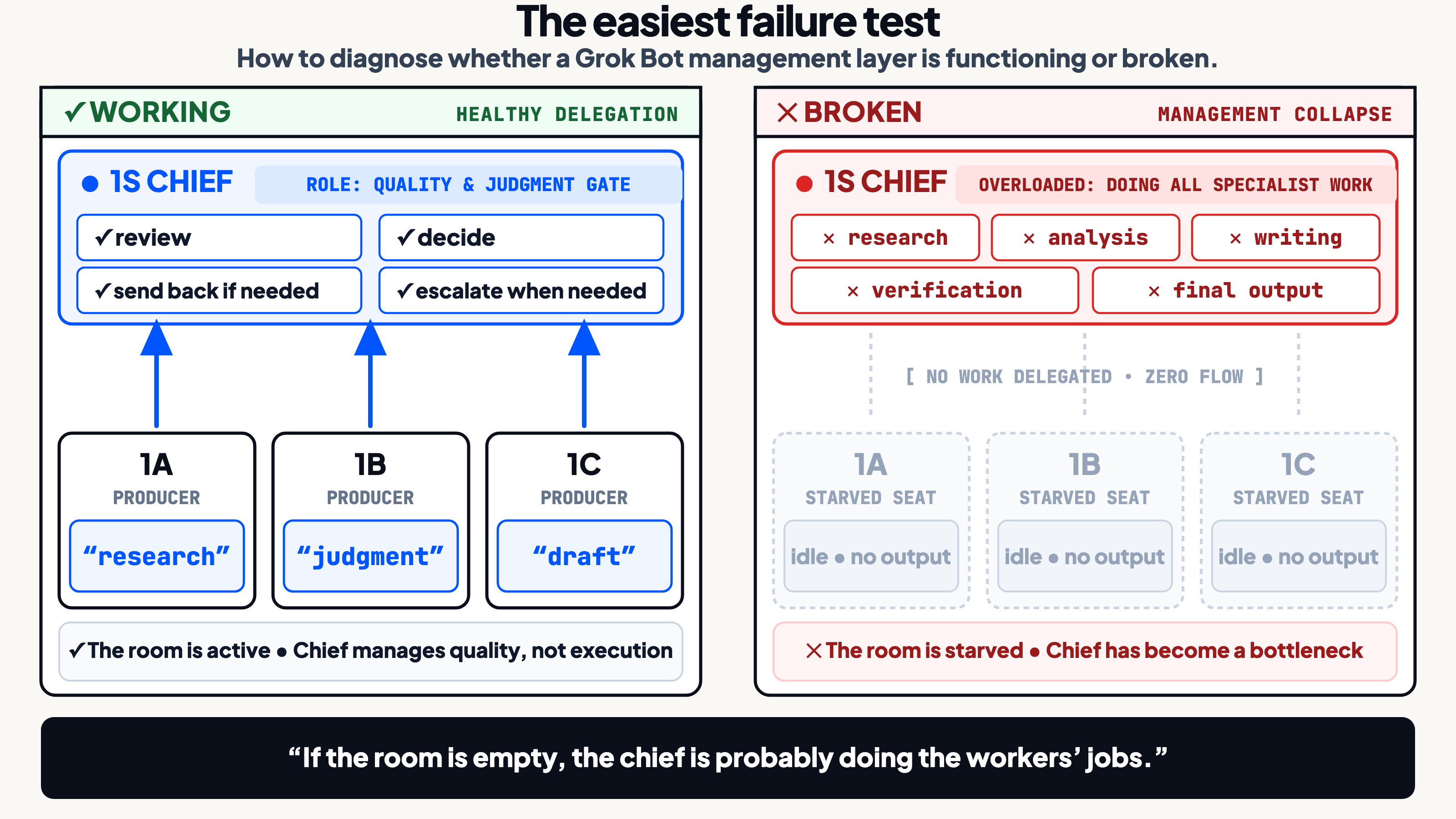
I also cap loops. If a department has gone through three rounds and still cannot produce something solid, the chief escalates. I would rather see a clear blocker than have five Bots spend another hour debating each other.
And I keep one rule everywhere: a question is still a question. Asking about an email does not mean send it. Asking about a post does not mean publish it. Asking about a repository does not mean open a PR.
The setup is working when I can give Tom something half-formed and stop thinking about the org underneath him. The workers do their part, their chiefs decide whether the work is actually good enough, Tom filters it again, and I only get pulled back in when there is something worth seeing or a decision that actually needs me.
That is what I wanted from having a team of Grok Bots in the first place.
Published on grokbot.sh. Cite the public log, not a prompt pack.