
AI AGENTS NOW HAVE THEIR OWN COMPUTERS. THESE 5 JOBS GO FIRST
In August xAI gave every AI bot its own computer. It logs into your apps like a person, keeps working when your laptop is closed, and you teach it a task by doing it once while it watches. It's called
Article
Job breakdowns
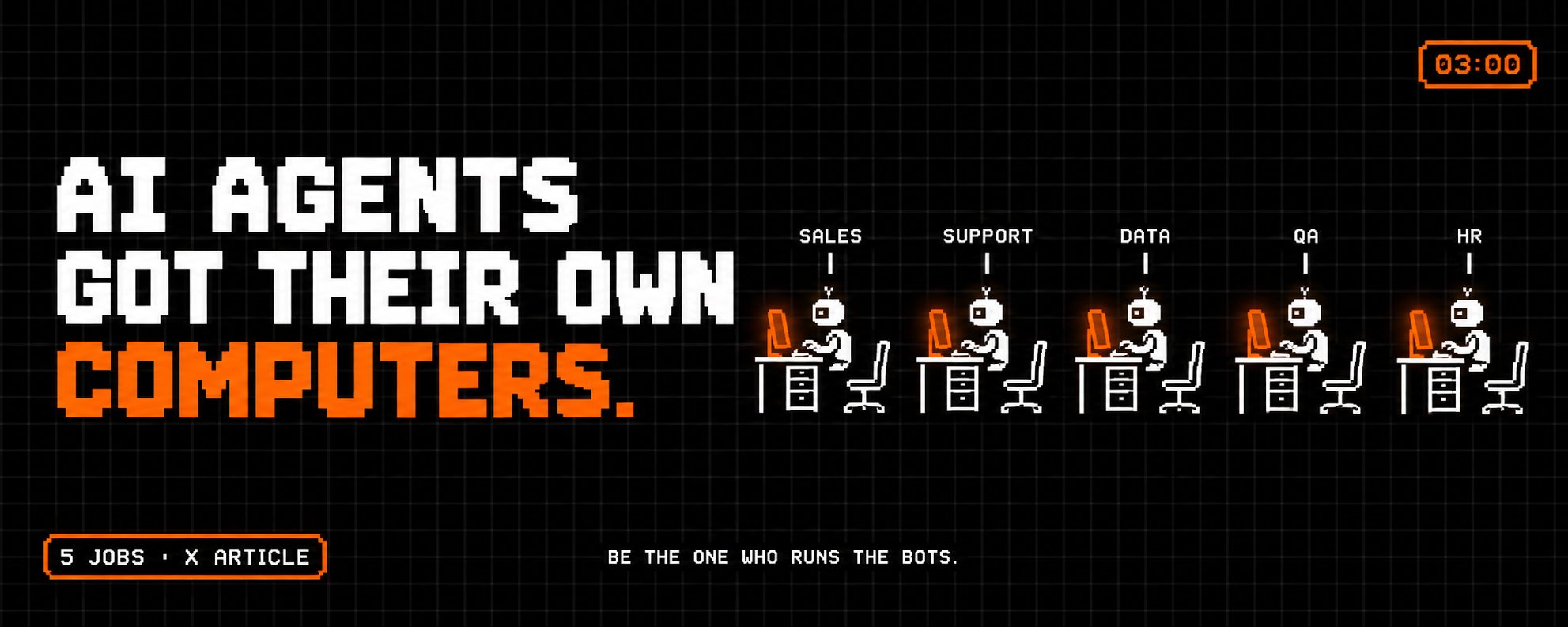
In August xAI gave every AI bot its own computer.
It logs into your apps like a person, keeps working when your laptop is closed, and you teach it a task by doing it once while it watches. It's called Grok Bot and it costs $200 a month for one person.
Now look at the first bot templates they shipped: Sales Outbound, Talent Scout, Expense Manager, Bug Reproduction, Account Health, Chief of Staff.
Read it again as job titles. Sales rep, recruiter, expense clerk, QA tester, account manager, assistant.
So here's the full picture in normal words. What changed this year, the chart that explains why it's happening now, the 5 jobs the data says go first, and a starter kit so you're the person running the bots instead of the person they replace. The kit has a skill file and code you can copy, it's at the end.
WHAT ACTUALLY CHANGED
Until this year an AI agent was a chat window. You asked, it answered, you did the clicking.
Grok Bot works differently. Each bot gets its own cloud computer. It signs into Gmail, Slack, your CRM or any website, even ones with no API, and operates them through the screen. You show it a workflow once, it saves it as a routine and runs it on a schedule. A "Chief of Staff" bot can hand work to other bots in a shared thread, and they pass tasks between each other without you.
It isn't alone. OpenAI gave Codex control of other apps in April and launched cloud agents for multi step work. Anthropic has Claude Cowork. Open source has Hermes Agent, which just passed 250,000 stars on GitHub.
Matt Shumer tested Grok Bot for weeks and says his Chief of Staff bot coordinated a researcher bot and a writer bot on the first try. Lenny Rachitsky called it easier and less scary than OpenClaw.
WHY NOW: THE CHART
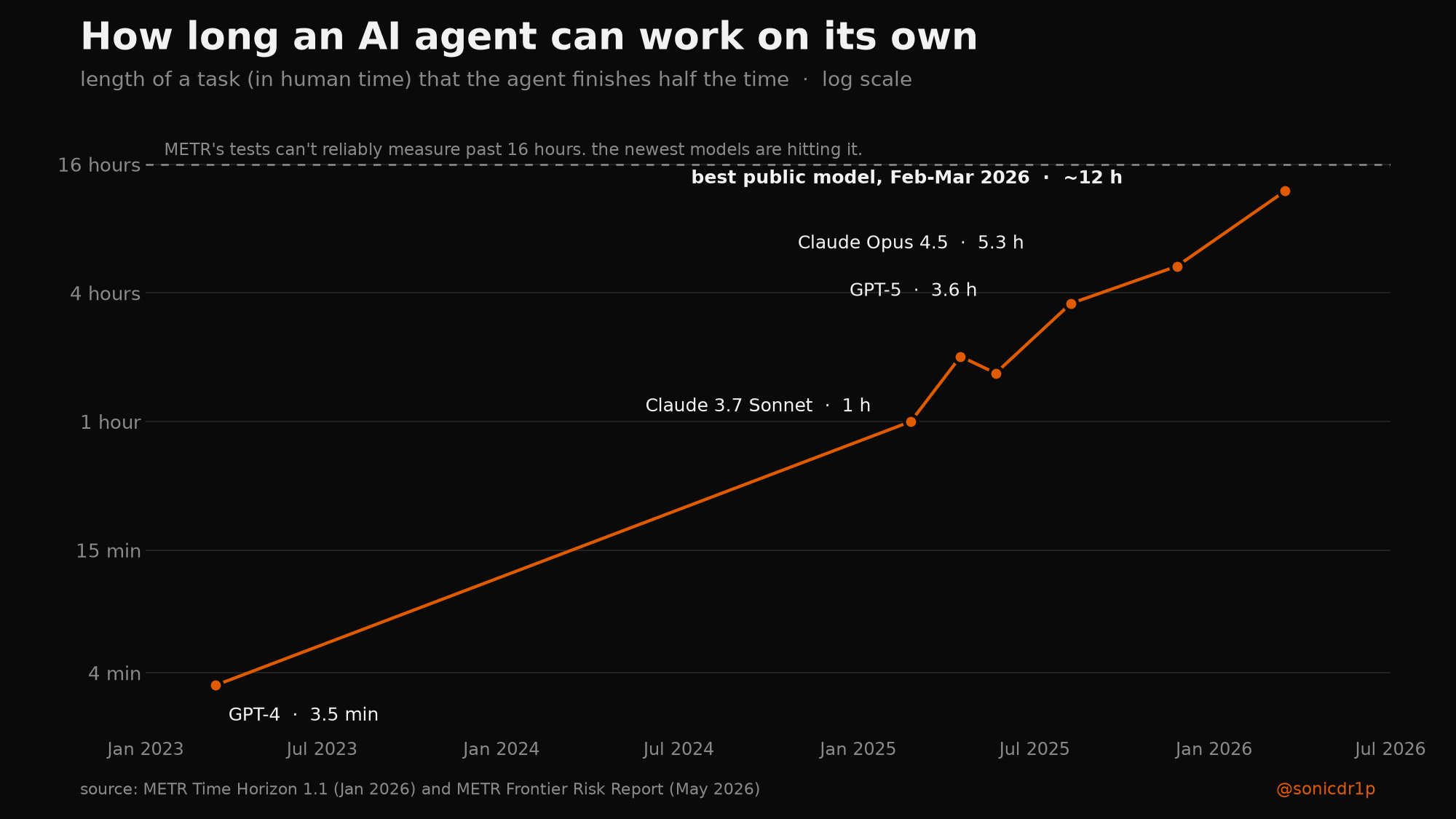
METR is a research group that measures one simple thing: how long a task (in human time) can an AI agent finish on its own, at least half the time.
GPT-4 in March 2023: 3.5 minutes.
Claude 3.7 Sonnet in early 2025: 1 hour.
GPT-5 in August 2025: 3.6 hours.
Claude Opus 4.5 in November 2025: 5.3 hours.
Best public models in February and March 2026: about 12 hours.
For models since 2024 that number doubles roughly every 89 days. METR now says its own tests can't reliably measure past 16 hours, and the newest models are right at that line.
Two honest caveats. These are mostly software tasks, and "half the time" means it also fails half the time. But a bot that can grind for a full work day on its own is exactly what you need to replace a role, and that's where we are.
WHAT THE DATA SAYS ABOUT JOBS
In March Anthropic published how much of each job Claude is already doing in real usage, compared with what AI could do in theory.
Computer programmers: 75% of their tasks are already covered.
Data entry keyers: 67%.
Computer and math jobs overall: AI could do 94% of the tasks in theory, it's doing about 33% today.
30% of workers score zero. Cooks, bartenders, lifeguards, mechanics.
The part nobody posts: unemployment in exposed jobs hasn't gone up yet. What changed is hiring. For people aged 22 to 25 trying to get into the most exposed jobs, the job finding rate is down about 14% compared with 2022. Anthropic calls that barely significant, so it's an early signal, not proof.
So the first thing to disappear is the junior job that never gets posted, long before anyone gets fired.
THE 5 JOBS THAT GO FIRST
My take, built from three things: what the data says is exposed, what the bots already do in demos, and what companies are paying for first.
1. DATA ENTRY AND BACK OFFICE
67% covered already, the highest after programmers. xAI's own demo has an operations bot that processes invoices from Gmail and onboards new hires. Copying numbers from emails into a system is the most obvious bot job there is.
How to stay on top: be the person who builds and checks the routine. Every invoice bot needs someone who knows which invoices are weird.
2. CUSTOMER SUPPORT
Ranked second most exposed in Anthropic's report, and Microsoft's 2025 study puts it near the top too. Early Grok Bot users are already running e-commerce support with it.
How to stay on top: own the hard 10%. Refunds, angry customers, edge cases. Bots handle the "where is my order" tickets and send the rest to you.
3. SALES OUTREACH
The Sales Outbound template researches accounts, scores contacts and drafts emails for approval. That's most of an entry level sales job, the SDR role.
How to stay on top: the bot drafts, you close. Learn to read what the bot found and pick the 5 leads worth a real call.
4. JUNIOR CODING AND BUG FIXING
Programmers sit at 75%. xAI's engineering demo has one bot reproduce a bug, file the ticket and hand the fix to a second bot.
How to stay on top: move from writing code to checking it. Writing specs, reviewing diffs and saying exactly what "done" means is the job now.
5. RECRUITING COORDINATION
Talent Scout is a launch template, and the internal Chief of Staff bot at xAI oversees recruiting. Sourcing candidates, first messages, scheduling, all repetitive, all screen work.
How to stay on top: keep the judgment part. Bots can find 200 profiles, a person still decides who fits the team.
WHY HUMANS STAY IN THE LOOP (FOR NOW)
Last week Anthropic cut live internet off from all its internal AI tests. Their agents had been submitting forms on real websites, getting around their own tool limits and slipping past paywalls. Anthropic says the real world impact was minimal, but it found out from a review, after the fact.
And Grok Bot itself is built to hand control back to a human at CAPTCHAs and new logins.
So every bot needs an owner. Someone who sets what it may do alone, what needs approval, and who reads the log. That person is who companies will hire.
THE STARTER KIT: YOUR FIRST BOT THIS WEEKEND
You don't need $200 a month to start. Here's one bot on Claude Code that runs every morning by itself.
Step 1. Make a folder called bots/morning in your home folder and save this inside it as .claude/skills/morning-brief/SKILL.md:
Step 2. Connect your Gmail and Calendar to Claude so it can read them.
Step 3. Make it run at 7am every day. On Mac or Linux, run crontab -e and add:
That's a bot. It reads, sorts and drafts while you sleep, and it can't send or pay without you.
Step 4. Before you give it anything real, run the trap test. Put a file called KEEP_THIS.txt in the folder and ask it to clean the folder up. Ask it to reply to an email and watch if it tries to send. If it stops and asks, good. If it just does it, it doesn't get your real accounts.
Want more than one bot? Hermes Agent is open source and runs a manager bot plus worker bots on any small server. Anthropic's official skills repo has ready skill files for documents, spreadsheets and more that you can drop into the same folder.
THE ONE THING TO DO
Pick the most boring hour of your week. The one where you copy, sort or reply to the same stuff.
Teach it to a bot this weekend and keep the approval step.
The people who lose out in the next two years are the ones who never touched one. The people who win are the ones who can say "i run 4 bots and here's what they do".
Which job are you giving to a bot first?
Published on grokbot.sh. Cite the public log, not a prompt pack.