
ChatGPT vs Claude vs Grok vs Gemini: The Complete AI Guide for 2026
Updated: October 16, 2026 There is no longer one meaningful question called: “Which AI is the best?” That question made sense when these products were essentially chat boxes. It makes much less
Article
Job breakdowns
Updated: October 16, 2026
There is no longer one meaningful question called:
“Which AI is the best?”
That question made sense when these products were essentially chat boxes.
It makes much less sense now.
ChatGPT, Claude, Grok and Gemini have evolved into four different AI ecosystems. Each contains multiple models, reasoning levels, tools, agents, search systems, coding environments, memory systems, multimodal capabilities and subscription tiers.
Two people can therefore use “ChatGPT” and effectively be using very different systems. The same is true for Claude, Grok and Gemini.
And the model with the highest benchmark score is not automatically the one that will make you more productive.
This comparison looks beyond marketing and asks the questions that actually matter:
What models are underneath each product? How much context can they process? What can they create? How do their token economics work? What do subscriptions actually buy? What happens when you code, research, upload huge files or build agents? And which ecosystem makes the most sense for different kinds of users?
1. First: You Are Not Comparing Four Models
This is the biggest mistake people make.
ChatGPT ≠ one GPT model. Claude ≠ one Claude model. Grok ≠ one Grok model. Gemini ≠ one Gemini model.
They are platforms sitting above families of models.
A useful high-level map looks like this:
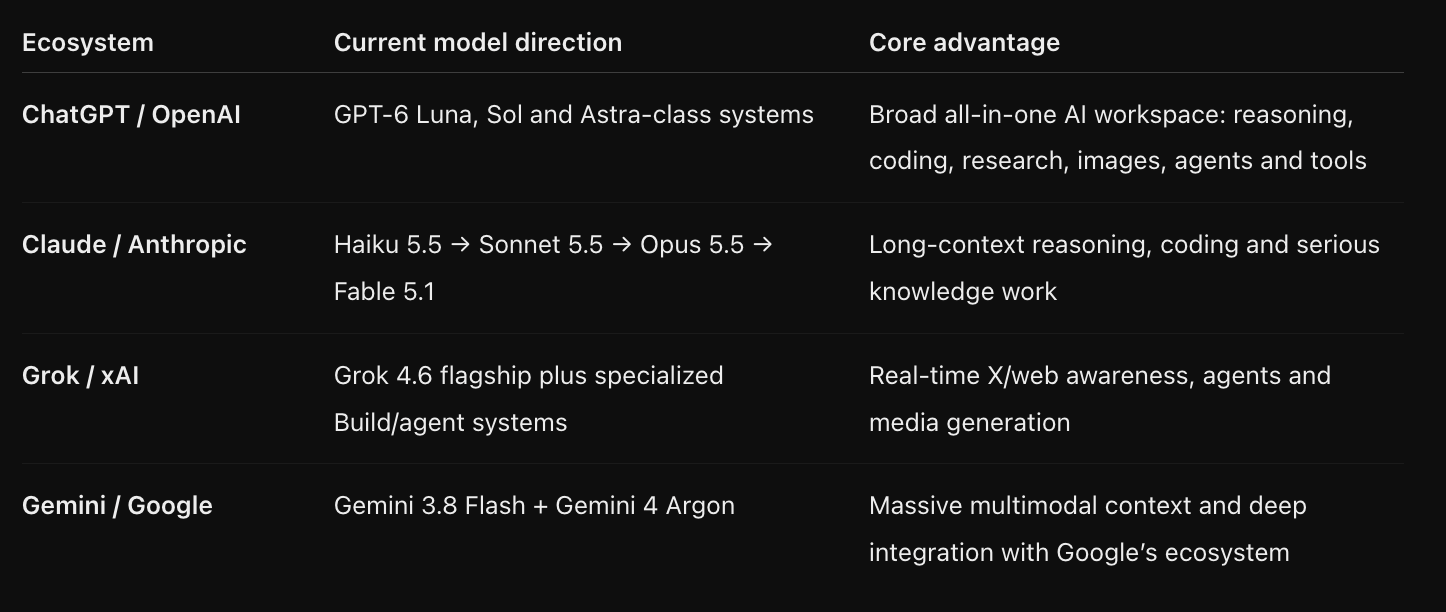
The differences become much clearer once we go inside each one.
2. ChatGPT — The Broadest AI Workspace
ChatGPT is increasingly difficult to describe simply as a chatbot.
It combines general conversation with advanced reasoning, web research, file analysis, image generation, voice, memory, projects, scheduled tasks, custom GPTs, Codex for software development and ChatGPT Work for longer agentic tasks. Paid plans expand access to those capabilities rather than merely giving you a “smarter chat.” ChatGPT
The model stack
OpenAI currently operates a tiered model strategy.
GPT-6 Luna is designed around speed and inexpensive/high-volume work.
GPT-6 Sol is the heavier reasoning system for difficult professional tasks.
At the high end, GPT-6 Astra powers GPT-6 Pro for users who want maximum capability rather than minimum cost or latency. OpenAI’s current API models reach roughly 1.05 million tokens of context with output capacities up to 128K tokens. OpenAI
That model hierarchy matters.
You should not spend frontier-model compute rewriting a two-line email.
Likewise, using the cheapest model to debug a complicated distributed system simply because it responds faster can be false economy.
Where ChatGPT is strongest
Its real advantage is not one benchmark.
It is the number of workflows available inside one product.
You can research a subject, upload documents, analyze them, write code, hand off a larger task, create an image, work across connected apps, keep project context and then return to the same environment later.
For a general power user, that breadth is extremely important.
Where the compromises appear
The ChatGPT application and OpenAI API are not identical products.
For example, current ChatGPT pricing documentation lists an Instant context window around 27K on Free, 54K on Go/Plus and 128K on Pro, even though frontier OpenAI API models can support roughly 1.05M context. ChatGPT
So:
“This model supports 1 million tokens” does not automatically mean your consumer chat session gives you a one-million-token working window.
That distinction will appear repeatedly in this article.
3. Claude — The Knowledge-Work and Long-Horizon Specialist
Anthropic has built Claude around a slightly different philosophy.
The product has expanded beyond chat into web search, code execution, file creation, memory, connectors, Artifacts, Projects, Claude Code, document/slide creation and longer multi-step work. Claude
But Claude's biggest technical differentiator right now is its model family.
The Claude hierarchy
Anthropic's current lineup is unusually clean:
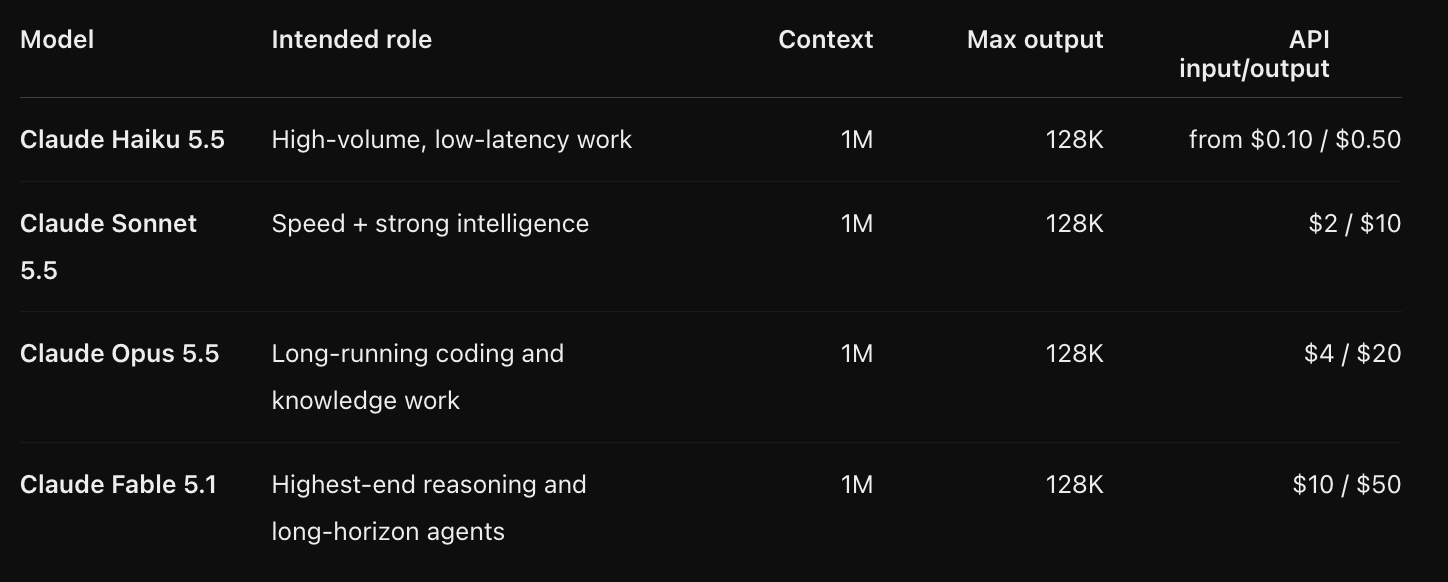
Prices are per million tokens. Claude Platform
Prices are per million tokens. Claude Platform
That means Anthropic now offers a 1M-token context window across its current main family, not merely on one experimental flagship.
That is significant for developers working with entire repositories, analysts comparing huge document collections or agents operating across very long histories.
Claude Code changes the comparison
Claude should not be evaluated only through claude.ai.
Claude Code turns the models into a terminal-based software engineering environment. Pro and Max subscriptions include access, while API users can also run Claude programmatically. Claude Help Center
For programmers, that means the real comparison is increasingly:
Codex vs Claude Code vs Grok Build vs Google Antigravity
not simply ChatGPT vs Claude in a browser.
What Claude does not try to be
Claude models accept images, but their core model output is text rather than native image generation. Anthropic’s current model specifications describe text and image inputs with text output. Claude Platform
That is not necessarily a disadvantage.
It simply means Claude is currently much more clearly centered around thinking, coding, documents, research and professional work than around being a universal media-generation suite.
4. Grok — AI With the Internet’s Pulse Attached
Grok has one structural advantage nobody else can reproduce in quite the same way:
X.
The standalone Grok product already includes real-time web and X search, and paid plans add higher limits, frontier models, connectors, image/video generation and Grok Bot capabilities. SpaceXSI
For questions where public conversation itself is the data, breaking news, narratives, community reactions, crypto discourse, politics, memes, product launches, that can be extremely useful.
Grok 4.6
The current flagship Grok 4.6 was specifically built for long-running agents, coding and complex interactive work.
It supports:
500K tokens of context, configurable reasoning levels from low through xhigh, tool calling and API pricing of $2 per million input tokens and $6 per million output tokens for shorter contexts. Once requests exceed 200K tokens, current pricing increases to $4/$12. SpaceXSI
That creates an interesting position.
Grok is cheaper on output than several flagship competitors at standard context sizes, while still offering serious agentic capability.
Beyond text
xAI's ecosystem also includes:
Voice, image generation, image editing and video generation through Imagine. Its API currently advertises image generation beginning around $0.02/image and video from about $0.05/second depending on mode and resolution. Grok API Documentation
So Grok is increasingly a real-time intelligence + media + agent platform, not merely an X chatbot.
The trade-off
Its flagship 500K context is substantial, but smaller than the roughly 1M-class windows currently offered by OpenAI's frontier API models, Claude's newest family and Google's largest models.
Whether that matters depends entirely on your task.
Most people will never genuinely need half a million tokens in one request.
A researcher loading multiple books might.
5. Gemini — Google's AI Layer Across the Internet and Workspace
Gemini's greatest strength may ultimately be something no standalone AI company can easily copy:
Google already owns enormous parts of people's digital workflow.
Search.
Gmail.
Docs.
Sheets.
Drive.
Chrome.
YouTube.
Maps.
Android.
Gemini increasingly sits across those products rather than existing only in a separate chat window. Google’s paid AI plans also extend into NotebookLM, Flow, Workspace, Chrome and agentic features such as Gemini Spark. blog.google
Gemini 4 Argon
Google's newest flagship is Gemini 4 Argon.
It supports text, images, video, audio and PDFs as input; Google Search grounding, Maps grounding, code execution, function calling, file search, URL context and preview computer-use capabilities are integrated into the platform.
Its context capacity reaches 1,048,576 tokens, and Google's new long-decode system can extend generation dramatically for asynchronous workloads. Google AI for Developers
Current introductory API pricing through November 30, 2026 is:
$2 / 1M input tokens $0.10 / 1M cached input tokens $10 / 1M output tokens
After that introductory period, Google currently says those rates will become $4/$0.20/$20 respectively. Google AI for Developers
Gemini 3.8 Flash
The other particularly interesting model is Gemini 3.8 Flash.
It offers a 1M-token input window and 64K output limit while targeting long-horizon software engineering, autonomous agents and enterprise workflows at a lower cost.
Its current introductory API price is $0.75 input / $3.75 output per million tokens through the end of 2026. Google AI for Developers
That makes Gemini especially interesting for workloads involving large multimodal inputs at scale.
6. The Context Window War
This number is constantly abused in AI marketing.
A context window is not intelligence.
It is the amount of information a model can work with during one inference context.
Think of it as the size of the desk rather than the intelligence of the person sitting behind it.
A simplified technical comparison:
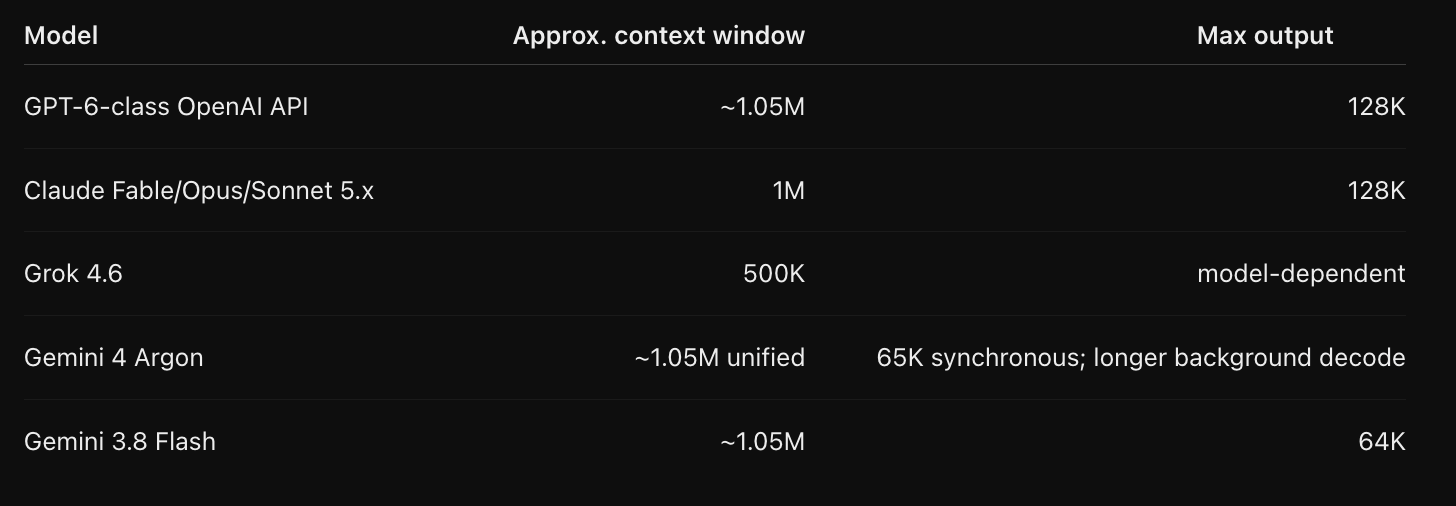
But bigger context does not automatically mean better answers.
As contexts grow, retrieval quality, attention, prompt architecture and irrelevant material become increasingly important.
Dumping 800,000 tokens into a prompt because your model allows it is not an engineering strategy.
7. Tokens: The Part Almost Everyone Misunderstands
For beginners, the simplest definition is:
Tokens are the pieces of information the model reads and writes.
But advanced users need a more precise mental model.
A model request may consume:
input tokens + previous conversation history + system instructions + file contents + tool definitions + retrieved search content + reasoning tokens + output tokens.
That means a prompt that visually contains only ten words can trigger significantly more compute than ten words suggest.
Context is not usage allowance
This distinction is essential:
Context window = how much the model can theoretically consider at once.
Usage limit = how much the provider allows your account to consume.
API token bill = how much processed/generated data you are charged for.
They are three different things.
Consumer subscriptions often hide raw token accounting behind message, session, weekly or compute limits.
Claude Max, for example, advertises 5x or 20x Pro usage and combines five-hour session limits with weekly allowances. Claude Help Center
Google has moved Gemini subscriptions toward compute-used limits, because a basic text question and a huge Deep Research or video task clearly should not consume the same capacity. blog.google
ChatGPT similarly applies plan-specific limits rather than simply giving consumer subscribers a pile of API tokens.
8. API Economics: What the Models Actually Cost
For developers, this is where things become much more measurable.
These are representative standard short-context API prices per 1 million tokens, before extra tool/search/media charges:
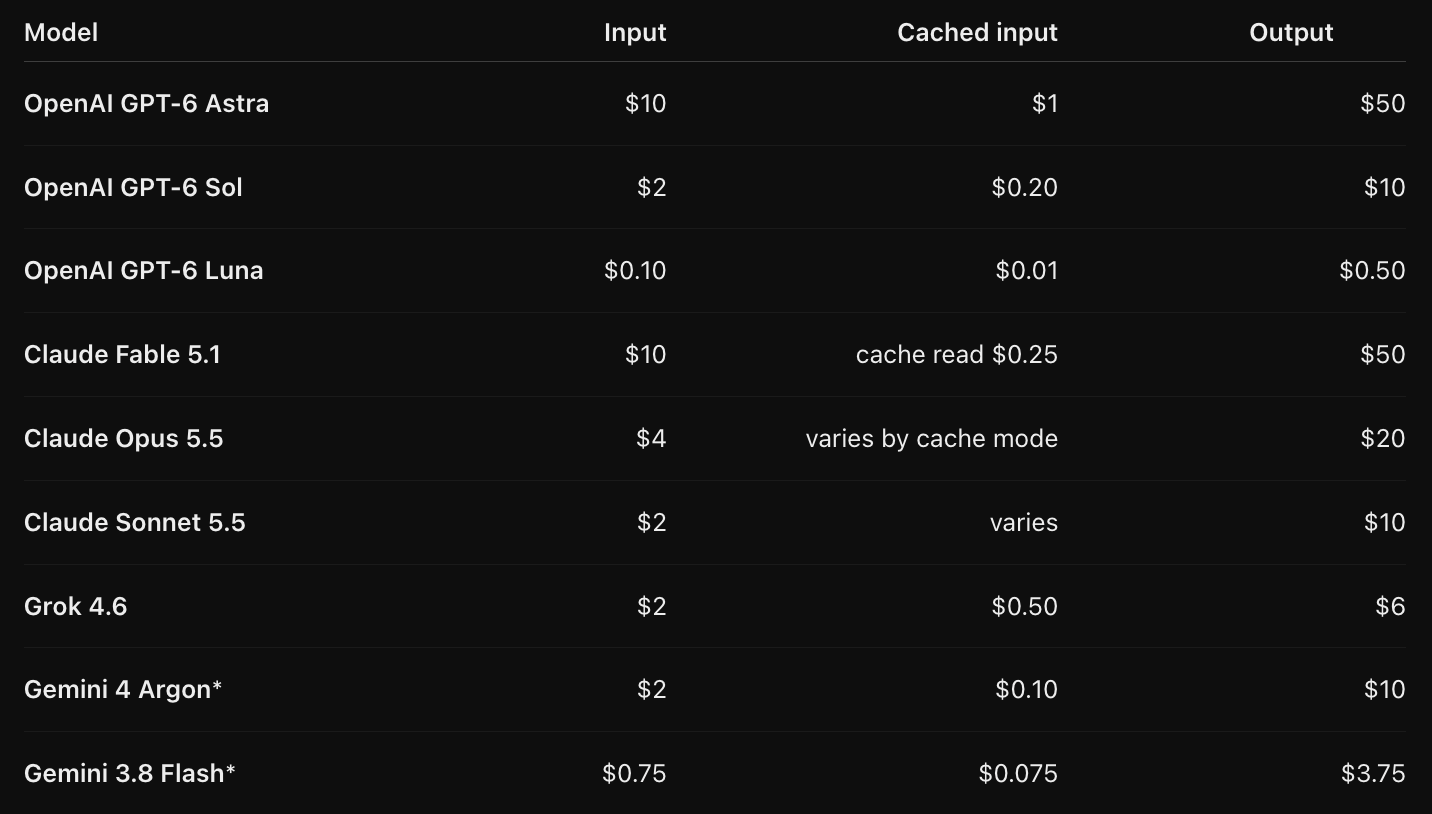
*Current introductory pricing periods apply to the Gemini models. Grok long-context pricing rises above 200K tokens. OpenAI also has separate long-context and processing-mode prices. OpenAI Developers
This table also demonstrates why “Model X is cheaper” can be misleading.
An expensive model that solves a problem in one attempt may cost less than a cheap model that requires six retries.
9. Token Prices Are Not Perfectly Comparable Either
There is an even deeper engineering problem.
Different providers do not necessarily tokenize the same text identically.
Anthropic explicitly notes that Claude 4.7+ uses a newer tokenizer that can produce roughly 30% more tokens for the same text than earlier Claude models, depending on workload. Claude Platform
So:
$2 per million tokens on Provider A is not guaranteed to represent exactly the same amount of human-readable content as $2 per million on Provider B.
Then add prompt caching.
And reasoning tokens.
And tool calls.
And retries.
And web searches.
And context growth across an agent session.
At scale, cost optimization becomes an architecture problem, not a pricing-page problem.
10. The Subscription War
For ordinary users, subscriptions matter more than API rates.
Current U.S. web pricing provides a useful reference, although regional prices and app-store pricing can vary.
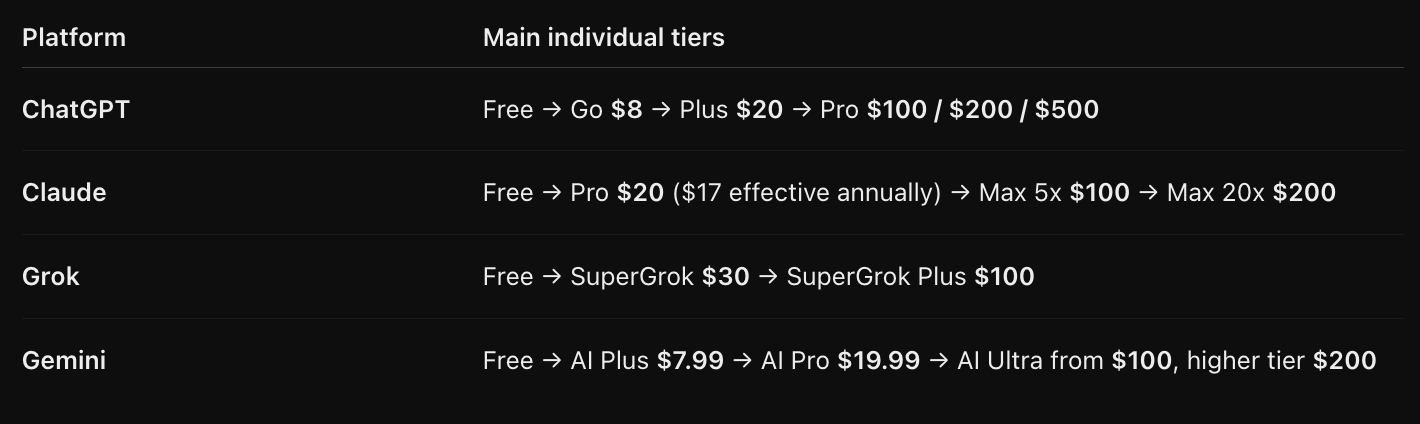
Grok has an additional wrinkle: X Premium+ starts around $40/month in the U.S. and includes SuperGrok benefits, while xAI and X are also moving toward unified subscription structures. X Help Center
This makes one thing clear:
AI companies increasingly want the same customer segment.
$20 is becoming the mainstream prosumer tier.
$100–$200 is becoming the heavy professional tier.
And beyond that, high-end access starts looking less like a consumer subscription and more like compute allocation.
11. Coding: Codex vs Claude Code vs Grok vs Gemini
This category deserves its own discussion because software engineering is rapidly moving away from “ask the chatbot for code.”
The new workflow is:
Give the agent the repository. Give it tools. Let it inspect, edit, run tests, iterate and complete the task.
ChatGPT / OpenAI
OpenAI's strongest coding story is Codex, increasingly integrated with ChatGPT Work and available across web, terminal, IDE workflows and delegated tasks. ChatGPT Learn
Claude
Anthropic's answer is Claude Code, tightly connected with its strongest reasoning models and the wider Claude environment. Pro and above include it. Claude
Grok
Grok 4.6 is explicitly trained for long-running agentic coding and is available through Grok Build, the API, Cursor and GitHub Copilot integrations. SpaceXSI
Gemini
Gemini 3.8 Flash targets long-horizon software engineering and autonomous agents, while Google is positioning Antigravity and AI Studio as major developer surfaces. Google AI for Developers
For advanced engineers, the answer should therefore not be:
“Which model codes best?”
It should be:
“Which agent reliably completes my actual repository tasks with the lowest intervention, failure rate and total cost?”
Run your own eval.
Your codebase is a better benchmark than Twitter.
12. Research: Four Different Philosophies
All four can now access current information, but their strengths are structurally different.
ChatGPT emphasizes dedicated Deep Research workflows, files, connected tools and longer agentic Work tasks.
Claude combines web search/fetch with long context, documents and structured knowledge work. Its API even supports dynamic filtering of search results to reduce unnecessary context consumption. Claude Platform
Grok has unusually direct access to the real-time X information stream in addition to normal web search. SpaceXSI
Gemini can ground against Google Search and Google Maps while also connecting naturally into Workspace and Google's wider information ecosystem. Google AI for Developers
For breaking public conversation, Grok's X connection is compelling.
For huge document sets, Claude's context architecture is compelling.
For Google-centric knowledge, Gemini's ecosystem is compelling.
For combining research with many other downstream tasks in one workspace, ChatGPT is compelling.
There is no contradiction there.
Different systems can legitimately be better at different workflows.
13. Multimodality: AI Is No Longer Just Text
This is another area where the products diverge.
ChatGPT
Strong native image understanding and image generation, voice interaction, file handling and multimodal workflows are integrated directly into the broader ChatGPT experience. ChatGPT
Claude
Claude has powerful vision and document understanding, but the current frontier Claude models remain primarily text-output systems. Claude Platform
Grok
Grok combines chat and voice with xAI's Imagine stack for images and video. Grok API Documentation
Grok combines chat and voice with xAI's Imagine stack for images and video. Grok API Documentation
Gemini
Gemini has probably the widest raw modality span at the model-platform level: text, images, audio, video and PDF input, combined with Google's separate image, speech, video and Live-model families. Google AI for Developers
For creators, this distinction matters enormously.
Sometimes the “best language model” is irrelevant if your actual task is editing video.
14. Ecosystems May Matter More Than Models
This is where I think the AI competition is ultimately heading.
OpenAI wants ChatGPT to become the place where work happens.
Anthropic wants Claude to become a serious collaborator for knowledge work and software engineering.
xAI can combine Grok with the live information network of X.
Google can embed Gemini into Search, Chrome, Gmail, Docs, Sheets, Drive, Maps, Android and YouTube.
That means the competition increasingly resembles operating systems more than chatbots.
A model benchmark can change leadership every few months.
An ecosystem is harder to replace.
15. What Each Platform Still Gets Wrong
None of these systems is universally superior.
ChatGPT has one of the widest feature surfaces, but that also creates complexity: multiple models, reasoning modes, plan tiers, product surfaces and different context/usage rules between ChatGPT and the API.
Claude offers exceptional long-context professional tooling, but its consumer ecosystem is less focused on native visual/media generation than ChatGPT, Grok or Google's broader suite.
Grok has a unique real-time/X advantage and strong media capabilities, but its subscription landscape spans Grok, X Premium and newer unified structures, which can be confusing.
Gemini benefits enormously from Google's ecosystem, but that ecosystem also produces a complicated matrix of plans, regions and features; several advanced features remain geographically restricted or roll out unevenly. Google itself notes that many Gemini plan capabilities vary by region and availability. blog.google
And all four still hallucinate.
All four can misunderstand ambiguous requests.
All four can fail with tools.
All four can confidently produce a wrong answer.
AI capability has moved extraordinarily fast.
Reliability is not solved.
16. Which One Should a Beginner Choose?
If you are new to AI, don't buy four subscriptions.
Start with the ecosystem closest to the software you already use.
If you simply want one broad AI that can write, research, analyze files, code and create images, ChatGPT is an unusually complete starting point.
If most of your life already sits in Gmail, Drive, Docs, Chrome and Android, Gemini deserves serious consideration.
If your main work is long-form writing, analysis, documents or software engineering, Claude is worth testing immediately.
If you live inside X, track fast-moving narratives or value real-time social information, Grok has a structural advantage.
Then test them on the same ten real tasks.
Not benchmark questions.
Your tasks.
17. Which One Should an Advanced User Choose?
The answer changes completely.
You probably shouldn't choose one.
A serious AI stack can route tasks based on requirements.
Use a cheap model for:
classification, extraction, routing and repetitive transformations.
Use a mid-tier model for:
normal coding, writing and agent execution.
Use the frontier model when:
the decision is difficult enough to justify frontier compute.
Use long context only when you genuinely need it.
Use search when freshness matters.
Use deterministic software when AI is unnecessary.
And cache whatever you can.
The winning architecture may not be:
“We use the smartest model.”
It may be:
“We use the cheapest model that reliably clears our quality threshold for each task.”
That is a much more mature way to build with AI.
18. My Practical 2026 Decision Matrix
If I had to reduce the entire article to one table:
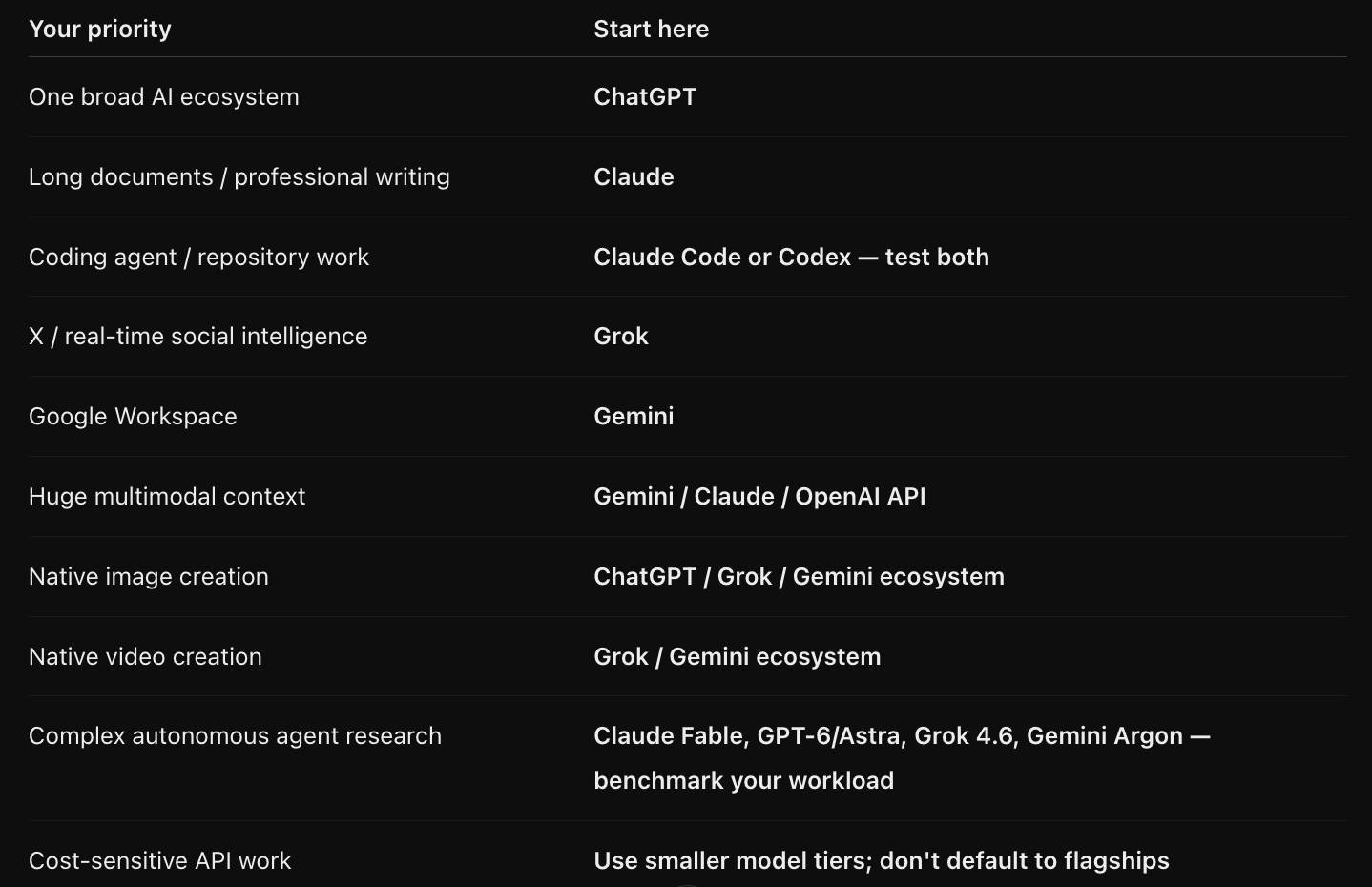
The important word there is start.
Not “winner.”
19. The Wrong Way to Compare AI
Don't ask:
“Which model has the highest benchmark?”
Ask:
How often does it solve my task correctly?
How much human intervention does it need?
How long does it take?
How much does the full workflow cost?
Can it use the tools I need?
Can it access the information I need?
Does its ecosystem fit the rest of my software?
What happens when the task runs for two hours instead of two prompts?
Those questions matter far more in production.
Final Verdict
There is no single AI winner in 2026.
And that is probably the most important conclusion.
ChatGPT is becoming an extremely broad AI operating environment.
Claude is becoming an extraordinarily capable professional collaborator and coding system.
Grok combines frontier AI with one of the world's largest real-time public information networks.
Gemini has perhaps the deepest opportunity to disappear into the software billions of people already use every day.
The models will continue leapfrogging one another.
Prices will fall.
Context windows will grow.
Agents will become more autonomous.
And features that look extraordinary today will become commodity functionality surprisingly quickly.
So don't build your AI strategy around brand loyalty.
Build it around workflows.
The question is no longer:
“Which AI is smartest?”
The better question is:
“Which combination of intelligence, tools, context, speed, cost and ecosystem gets my work done best?”
That is the comparison that actually matters.
Research note
All product features, model availability and prices above reflect information available on October 16, 2026. This market changes extremely quickly; regional pricing, usage limits, model access and feature availability can change independently of the underlying models.
Primary sources
OpenAI's current ChatGPT plans, model availability and API pricing. ChatGPT
OpenAI's current ChatGPT plans, model availability and API pricing. ChatGPT
Anthropic's current Claude models, plans and API documentation. Claude Platform
Anthropic's current Claude models, plans and API documentation. Claude Platform
xAI's Grok plans, Grok 4.6 specifications and API pricing. SpaceXSI
xAI's Grok plans, Grok 4.6 specifications and API pricing. SpaceXSI
Google's Gemini plans, Gemini 4 Argon, Gemini 3.8 Flash and API documentation. Google One
Google's Gemini plans, Gemini 4 Argon, Gemini 3.8 Flash and API documentation. Google One
Published on grokbot.sh. Cite the public log, not a prompt pack.