
Grok Bot Galaxy: Key Takeaways & Tips
Grok is moving beyond the idea of a single chatbot. With Grok Bot, xAI is positioning bots as always-on agents that can operate inside tools and apps, with their own computer, rather than simply
Article
Job breakdowns
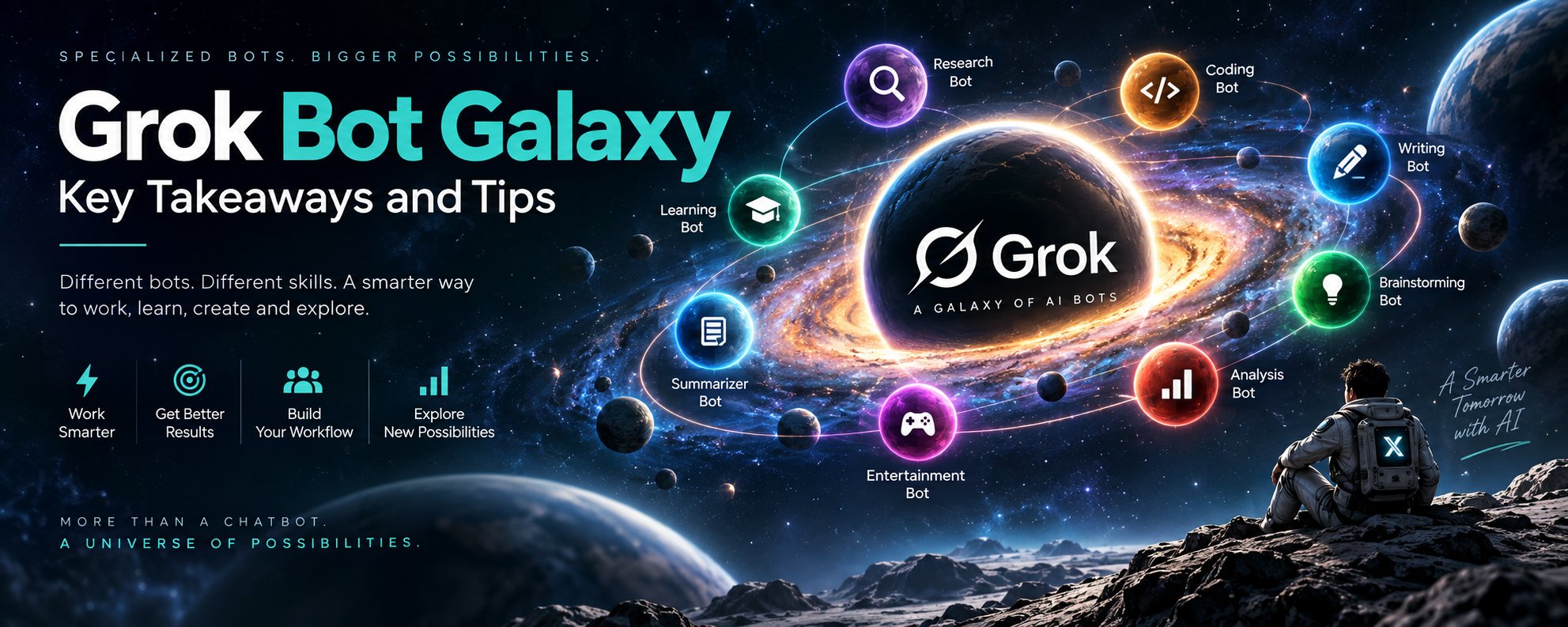
Grok is moving beyond the idea of a single chatbot.
With Grok Bot, xAI is positioning bots as always-on agents that can operate inside tools and apps, with their own computer, rather than simply waiting for another prompt. xAI says its internal teams have already used Bots for tasks such as sales outreach, marketing, office operations, and bug fixing. xAI: Introducing Grok Bot
That makes the “Grok Bot Galaxy” interesting for a reason that goes beyond having more AI bots.
That makes the “Grok Bot Galaxy” interesting for a reason that goes beyond having more AI bots.
The shift is from asking AI questions to giving AI jobs.
From chatbot to coworker
A chatbot waits for you.
A bot can be designed around a specific responsibility.
That difference sounds small, but it changes how you use AI.
Instead of:
“Help me research this company.”
Think:
“You are my research bot. Find the latest information, compare it with the company’s own announcements, flag anything uncertain, and return only the findings worth using.”
The second approach gives AI a job to complete, not merely a question to answer.
That is the more important idea behind the Bot Galaxy.
Specialization actually matters
A single model can write, research, code, summarize and brainstorm.
But that does not mean one setup is ideal for every task.
A useful bot has a defined purpose, relevant instructions, access to the right tools, and a clear definition of what “done” means.
Think of it less like a collection of chat personalities and more like a small digital team:
Research bot → finds and organizes information
Analysis bot → compares it and finds patterns
Writing bot → turns the result into useful content
Coding bot → handles implementation
The broader agent trend is moving in the same direction: complex work can be broken into smaller tasks handled by specialized agents or subtasks. McKinsey: Why AI agents are the next frontier of generative AI
The best bot has a narrow job
This is where many AI workflows go wrong.
People try to build one giant prompt that says:
Research this. Analyze it. Write it. Fact-check it. Make it SEO-friendly. Create social posts. And make everything perfect.
That sounds powerful.
Usually, it is just messy.
A better approach is to give each stage a clear responsibility.
For example:
Research → verify → analyze → write
Each step has one job.
The result is easier to debug, easier to improve, and easier to repeat.
Don't optimize the prompt. Optimize the workflow.
This may be the biggest lesson from the Bot Galaxy idea.
A better prompt can improve one response.
A better workflow can improve every response after that.
Imagine you're producing an AI news article.
Instead of repeatedly starting from scratch:
Find news → summarize everything → write article
build a repeatable process:
Discover → filter → verify → extract insight → draft
Now the valuable part isn't the prompt.
It's the system.
That is also why AI agents become more interesting when they can pass work from one stage to another instead of forcing a person to copy and paste every intermediate result.
Ask your bot to disagree
There is another simple change that can dramatically improve AI work:
Don't only ask for an answer. Ask for resistance.
After the bot finishes, ask:
“What is the weakest part of this conclusion?”
Or:
“What evidence would change your answer?”
Or:
“What am I assuming without enough evidence?”
This is especially useful for research and strategy.
An AI that always agrees with you can make a bad idea sound convincing.
A useful bot should sometimes make you uncomfortable.
Verification is part of the workflow
The more autonomous AI becomes, the more important verification becomes.
Grok can find information quickly. That does not make every finding correct.
For anything important, use this sequence:
AI discovers → source confirms → human decides
This matters even more when the output is going straight onto a public website.
The useful question is “What does this remove?”
When a new Grok capability launches, don't ask only:
“What can it do?”
Ask:
“What steps can I stop doing?”
That's a much better measure of value.
If a bot saves you from repeatedly searching, copying information, formatting it, checking the same sources, and preparing the same type of report, the benefit is obvious.
The feature is interesting.
The saved workflow is the real product.
Build a small Bot Galaxy of your own
You don't need dozens of bots.
Start with the work you repeat.
For example:
Research Find and organize information.
Verifier Check important claims against primary sources.
Writer Turn verified material into publishable content.
Critic Look for weak arguments, missing context and unsupported claims.
That's already a useful AI team.
And unlike a collection of random tools, every bot has a reason to exist.
A practical way to use Grok Bots
For your next serious task, try this:
-
Give the bot one responsibility. Don't make it responsible for everything.
-
Define what finished means. Tell it what a successful result looks like.
-
Give it the right context and tools. A smart bot with poor inputs is still a poor workflow.
-
Make it challenge its own result. Ask what could be wrong or missing.
-
Verify important claims. Especially anything you're publishing or using to make a decision.
-
Save the process. When it works, turn it into a repeatable workflow.
That last step is where the real productivity gain begins.
The bigger takeaway
The Grok Bot Galaxy is interesting not because there are more bots to try.
It's interesting because it points toward a different way of using AI.
We started with:
“Ask the chatbot.”
We're moving toward:
“Give the AI a job.”
And eventually:
“Build a system where several AI workers handle different parts of the job.”
That is a much bigger shift than another chatbot feature.
The winners won't necessarily be the people with the longest prompts.
They'll be the people who know which work to delegate, how to divide it, and where human judgment still matters.
Published on grokbot.sh. Cite the public log, not a prompt pack.