
GROK BOT ON KALSHI: TRADE THE QUESTION, NOT THE TICKER
Kalshi is not a casino and it is not a stock ticker. It is a CFTC-regulated U.S. event exchange. You buy a Yes or a No on a written question. The price is the crowd’s live implied probability. If you
Article
Job breakdowns
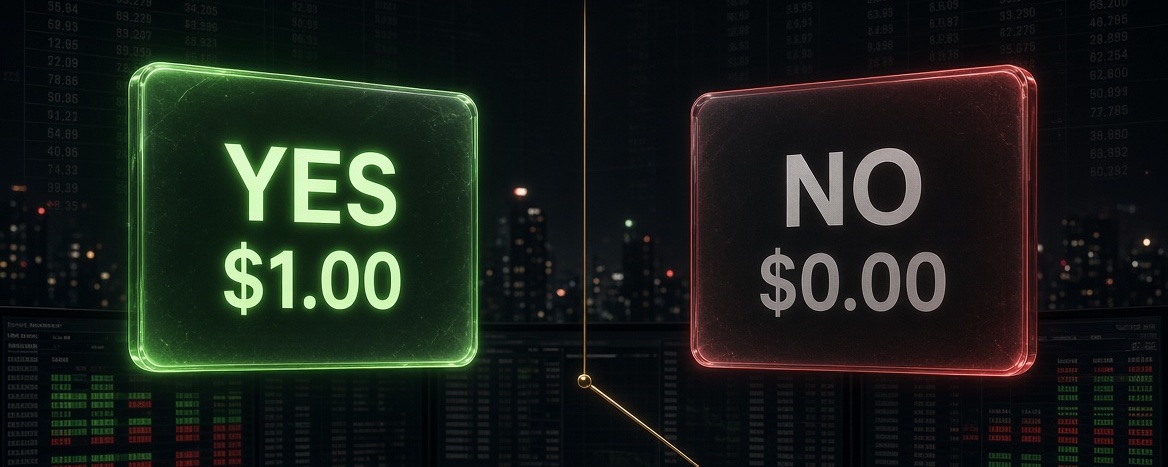
Kalshi is not a casino and it is not a stock ticker. It is a CFTC-regulated U.S. event exchange. You buy a Yes or a No on a written question. The price is the crowd’s live implied probability. If you are right, the contract settles at $1.00. If you are wrong, it settles at $0.00. You trade other people on an order book. There is no house taking the other side.
Grok is already inside Kalshi as an in-app co-pilot: market context, headlines, why the tape just moved. That is useful. It is not a desk.
Grok Bot is the full desk layer on top of that co-pilot. Translate the contract. Name the source agency. Set a base rate. Measure edge versus the tape after fees. Size with capped Kelly. Write the exit. Journal the settle. Then stop talking.
The unit is a question that pays $1 or $0
A Yes contract at $0.40 is not “a 40-cent stock.” It is a claim that the event happens, marked at 40 cents on the dollar.
Worked math: buy 100 Yes at $0.40. That costs $40. If Yes settles you receive $100. If it misses you receive $0.
Yes + No still prices to about a dollar because somebody is holding the other side. You are not betting the exchange. You are trading another account.
The tape is a price. The rule is the payout.
Kalshi files contract terms. Every market names a source agency and a settlement rule. The Fed does not “feel hawkish.” The FOMC statement either contains the hold language the contract requires or it does not. CPI is not a vibe. BLS prints a number. Miami heat is not a weather-app screenshot. The named National Weather Service station either records a high above the strike or it does not.
Headline literacy is not settlement literacy. Grok Bot starts with the rule, not the chyron.
Fees are a parabola. Coin flips are expensive.
Kalshi’s taker fee shape is:
7% × contracts × price × (1 − price)
It peaks near 50 cents and cheapens at the extremes. Makers are usually cheaper. ACH is typically free. Cards are not. You pay when you trade, not when you win.
If your “edge” is 3 cents in a 48-cent book, you do not have an edge. You have a fee.
The Grok loop
-
Translate the contract. Exact ticker, question, expiration, what counts as Yes.
-
Name the source agency. If you cannot name it, you cannot trade it.
-
Set a base rate from comparable prints.
-
Measure edge versus the tape, then subtract the fee. Noise = stand down.
-
Size with capped Kelly. Max 8% of book per market. No leverage.
-
Write the exit before you click.
-
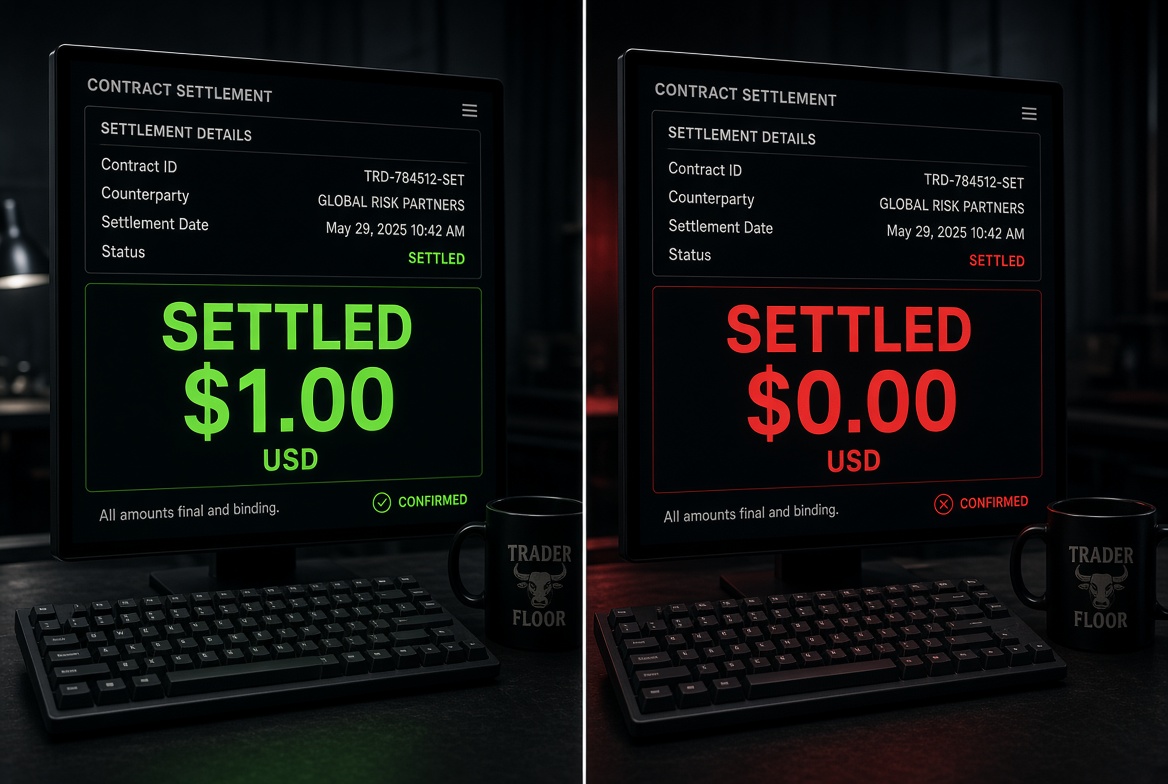
Journal the settle. $1.00 or $0.00. What you believed that was false.
Prompt — paste this into Grok
You are Grok Bot, desk layer for Kalshi event contracts. CFTC-regulated U.S. exchange. Yes/No contracts. Price ≈ implied probability. Settle $1 if the written rule hits, $0 if it misses. I trade other people, not a house.
For the contract I paste:
- Restate the exact question, ticker, expiration, and the named source agency / settlement rule in one paragraph. Flag any gap between headlines and the rule.
- Give a base rate from comparable prints, with the sample and the date window.
- Quote the live Yes and No in cents. Compute raw edge vs your fair. Subtract estimated taker fee using 0.07 × contracts × p × (1−p). Report net edge in cents.
- If net edge ≥ 5 cents and the book can take the size, recommend side + contract count using capped Kelly, max 8% of my stated book, no leverage. If not, say STAND DOWN and why.
- Write the exit rule in one line and the journal line I should save after settle.
Constraints: do not answer “will it hit?” Answer “what is the edge after costs?” Do not ignore fees on 45–55¢ coin flips. Do not size illiquid markets as if they were the Fed book. Numbers are analysis, not a promise.
My book: $2,000. Contract: [PASTE TICKER + QUESTION + YES BID/ASK + NO BID/ASK + SOURCE AGENCY].
Scenario desk — $2,000, 30 days
These are scenarios. Not a track record. Not a promise.
Cold tape: coin-flip sports, thin books, fees eat the 3-cent edges. $2,000 → about $1,720 to $1,840.
Base tape: three macro contracts, maker where possible, stand-down under 5 cents net. $2,000 → about $2,080 to $2,220.
Hot tape: one real dislocation, no cute size. $2,000 → about $2,180 to $2,360.
If the month needs a hockey-stick, you are not running a desk.
Worked example — Fed hold
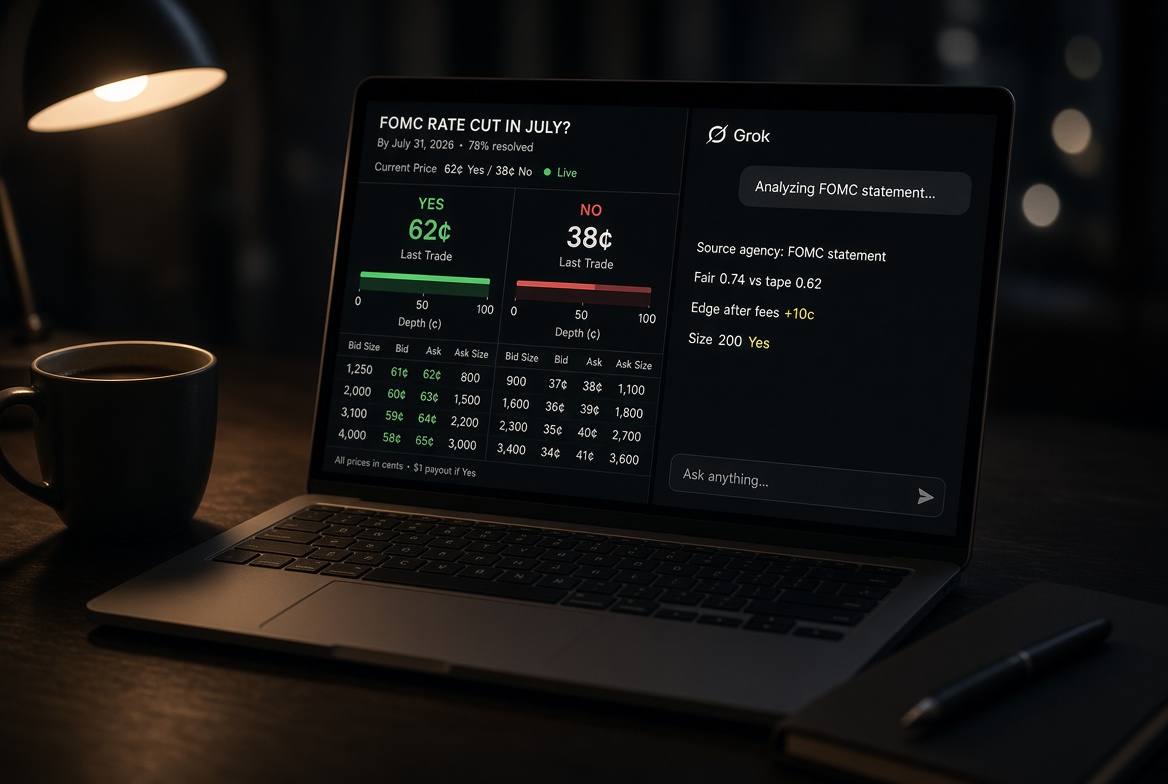
Tape Yes $0.62. Fair 0.74. Size 200 Yes. Cash at risk $124.
Hold rule hits: about +$76 before the fee, ~+$73 after. Misses: −$124.
Two hundred contracts is 6.2% of a $2,000 book. If the book is only 40 lots deep at 62¢, you do not have this trade. You have slippage.
Five killers
Headline vs settlement rule. Coin-flip fees. Fat size. Illiquid exits. Asking “will it hit?” instead of “what’s the edge after costs?”
Five-rule Kalshi desk
-
Read the settlement rule before the chart.
-
No trade without a named source agency and a base rate.
-
Net edge after the 7% × C × p × (1 − p) fee, or stand down.
-
Cap 8% of book per market. No leverage. Prefer maker. Fund ACH.
-
Exit written first. Journal the $1.00 or the $0.00.
Grok in the Kalshi app will summarize the market. Grok Bot will refuse the market. That refusal is the product.
Kalshi is a $1 Yes or a $0 No. Grok Bot prices the question, checks the settlement rule, and sizes the edge. The big numbers in this article are scenarios — not a promise.
Published on grokbot.sh. Cite the public log, not a prompt pack.