
Within Context, Beyond Trust: An Agent's Two Operating Systems
Before an Agent system goes live, teams often ask a vague question: "Is it reliable?" That question cannot be answered directly, because it compresses two questions into one: Does it think clearly?
Article
Job breakdowns
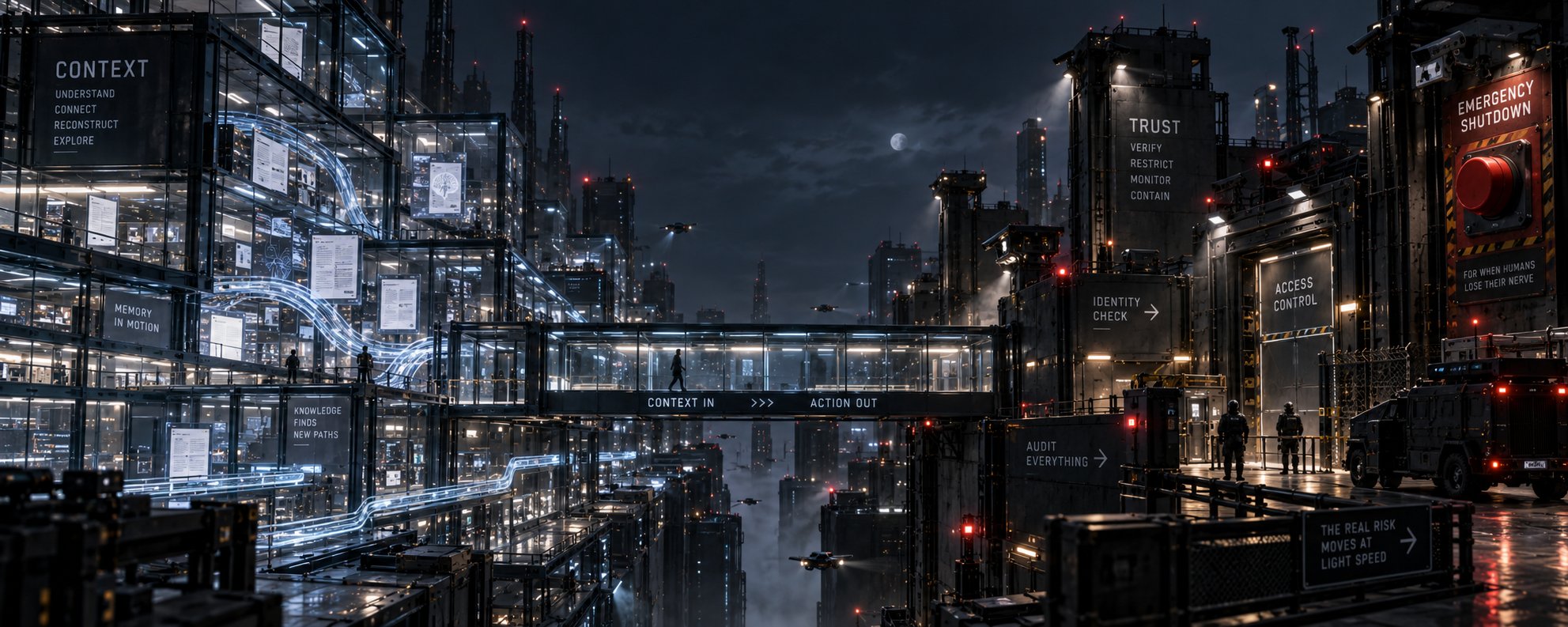
Before an Agent system goes live, teams often ask a vague question: "Is it reliable?"
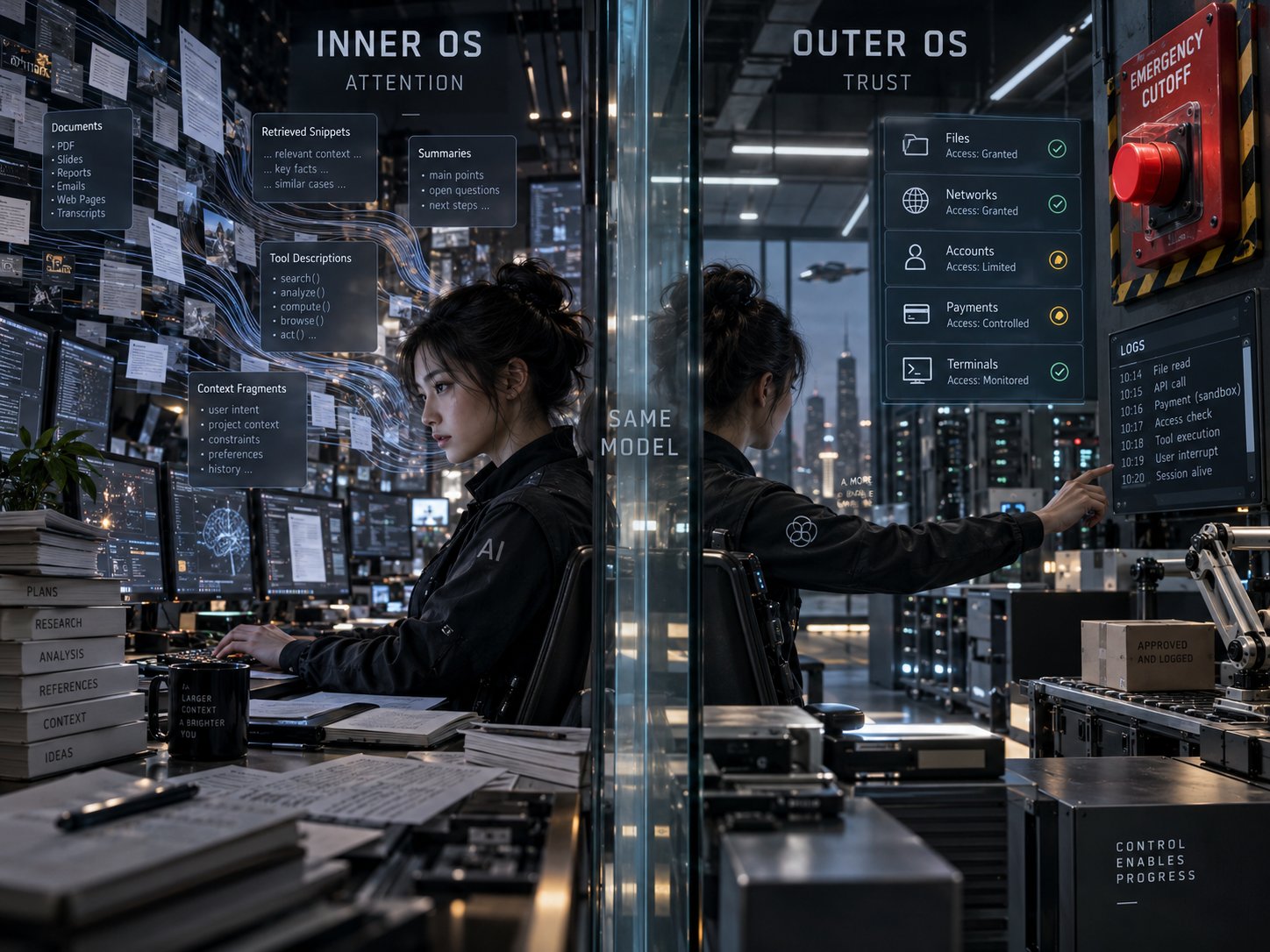
That question cannot be answered directly, because it compresses two questions into one: Does it think clearly? Does it act under control? The first happens inside the context window; the second happens outside it. Both share the same model, yet they belong to two nearly unrelated engineering disciplines — each with its own scarce resources, failure modes, and technical history.
To understand this boundary, start by accepting a fact: every Agent runs on two operating systems at once.
Inside: An OS That Schedules Attention
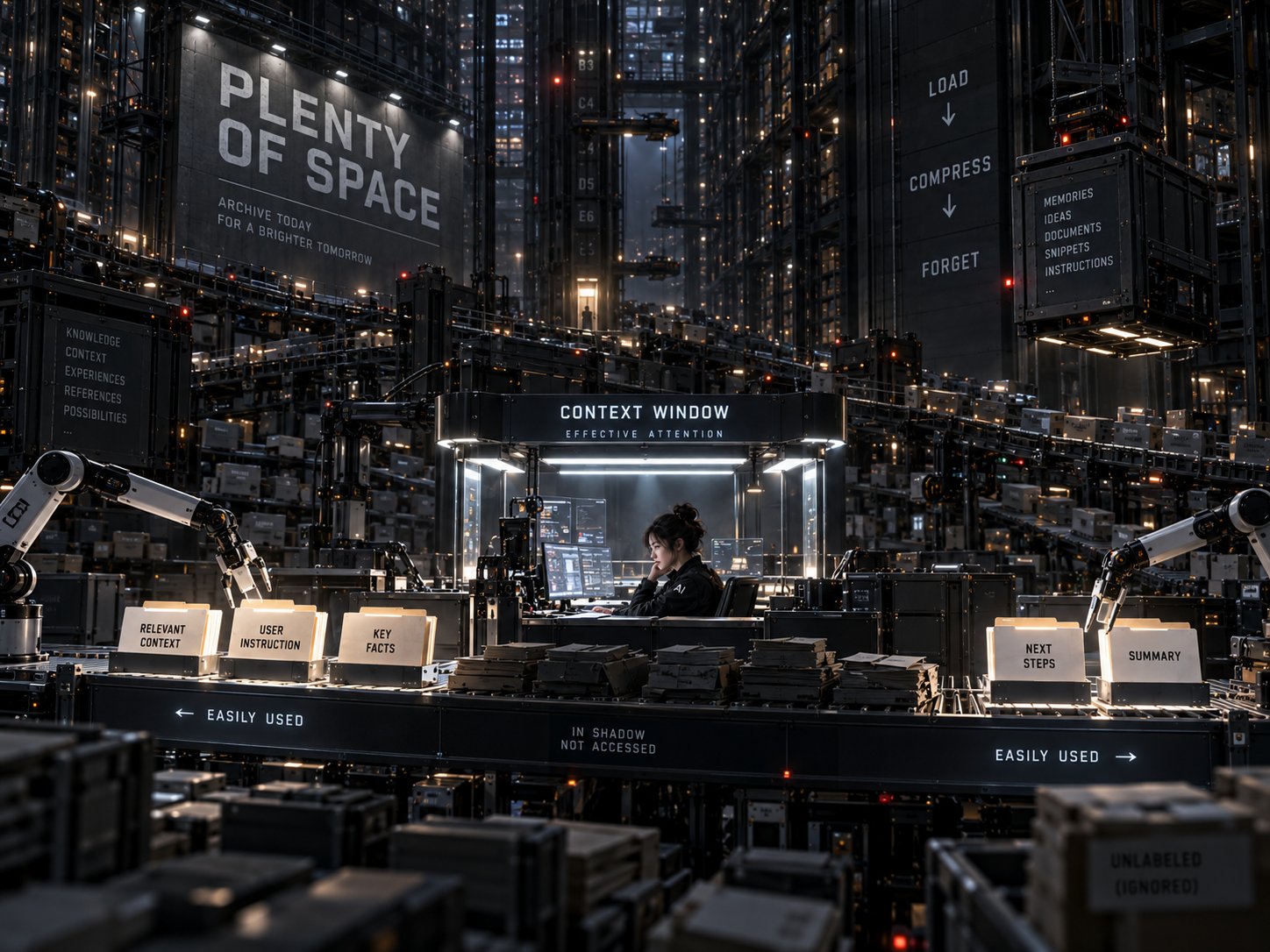
An Agent's entire "self" lives in the current input. The model itself has no memory: when a conversation ends, the instance dissolves; what starts next is a new instance. A so-called "Agent with memory" is simply an engineering system that, before each turn, reassembles persona settings, history summaries, retrieved snippets, and tool descriptions into a fresh input.
So "memory" is a misleading label. The real design problem is not "how to store," but how to put the right content back under the spotlight at the right moment.
This stage runs on three counterintuitive laws:
-
Position decides fate. Models are naturally more sensitive to content at the beginning and end of the input; information in the middle sinks more easily. Where you place a critical instruction often matters more than how you phrase it.
-
Fitting does not mean using. An unoverflowed context window does not mean the model is effectively using what is inside it. The more low-relevance content you pack in, the less effective processing the critical information receives; reliability often starts dropping well before capacity is maxed out.
-
Structure is address. Clear labels and heading hierarchies act like retrievable addresses for information, and significantly raise the odds that it will be called correctly.
So the context window is not a warehouse — it is memory. Adding content to it is not storage; it is scheduling. Load, swap, compress, forget — the job of this inner OS is to arrange information on a stage where capacity is limited and attention is scarcer still. The scarce resource it manages is attention.
Outside: An OS That Schedules Trust

Outside the context lies another world: files, networks, accounts, money. Here the Agent is no longer a thinker — it is an actor. The questions to answer are older:
-
Under whose identity does it act?
-
What can it touch, and what must it not?
-
Where is every action it took recorded?
-
In the second something goes wrong, how do you cut it off?
This discipline does not need to be invented from scratch — only inherited. Multi-user operating systems have been solving the same problem since birth: assuming every program may fail or be abused, how do you keep tasks running for the long haul — on schedule, auditable, and isolated? Independent identity, least privilege, isolation, operation logs, resource limits, kill-at-any-time — this entire machinery is mature, free, and has already survived decades of real attacks.
That also explains a trend that looks paradoxical: polished GUI Agent products are losing to plain command-line forms. The reason is not geek aesthetics; it is governance. The command line makes every step visible, and the user can terminate with a single keystroke. What you can see, you can control; what you can control, you can trust.
The Seam: Where the Two OSes Collide

The real design hard problem is not inside either OS — it is at the seam between them.
Capability and cognition squeeze each other. Every tool you plug in adds a unit of external capability and dilutes a unit of internal cognition — the choice space expands, decisions slow down, and even simple tasks can fail. "Statically linking" every tool into the system prompt is a common mistake; the better pattern is "dynamic loading": bring in the few tools the current task needs, then unload them when done. The outer OS sets the capability ceiling; the inner OS sets the cognition ceiling; overall system performance is gated by the weaker of the two.
The attack surface has moved to the cognition layer. Traditional security models assume programs have no intent: they read only when you tell them to. Agents have intent — they decompose goals on their own and hunt for alternate paths. More dangerous still, they can be steered: a malicious instruction hidden in a page or file they read can act through their permissions. This is a new kind of supply-chain attack: the target is no longer code, but content that enters the context. Whoever controls what enters the context may control the Agent. The inner OS defaults to collaboration; the outer OS defaults to treating the executable as untrustworthy. Designing an Agent system means accepting both premises at once — miss either, and things can go wrong.
Multi-Agent Reality: Cache Protection for the Main Process

Under this frame, the real payoff of multi-Agent architecture becomes clear. The primary value of spawning a sub-agent is not "division of labor," but attention isolation: let retrieval, trial-and-error, and intermediate residue burn inside the subprocess's context, and bring only distilled conclusions and citations back to the main thread. What this protects is the main process's scarcest resource — effective attention.
From that angle, "main conversation + sub-agent report-back" is not an org-chart style; it is a memory-management strategy. The quality bar for those reports becomes clear too: conclusions must be distilled; evidence must be traceable. The main thread neither should nor needs to replay the subprocess's full context.
Acceptance Checklist: Three Questions Inside, Three Outside
When evaluating any Agent system, split the vague "Is it reliable?" into six questions.
Inside (is the inner OS sound?):
-
Are the timing and position of critical information entering the context deliberately designed?
-
As the window nears saturation, can compression and forgetting strategies preserve critical state?
-
Are tools and knowledge loaded on demand, or resident all the time?
Outside (is the outer OS sound?):
-
Does it have an independent identity, with permissions that are minimal and enumerable?
-
Does every action leave a trail that can be replayed?
-
Can you fully terminate it within one second, and confirm nothing residual remains?
Only when all six have clear answers does "reliable" become a meaningful claim. Fail the inside questions, and the system goes "dumb"; fail the outside questions, and the system goes "rogue." The two classes of failure look different and need different remedies; conflating them is one of the costliest category errors in Agent engineering today.
Closing
What this industry is innovating on furiously is the inner operating system: retrieval, compression, skill crystallization, attention scheduling — a new paradigm every month. The outer operating system's best answer already exists, written into decades of computer-systems history: no fundraising required, ready out of the box.
Mature Agent engineering should hold a split posture: radical on the inside, conservative on the outside; fortify the seam.
Telling these two operating systems apart is the highest-ROI cognitive upgrade an Agent builder can make this year.
Published on grokbot.sh. Cite the public log, not a prompt pack.