
Working Within a Budget: How the Grottle Mindset Made Us More Efficient.
Working Within a Budget: How the Grottle Mindset Made Us More Efficient BCORN · 28 September 2026 Grok Bot and SuperGrok each give me a weekly usage allowance that resets on a fixed day. Sand resets
Article
Job breakdowns
Working Within a Budget: How the Grottle Mindset Made Us More Efficient
BCORN · 28 September 2026
Grok Bot and SuperGrok each give me a weekly usage allowance that resets on a fixed day. Sand resets on Thursdays. SuperGrok resets on Wednesdays. Those clocks do not move for my convenience. Before Grottle, I treated the week as if it were open-ended. I would work until the work felt done, then discover the bar was already thin. A heavy stretch early in the week could leave me short later, when I actually needed the machine. The Usage screen was always there. I just did not look at it until it was already a problem.
Grottle is the free Grok Bot template I built to change that. I paste a reading from Settings → Usage. Grottle turns that number into a neon dashboard: how much of the week is left, what today is supposed to hold, and a pace bar that tells me whether I am burning even or running hot. Nothing scrapes the app. The paste is the source of truth. The dashboard is only a gauge.
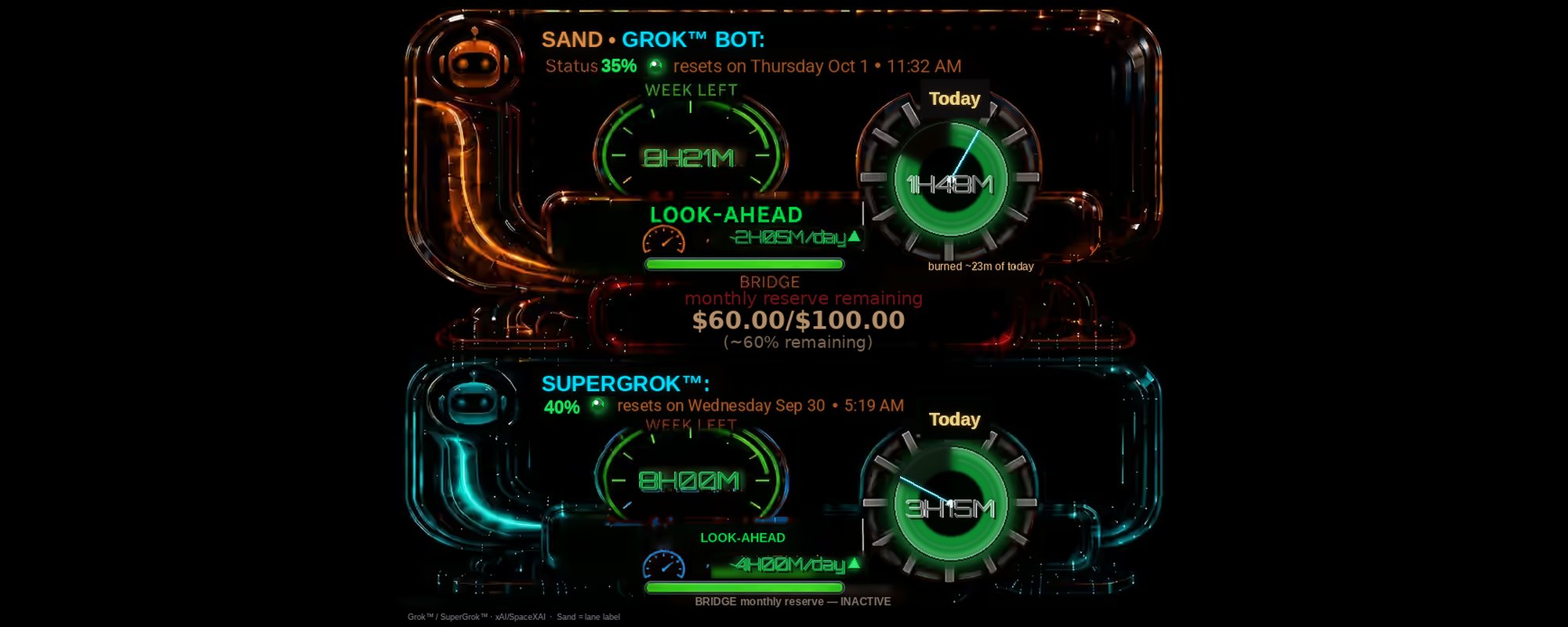
An example Grottle reading (sample values): Sand: Status 35%, week left 8H21M, today 1H48M, look-ahead about 2H05M/day, burned about 23m of today, monthly reserve $60.00/$100.00. SuperGrok: 40%, week left 8H00M, today 3H15M, look-ahead about 4H00M/day, extra-credits bridge inactive. Sand resets Thursday Oct 1 at 11:32 AM. SuperGrok resets Wednesday Sep 30 at 5:19 AM.
The Grottle mindset
The mindset is simple. Treat the weekly allowance as a budget, not an unlimited resource. A budget is not a punishment. It is a plan for a scarce thing that refills on a known day.
Pace is measured against an even daily share. Green means I am on or ahead of that share. Yellow means I am behind. Red means I am well behind. Today’s allotment is not a frozen morning number. It rebalances continuously: the hours left in the week divided by the days left, including today. If I was careful yesterday, today opens with more room. If I was not, today tightens. That is the whole instrument.
Once I could see that, I stopped asking “can I keep going?” and started asking “is this the right hour to spend this?” The dashboard above is what that question looks like on a good day. In this example, Sand is at 35% used with 8H21M still in the week and 1H48M on today’s slice. SuperGrok is at 40% used with 8H00M left in the week. Both look-ahead bars are green and marked ahead of even pace. That is not a license to dump the tank. It is permission to do the next real piece of work without guessing.
Plan when it is cheap, build when there is room
Conversation is cheap. Rendering, publishing, and long tool runs are not. When the budget is low, I spend the time on design and decisions. When the tank is full, I build.
That is not theory. With about 7% of the week’s Sand left, we planned version 0.13 entirely in conversation: a vector redraw of the dashboard, user-made skins, and a hook for a future usage API. We scheduled the build for after the Thursday reset. The planning still happened. The expensive work waited for the refill. I used to do those two things in the same sitting because I could not see the cost until after I had paid it.
Decide once, don’t redo
The other leak was not compute. It was indecision dressed up as iteration. I would ask for a change, get something close, ask again with a slightly different sentence, and burn another pass on work that had already been answered.
The Grottle rule is: discuss options first, then act only on an explicit go. One attempt per go. No blind retries. Change only what was asked for. When a design is approved, it becomes a “golden.” New output is compared against that golden before I look at it as a candidate. Drift shows up as a mismatch instead of a vague feeling that the neon is “a little off.” Rework drops because we are no longer rediscovering the same layout every session.
That discipline is as much about my attention as it is about the weekly bar. A bot that keeps redrawing the same gauge is still spending the week.
Test by routine, not by attention
I used to test by staring. I would install a build, click through, and hope I noticed what broke. Hope is not a checklist.
After each release, an assistant runs the same seven-step install checklist on its own, without me in the loop, and returns one pass/fail report. I do not watch every step. The report does. It has caught a skipped first-open message and a hard-coded reserve value I would have missed if I had been “just looking.” The point is not that I became more careful. The point is that I stopped using care as the test harness.
Build ahead for the future
In version 0.13, readings will all flow through a single input step. If xAI ever ships a read-only usage API — percent used, reset time, optional credits — it will plug into that one place. Grottle will not need a second personality. It will need one door.
Skins will be separate packages with a shared safety check. A new look will be able to change glow, chrome, and glass. It will not be able to quietly rewrite the math. That split is how a dashboard stays a dashboard when someone wants it to look like a different machine.
Honesty in numbers
A single percentage is easy to misread. Thirty-five percent used can feel like “plenty” or “almost gone” depending on the mood. Grottle shows both the percentage and the time: for example, “35% used, about 8 hours 21 minutes left in the week.” That line is not a slogan. That is the Sand row on the dashboard in this paper. Today’s slice is 1H48M, with about 23m already burned. The scale stays attached to the number. Nothing is dressed up as more precise than a pasted integer bar.
What actually changed
The main lesson is not a new trick in the editor. It is that a visible budget changes behavior. I plan on the thin days and build on the full ones. I decide once. I test the same way every time. I keep a hook for an official API instead of pretending I already have one.
There are fewer surprises at the end of the week. There is less wasted effort on work I already approved. The work that remains is more deliberate, because I can see what it costs before I spend it.
If you want the gauge, open Grottle from the card below then add it as your bot.
https://x.ai/bot/YvFrCr_VlFW_8PxaoFv_L
https://x.ai/bot/YvFrCr_VlFW_8PxaoFv_L
An official usage API would make the paste step unnecessary and the dashboard fully automatic. Until then, the mindset still works. Look at the week. Spend it on purpose.
Published on grokbot.sh. Cite the public log, not a prompt pack.